
Your cart is empty
Looks like you haven't made your choice yet
I wouldn’t consider myself a depressed person, however, I do suffer from anxiety from time to time.
I decided to try micro-dosing out of straight-up curiosity.
What I came to discover was phenomenal.
It changed my outlook on life, made me a better (more patient) mother and allowed me to focus on things that I typically would put off.
I also found that I was consuming alcohol less often and my fitness levels increased tenfold.
In my relationship with myself, I became more aware of my emotions in every passing moment and could address them on the spot instead of letting them build up.
I was in a better mood.
My mind stopped making up reasons for me to be unhappy and instead focused my attention on the positive.
Some days, a sense of inner peace would permeate my being.
Overall, my life became more emotionally attuned, social, happy, and carefree, and less rigid, serious, and fear-driven.
Many friends of mine remarked that I was more relaxed and calm and that I had more energy.
Patience. Focus. Less alcohol. Better fitness. Emotional awareness on the spot. Inner peace.
That’s what it felt like when the static turned down.
A dose day feels ordinary. Quieter, but ordinary.
There’s no trip. No colors. No drift. The coffee tastes the same and the school run still happens.
What changes is the texture. On a dose morning, I notice patience with my daughter that I didn’t have to manufacture. The short fuse just isn’t there.
I’ll start a task I had been putting off, sometimes one I’d been avoiding for weeks. Not through willpower. It just stops feeling heavy.
The evening drink is easier to skip, too. The glass of wine loses its gravitational pull. I want it less, and I don’t miss it.
The off day is for noticing the difference. That’s its whole job. You compare, and the comparison teaches you.
One practical note: a dose taken too late in the day can keep you awake, so I keep mine to mornings. Back to the benefit, because there’s far more of that than any cost.
What I write down
This is where most confusion lives, so let’s be precise.
A microdose, as Dr. James Fadiman described it, is about 0.15 to 0.2 grams of dried mushrooms, roughly one-tenth of a therapeutic dose. At that level, you don’t trip. You don’t drift. Most people simply feel a little clearer, a little lighter, a little more present.
From there, the scale moves gently upward. A range of 0.2 to 0.4 grams is slightly higher, still subtle but noticeable for people who want a bit more. And 0.5 grams is often called a creative dose: the point where ideas loosen up and flow more freely without tipping into anything overwhelming.
| Amount | What people call it |
|---|---|
| 0.15 to 0.2 g | Microdose, about one-tenth of a therapeutic dose |
| 0.2 to 0.4 g | Slightly higher, still subtle |
| 0.5 g | Creative dose |
Here’s the two days on, one day off rhythm in three steps:
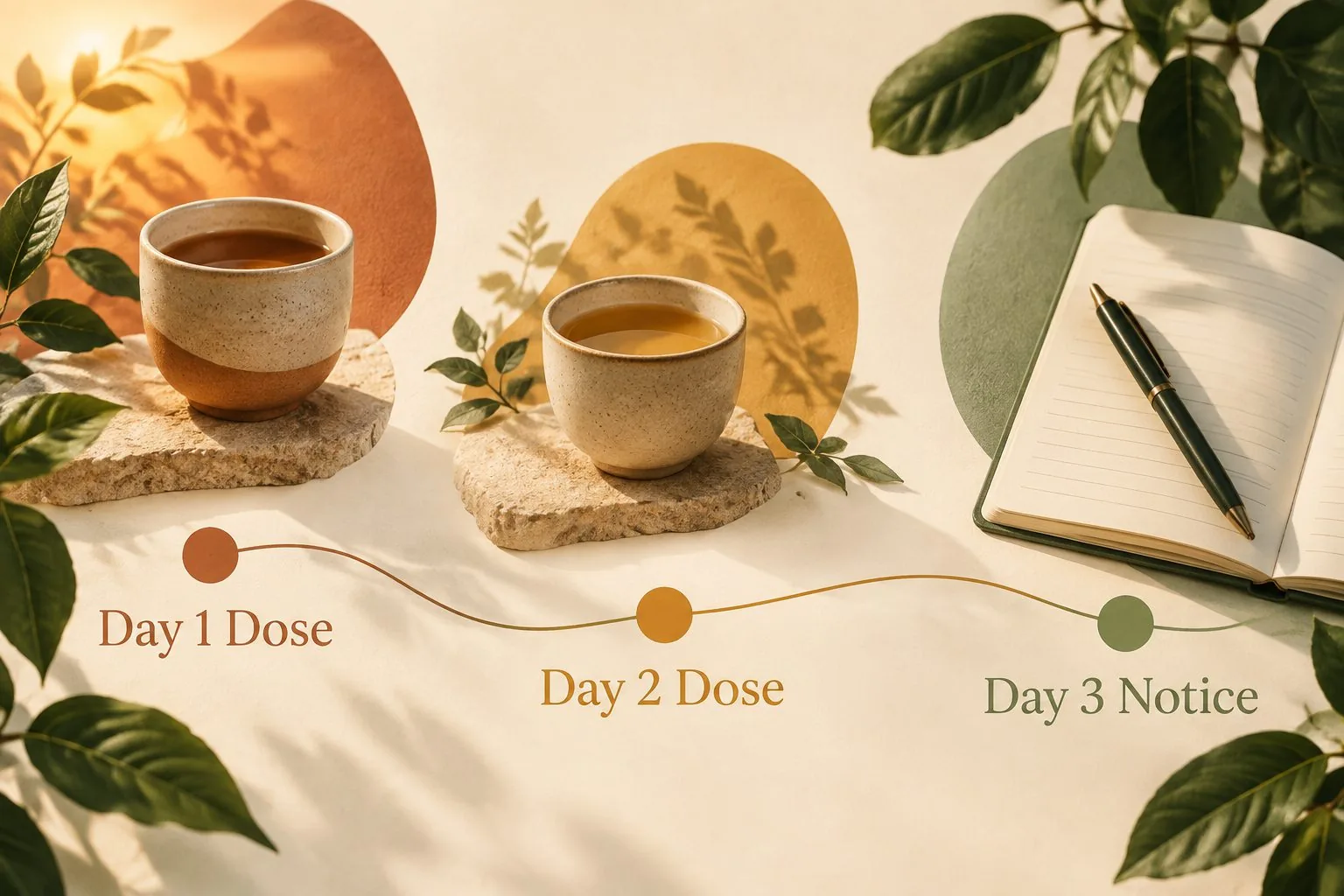
Monday to Friday with weekends off is the other rhythm I use.
Followed properly, microdosing does not get you high.
What it does do, consistently, is increase awareness. You notice your reactions as they form. You catch the irritation before it becomes a mood. You hear the person in front of you instead of rehearsing your reply.
My formula contains 0.1 mg of psilocybin per capsule. For exact amounts and the rhythm I recommend, the dosing guide walks you through it step by step.
It’s worth saying plainly: microdosing has helped many people with PTSD, trauma, depression, and addiction. I can’t promise it will do the same for every reader, since bodies and histories differ, but the pattern in people’s reports is too consistent to dismiss.
The one caveat I’ll offer is this: if you’re on prescribed medication or working with a mental health condition, bring your prescriber into the conversation before you start. Then, with that in place, there’s a lot worth exploring.
The institutions doing this work deserve more credit than they get.
MAPS, the Multidisciplinary Association for Psychedelic Studies, has spent decades funding rigorous clinical research into psychedelics, including studies on PTSD in veterans. The Beckley Foundation has supported similar work, spanning depression, social anxiety in adults with autism, and end-of-life anxiety in cancer patients.
Those aren’t fringe projects. They’re the scaffolding under a genuine shift in how we think about these compounds.
Microdosing was my training wheels.
The practice helped my brain find calmer, more positive pathways. Once I’d walked them enough times, I could reach them on my own.
I’m not alone in this, and I don’t just mean anecdote-by-anecdote.
Chryss Cada, a parent herself, wrote in an article for The Colorado Sun about microdosing for anxiety and low mood.
She found calm, where other people go looking for a buzz. She describes a working mother’s life: the noise, the pressure, the short fuse. A very small amount of psilocybin took the edge off without taking her anywhere.
More patience. Less friction.
Interviews by Ryan and colleagues, published in BMC Psychiatry, gathered people’s lived experiences with microdosing.
The themes lined up. People described becoming better listeners, feeling less social anxiety, and drinking less alcohol.
A slightly higher amount can feel too loud. A dose taken too late in the day can keep you awake.
The throughline is still the gains: connection, ease, and steadier habits.
Better listening. Less social anxiety. Less alcohol.
We keep hearing the same three things.
If you’re curious, start small and start intentional. That’s the whole philosophy.
For closeness, the connected, patient, present feeling I found in my own relationships, Bloom is the blend people reach for. It’s built for warmth.
For social days, when you want to be the version of yourself that enjoys the room, Brighten is the one people reach for. Think gatherings, dinners, the days you’d normally white-knuckle through.
And for a tight, tense day, shoulders up around your ears, jaw clenched, everything slightly too much, Holiday is exactly what it sounds like: permission to exhale.
Each one is different, and the full shop lays them out clearly. If focus is the piece you’re chasing, I’ve also written a guide on how to improve concentration naturally, and microdosing pairs well with it.
One at a time. Pay attention. Give it a few weeks.
Will I feel high?
No, not when you follow the protocol. That’s the entire point of a microdose. It sits below the threshold of intoxication. What people report instead is a subtle lift in mood, awareness, and presence. If you feel high, you’ve taken more than a microdose, and the answer is simple: take less next time.
Can microdosing cause anxiety?
For most people, it does the opposite and settles things down. But a small minority find certain amounts overstimulating, which is why starting low and going slow matters. I cover this in detail, including what to do if it happens, in my article on whether microdosing can cause anxiety.
What about drinking alcohol?
Here’s a pattern worth noticing: many people find they simply want alcohol less. I drank less. Participants in the BMC Psychiatry interviews reported drinking less. Microdosing tends to make you more aware of how things make you feel, and alcohol doesn’t survive that scrutiny as well as you’d expect. You don’t need to force anything. Most people just naturally reach for fewer glasses.
How long until I notice something?
Give it two to four weeks on a consistent schedule. Some people feel a shift within days; for others it builds gradually until they realize they’ve been unreasonably patient all week. The rest-day pattern helps here, since comparison days show you the difference clearly.
Can I microdose while on antidepressants?
This is a conversation for your prescriber, full stop. Don’t stop a prescribed medication to microdose; that’s not how this works, and it’s not safe. But many people do combine the two under medical guidance, and a growing number of clinicians are open to the discussion. Bring your questions to the person who knows your history.
Do I have to continue forever?
No. This is where the training-wheels idea really matters. Many people microdose for a season, integrate what they learned, and then stop, and the calm holds. The point is practice, and once the pathways are yours, they stay yours.
That’s the hopeful part I’d leave you with. Microdosing, done properly, is a rehearsal for living your life better. I found the route and kept walking it after the training wheels came off.
If you’ve got your own story with microdosing, or you’re standing at the edge of one, I’d love to hear it.
Comments
Pingback: Psilocybin Microdosing: Guide to Benefits and Safe Use