Ashwagandha
Withania somnifera
What Is Ashwagandha?
A 2012 clinical trial gave stressed adults 300mg of ashwagandha root extract twice daily for 60 days. Their cortisol—the hormone your body produces when it thinks something is trying to kill you—dropped by 27.9% compared to placebo. Not “participants reported feeling less stressed.” Their blood was drawn. The cortisol was measured. It was 28% lower. The study was published in the Indian Journal of Psychological Medicine, and if that number doesn’t stop you mid-scroll, consider that most pharmaceutical anxiolytics don’t move cortisol that much.
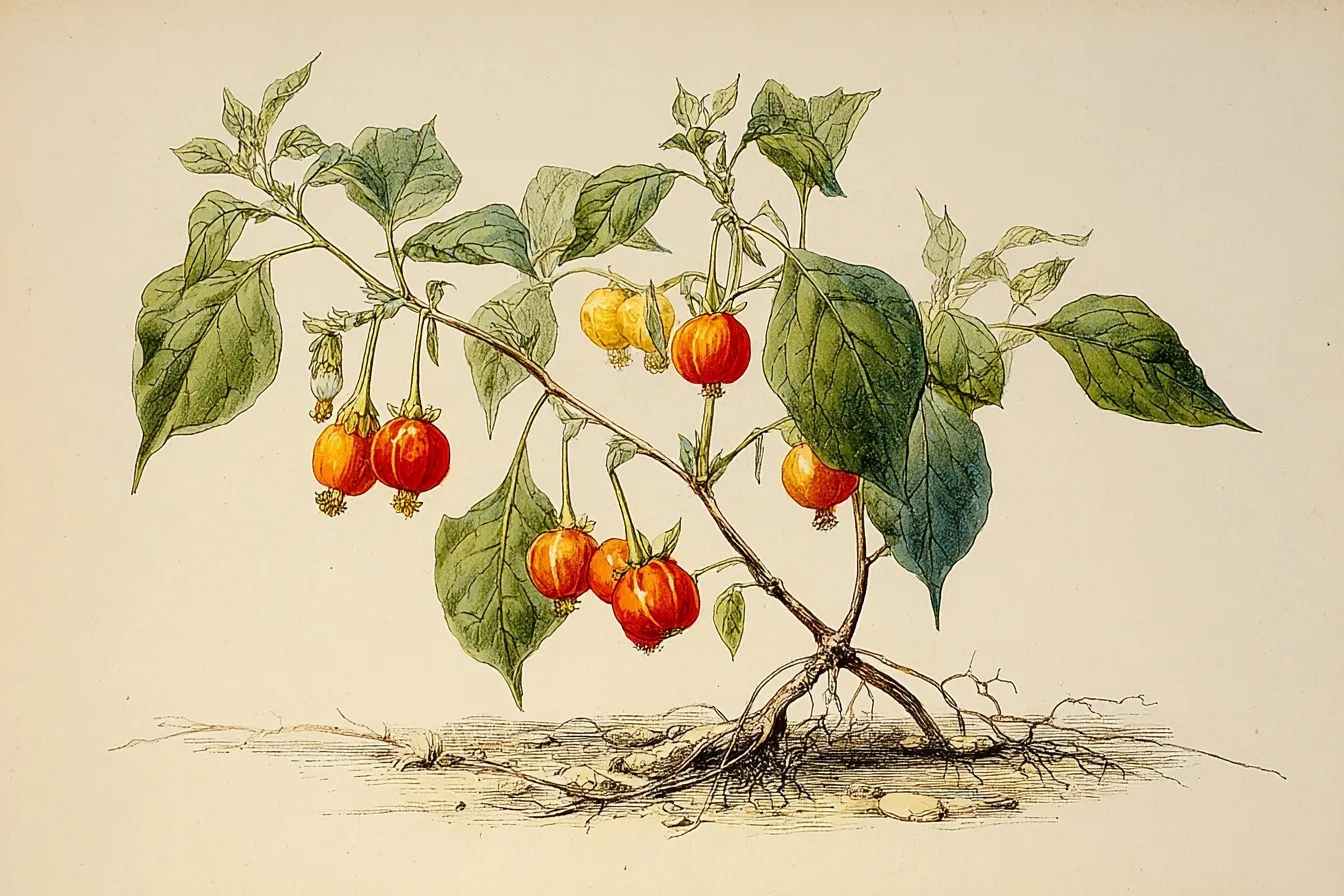
Ashwagandha (Withania somnifera) is a small shrub with yellow flowers and red berries that grows across India, the Middle East, and parts of Africa. In Ayurvedic medicine, it’s been prescribed for roughly 3,000 years—classified as a rasayana, a rejuvenating tonic for vitality and longevity. The Sanskrit name literally translates to “smell of the horse,” which refers both to the root’s distinctive odor and the traditional belief that it imparts the strength and stamina of a horse. Whether that second part is metaphor or marketing depends on your relationship with ancient herbalism. What’s not debatable is that it’s one of the most widely prescribed herbs in one of the world’s oldest medical systems, and modern science keeps finding reasons to agree.
The primary active compounds are withanolides—a group of steroidal lactones concentrated in the root. The most studied extract is KSM-66, a full-spectrum root extract standardized to 5% withanolides. Withanolides modulate the hypothalamic-pituitary-adrenal (HPA) axis, which is the control system for your stress response. When your HPA axis is overactive—chronic stress, essentially—ashwagandha helps recalibrate it. It also modulates GABA receptors and has demonstrated anti-inflammatory effects via NF-kB pathway inhibition. The word “adaptogen” gets thrown around loosely in the supplement world, but ashwagandha actually earns it: it helps your body adapt to stress rather than simply suppressing the stress signal.
What Does the Research Say?
The headline study: Chandrasekhar et al. (2012), published in the Indian Journal of Psychological Medicine. A randomized, double-blind, placebo-controlled trial gave 64 subjects 300mg of ashwagandha root extract (KSM-66) twice daily for 60 days. Serum cortisol levels dropped by an average of 27.9% compared to placebo. The treatment group also reported significant reductions in perceived stress on the PSS (Perceived Stress Scale). Sixty-four people is not a massive sample, but a 28% cortisol reduction is not a subtle finding. That’s the kind of number that makes endocrinologists pay attention.
A larger 2019 study by Lopresti et al., published in Medicine, tested 240 subjects over 8 weeks with 240mg of ashwagandha extract daily. Cortisol was 14.5% lower in the treatment group versus placebo by the end of the trial. DASS-21 scores for anxiety dropped significantly. Morning cortisol specifically—the spike that wakes you up feeling like you’re already behind on the day—showed the most notable change. The larger sample and the lower dose are both worth noting: even at a modest dose, the effect was statistically significant across a meaningful number of people.
For thyroid function: Sharma et al. (2018), published in the Journal of Alternative and Complementary Medicine, found that ashwagandha supplementation normalized thyroid indices in subclinically hypothyroid adults over 8 weeks. TSH levels improved toward the normal range, and T3 and T4 levels increased. This is relevant because thyroid function directly affects energy, metabolism, and mood—and chronic stress is one of the things that can suppress thyroid function in the first place.
How Does It Feel?
It’s slow. That needs to be said upfront because the cortisol data is so striking that you might expect to feel a wall of calm on day one. You won’t. Ashwagandha is an adaptogen, and adaptogens work by recalibrating systems over time, not by flipping switches. Most people notice the first real shift around week two—and it’s usually not what you’d expect.
What tends to happen: you’re in a situation that would normally spike your stress—a difficult email, a traffic jam, your kid screaming about something deeply unimportant—and you notice that the spike doesn’t come. Or it comes, but it’s quieter and shorter. The event happens, you respond to it, and then you move on instead of carrying the residue for the next two hours. Your baseline drops. Not your emotions, not your engagement with life. Just the background noise level. One customer told us it was like the difference between driving with the emergency brake on and driving without it. You didn’t know the brake was on until someone released it.
By week four, if you’re paying attention, there’s a quality to your mornings that’s different. You wake up and the day doesn’t immediately feel heavy. There’s energy that isn’t caffeinated or manic—it’s just available. The ashwagandha is doing its work on cortisol and your HPA axis, and the downstream effect is that your body stops acting like every Tuesday is a survival situation.
A note of realness: some people report mild drowsiness in the first few days, especially at higher doses. It usually resolves. If you’re taking it in the evening, this can actually be a feature rather than a bug, since ashwagandha has been associated with improved sleep quality in clinical trials.
Formulations Featuring Ashwagandha
Daydream—Calm Clarity ($80, 30 capsules)
- Ashwagandha per capsule: 50mg
- Also contains: L-Theanine 50mg, Golden Teacher 125mg
- Why it’s in this formula: Daydream pairs ashwagandha’s cortisol reduction with L-theanine’s alpha brain wave stimulation—two completely different pathways to the same destination: calm clarity. The ashwagandha works on the hormonal axis over weeks; the L-theanine provides immediate neural calm in minutes. The psilocybin microdose (125mg Golden Teacher) adds mood elevation and neuroplasticity. Together, the formula addresses stress at the hormonal, neural, and perceptual levels simultaneously. We designed Daydream for the person who wants to stop running on cortisol and start running on something better.
Pairs Well With
L-Theanine—Ashwagandha lowers cortisol; L-theanine increases alpha brain waves. Together they produce a calm clarity that’s neither sedating nor stimulating. Both are in psilocybin + L-theanine + ashwagandha formulations, and the combination is one of the most studied anxiolytic stacks in supplement research. Ashwagandha handles the weeks-long hormonal recalibration; L-theanine handles the thirty-minutes-from-now situation. Read about L-Theanine ->
Psilocybin (Golden Teacher)—Ashwagandha’s cortisol reduction creates a smoother baseline for microdosing. Less background stress means the psilocybin’s mood elevation and sensory enhancement come through more clearly—like turning down the static so you can hear the music. If your microdosing experience feels jagged or inconsistent, an overactive stress response might be the interference. Ashwagandha addresses that. Both are in psilocybin + L-theanine + ashwagandha formulations. Read about Golden Teacher ->
Reishi—Both are calming adaptogens, but they work through different mechanisms. Ashwagandha modulates cortisol through the HPA axis; reishi is GABAergic and works through immune modulation and beta-glucan activity. Stacking them covers two distinct stress-response pathways. If ashwagandha is the thermostat, reishi is the insulation—both help keep the system stable, but from different directions. Read about Reishi ->
Safety & Interactions
Consult your healthcare provider if you:
- Are pregnant or breastfeeding (ashwagandha may have abortifacient properties at high doses—this is a hard stop, not a soft suggestion)
- Are taking thyroid medications (ashwagandha can increase thyroid hormone levels, potentially requiring dose adjustments)
- Are on immunosuppressive therapy (ashwagandha has immunostimulatory effects)
- Are taking sedatives or anti-anxiety medications (additive effects possible)
- Are taking diabetes medications (ashwagandha may lower blood sugar)
- Have a history of liver conditions (see safety note below)
- Are scheduled for surgery (discontinue at least 2 weeks before)
- Are under 18
Known interactions:
- Thyroid medications (levothyroxine, etc.): Ashwagandha has demonstrated the ability to increase T3 and T4 levels in clinical studies. If you’re on thyroid hormone replacement, adding ashwagandha could push levels higher than intended. Have your thyroid monitored.
- Sedatives and benzodiazepines: Ashwagandha has GABAergic activity. Combining with prescription sedatives may produce additive effects.
- Blood sugar medications: Some evidence suggests ashwagandha can lower blood glucose. Monitor accordingly if you’re on insulin or oral hypoglycemics.
- Immunosuppressants: Ashwagandha stimulates immune function, which could theoretically counteract immunosuppressive therapy.
A note on liver safety—transparency matters here: Emerging case reports and a growing body of pharmacovigilance data have raised concerns about potential liver toxicity (hepatotoxicity) associated with ashwagandha, particularly at high chronic doses. The National Institutes of Health’s LiverTox database has documented cases of clinically apparent liver injury linked to ashwagandha products. Most reported cases involved doses higher than standard supplement recommendations, and most resolved after discontinuation. The risk appears to be rare, but it’s real enough that we’d be doing you a disservice by not mentioning it.
Our position: at the 50mg per capsule in Daydream, taken at the recommended 1 capsule daily, you’re well below the dose ranges associated with liver concerns. But if you’re planning to take ashwagandha at higher doses from other sources, or if you have pre-existing liver conditions, consult your doctor and consider periodic liver function testing.
Dose considerations: Clinical studies typically use 300-600mg of root extract daily (usually KSM-66 standardized to 5% withanolides). Each Daydream capsule contains 50mg of ashwagandha. Our recommended dose of 1 capsule daily is conservative relative to studied amounts. Even at 2-3 capsules, you’d be at 100-150mg—still well below most clinical study doses. The cortisol-lowering effects observed in research used 240-600mg daily.
Ashwagandha literally translates to “smell of the horse” and I need everyone to sit with that for a second because three thousand years ago in India someone dug up a root, sniffed it, thought “horse,” and then decided that was a SELLING POINT. And they were right. Three millennia later we have double-blind placebo-controlled trials confirming that the horse-smelling root makes your cortisol drop by twenty-eight percent and the Oracle is now contemplating whether horses are just naturally less stressed than humans or whether we’ve been overthinking the whole wellness industry this entire time. The ancient Ayurvedic doctors didn’t have EEG machines or serum cortisol assays they just had a root and a nose and apparently that was enough.