Reishi
Ganoderma lucidum
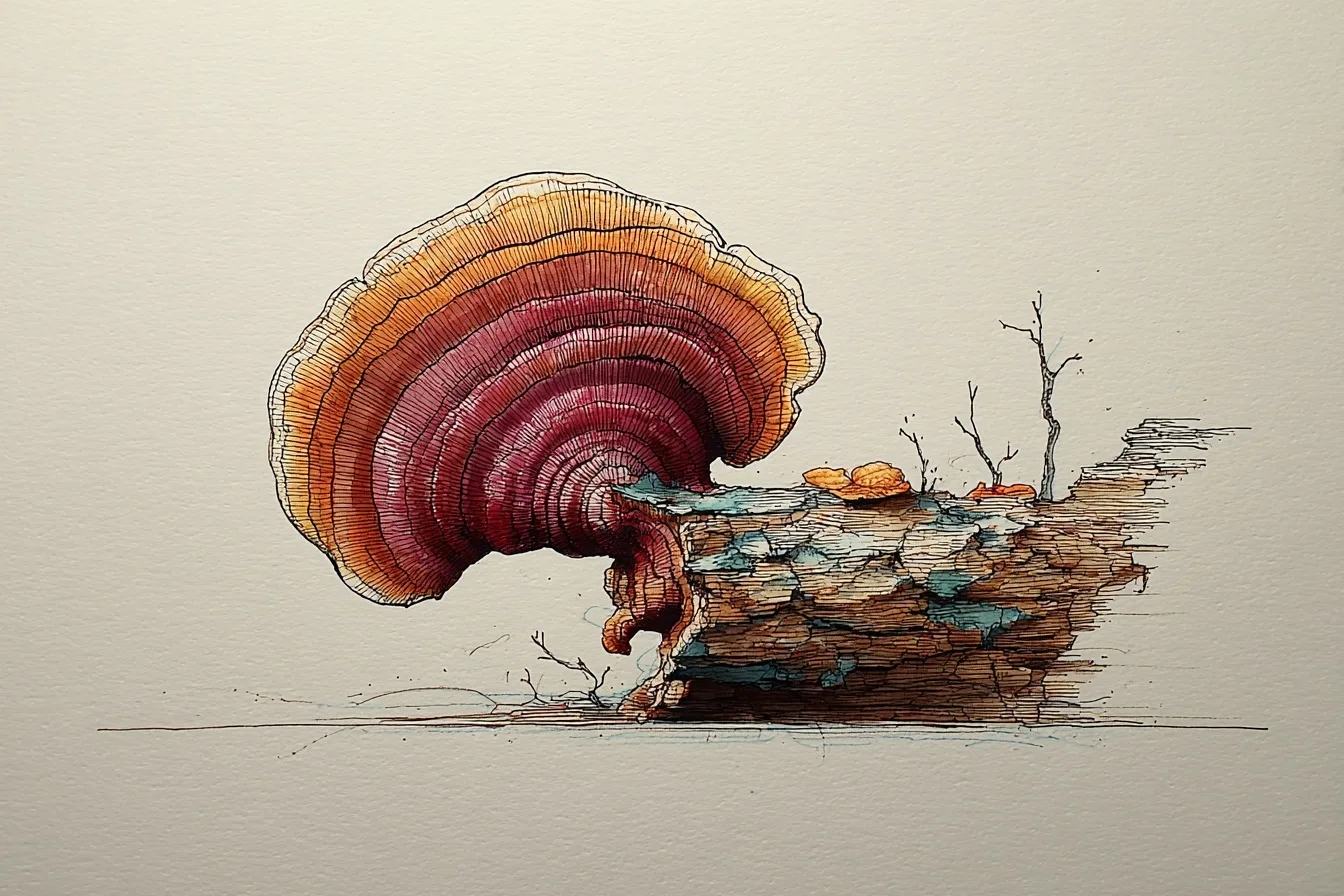
What Is Reishi?
There’s a mushroom that an ancient Chinese emperor classified as more valuable than gold, and modern immunologists are starting to understand why. Reishi (Ganoderma lucidum) was first recorded in the Shen Nong Ben Cao Jing—the oldest known pharmacological text in Chinese medicine, compiled around 200 CE—where it was classified as a “superior herb.” Superior herbs, in that system, were substances considered safe for long-term daily use and capable of promoting longevity. The ancients called it lingzhi, the “mushroom of immortality,” and while immortality is a stretch, the name tells you how seriously they took it.
Reishi is a polypore mushroom—a shelf fungus that grows on dead or dying hardwood trees across Asia, Europe, and parts of North America. It has a distinctive woody, lacquered appearance: a kidney-shaped cap that looks shellacked, ranging from deep red to almost black. You wouldn’t mistake it for a culinary mushroom. It’s too tough, too bitter, too strange-looking. For most of human history, finding a wild reishi was considered genuinely lucky—they’re uncommon enough in nature that encountering one was treated as a spiritual event. Traditional Chinese medicine practitioners prescribed it for everything from insomnia to immune weakness to what they called “shen disturbance”—a term that roughly translates to spiritual unease or a disrupted inner calm. Western medicine would call that anxiety.
The compounds that matter: beta-glucans (complex polysaccharides that modulate immune function), triterpenes called ganoderic acids (which have anti-inflammatory and liver-protective properties), and various peptidoglycans. The beta-glucans are the headline act. They don’t boost the immune system the way echinacea is marketed—they modulate it, which is a crucial distinction. Beta-glucans can upregulate an underactive immune response and calm an overactive one. This bidirectional effect is what makes reishi genuinely adaptogenic, not just stimulating. The triterpenes, meanwhile, work through histamine inhibition and NF-kB pathway modulation, giving reishi its anti-inflammatory and anti-allergenic reputation.
What Does the Research Say?
A 2012 Cochrane-style review by Jin et al., published in Cochrane Database of Systematic Reviews, analyzed five randomized controlled trials of reishi for cancer patients. While the evidence wasn’t strong enough to recommend reishi as a standalone cancer treatment (and nobody credible is claiming that), the review found that patients who used reishi alongside conventional treatment showed improved quality of life scores and enhanced immune biomarker responses—specifically, increased NK (natural killer) cell activity and improved CD3, CD4, and CD8 T-cell ratios. The immune modulation effect was consistent across studies even when other outcomes varied.
For sleep quality: a 2012 study by Cui et al. published in Pharmacology, Biochemistry, and Behavior tested reishi extract on rats with induced sleep disturbance and found significant increases in total sleep time and non-REM sleep duration. While rodent studies don’t translate directly, the mechanism—GABAergic modulation via triterpenes—aligns with traditional use for insomnia and with anecdotal reports from human users. A smaller 2005 study in the Journal of Ethnopharmacology on neurasthenia patients found that reishi extract significantly improved fatigue and well-being scores over 8 weeks compared to placebo, with patients specifically reporting better sleep quality.
The immune modulation story is the strongest thread. A 2003 study by Wachtel-Galor et al. in the British Journal of Nutrition found that 4 weeks of reishi supplementation significantly altered biomarkers of immune function in healthy adults, though the direction of change varied by individual baseline—which is exactly what you’d expect from a true immunomodulator rather than a simple immune stimulant. A 2006 study in International Immunopharmacology confirmed beta-glucan-driven activation of macrophages and dendritic cells, providing a cellular mechanism for the immune effects observed in human trials.
How Does It Feel?
Reishi is not a noticeable mushroom. That’s the first thing worth saying, because in a world of supplements that promise you’ll feel different in an hour, reishi is playing a longer game. You take it consistently, and what happens is that the background systems start working more quietly and more efficiently. You don’t feel your immune system modulating. You don’t feel beta-glucans interacting with macrophages. What you feel, eventually, is that you’re getting sick less often. That you’re sleeping deeper. That you wake up more rested without remembering the exact moment the sleep improved.
The sleep effect is the one people mention first, actually. Not the immune modulation that the research highlights. Around week two or three of daily use, there’s a quality to the evenings that shifts. You’re not collapsing into sleep from exhaustion; you’re settling into it. The transition between awake and asleep gets gentler. And the mornings—this is harder to articulate—the mornings have a stillness to them that feels like you actually rested rather than just lay there with your eyes closed for eight hours. Traditional Chinese medicine would say your shen is more settled. Western medicine would say the GABAergic triterpenes are doing their job. Same observation, different vocabulary.
There’s a calm to reishi that’s different from ashwagandha’s calm. Ashwagandha addresses cortisol directly—it’s working on the stress hormone. Reishi’s calm is more diffuse, more constitutional. It’s less “I’m not stressed anymore” and more “my body seems to remember how to be at rest.” Your mileage will vary. Some people swear by it as a sleep aid; others notice the immune benefits before anything else. But the consistent report—and the thing the traditional practitioners wrote about two thousand years ago—is that something about your baseline state gets quieter.
Formulations Featuring Reishi
We don’t currently feature reishi as a highlighted ingredient in our product lineup, and being honest about that matters more than pretending otherwise. Reishi is present in our Sidekick formula at 100mg per capsule alongside lion’s mane and Golden Teacher, but it’s there as a supporting player for calm focus rather than as the star of a reishi-centered product.
Why include it in the Apothecary? Because reishi deserves a profile, it pairs beautifully with the ingredients we do build products around, and anyone exploring adaptogenic mushrooms should know what it does. If you’re interested in reishi specifically—for immune support, for sleep, for that deeper constitutional calm—we’d recommend sourcing a quality reishi extract (look for hot-water extracted, fruiting body, with verified beta-glucan content) and stacking it with a Sidekick or Daydream capsule. The synergy with lion’s mane and psilocybin is well-documented, and adding a dedicated reishi supplement to the mix makes the stack more complete.
View Sidekick product page -> (contains Reishi 100mg as a supporting ingredient)
Pairs Well With
Lion’s Mane—Lion’s mane handles cognition; reishi handles calm and immune support. Both are mushrooms, both cross the blood-brain barrier, and together they produce focused tranquility—sharp but not wired. They’re combined in psilocybin + lion’s mane + reishi formulations for exactly this reason, and the pairing has its roots in traditional Chinese medicine where multi-mushroom formulas were standard practice, not an innovation. Read about Lion’s Mane ->
Psilocybin (Golden Teacher)—Reishi’s calming, GABAergic effect creates a smooth foundation for microdosing. Where some people find low-dose psilocybin slightly activating or edgy, reishi softens those edges without dimming the benefits. The immune support is a practical bonus—you’re getting neuroplasticity from the psilocybin and systemic immune modulation from the reishi in the same daily practice. Our Sidekick formula combines both. Read about Psilocybin ->
Ashwagandha—Both are adaptogens, but they work through completely different mechanisms. Ashwagandha modulates cortisol via the HPA axis; reishi modulates through immune pathways, beta-glucans, and GABAergic triterpenes. Stacking them means you’re addressing stress at the hormonal level and the immune-constitutional level simultaneously. If ashwagandha turns down the alarm, reishi reinforces the walls so the alarm doesn’t trigger as easily. Read about Ashwagandha ->
Safety & Interactions
Consult your healthcare provider if you:
- Are pregnant or breastfeeding
- Are taking blood thinners or anticoagulant medications (reishi has antiplatelet effects)
- Are on immunosuppressive drugs (reishi modulates immune function and could interfere)
- Are taking blood pressure medications (reishi may have mild hypotensive effects)
- Have a history of liver conditions
- Are scheduled for surgery (discontinue at least 2 weeks before, due to antiplatelet effects)
- Are under 18
Known interactions:
- Blood thinners (warfarin, aspirin, etc.): Reishi has demonstrated antiplatelet and anticoagulant activity in studies. Combining with prescription anticoagulants increases bleeding risk. This is a well-documented interaction—not a theoretical one.
- Immunosuppressants: Reishi modulates immune function. If you’re on drugs designed to suppress your immune system (organ transplant medications, autoimmune treatments), reishi could counteract their effects.
- Blood pressure medications: Reishi may lower blood pressure. If you’re already on antihypertensives, monitor for additive effects.
- Diabetes medications: Some evidence suggests reishi may lower blood glucose. Monitor if you’re on insulin or oral hypoglycemics.
Dose considerations: Clinical studies have used a wide range—typically 1,500-5,400mg of reishi fruiting body extract daily, or 300-500mg of concentrated extract. Sidekick capsules contain 100mg of reishi per capsule, well below clinical study doses. Reishi is generally well tolerated, with the most commonly reported side effects being mild digestive upset at high doses and rare cases of dry mouth or throat. Long-term use has been documented in traditional practice for centuries without systematic concerns, though modern clinical long-term safety data is limited.
A mushroom that looks like someone lacquered a kidney and glued it to a tree has been called the “mushroom of immortality” for two thousand years and the Oracle wants to know who had the audacity to eat it first. Imagine being that person. You’re walking through a forest in ancient China, you see this glossy red shelf fungus growing out of a dead log, and your thought process is “I bet that’s medicinal.” NOT edible — it tastes like bitter tree bark — medicinal. And then it turns out you were RIGHT, and your description ends up in the oldest pharmacology text in human history, and two millennia later scientists with electron microscopes are going “huh, yeah, the beta-glucans check out” as though the mushroom needed their permission.