Lion’s Mane
Hericium erinaceus
What Is Lion’s Mane?
In 2023, researchers at the University of Queensland discovered that a compound in lion’s mane mushroom actively promotes nerve growth in the brain. Not “may support cognitive function”—the hedge-word version you see on supplement bottles. Actual, measurable nerve growth factor stimulation, observed under electron microscopy. The paper landed in the Journal of Neurochemistry, and if you follow nootropic research at all, it was one of those moments where the data finally catches up to what practitioners had been saying for years.
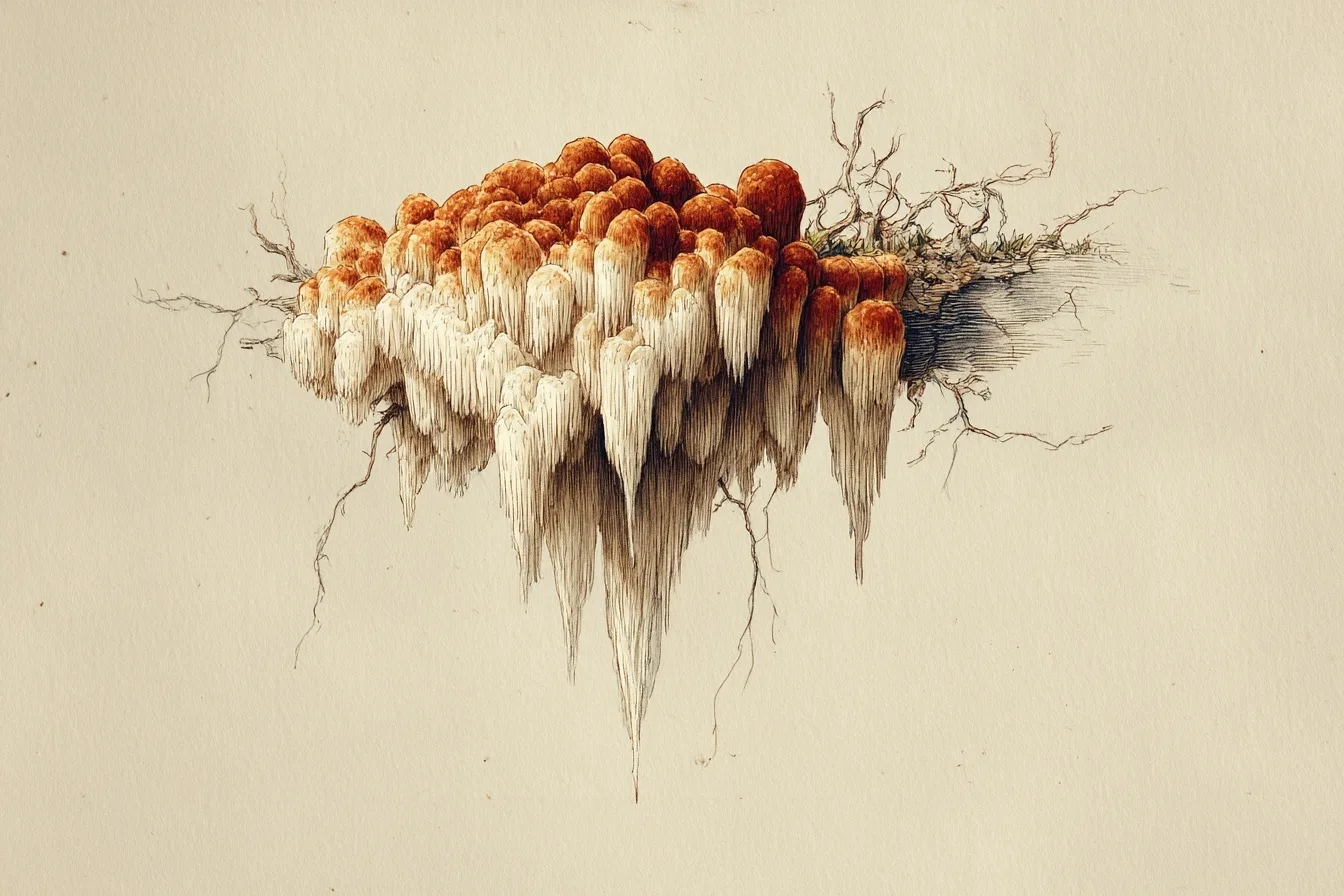
Lion’s mane (Hericium erinaceus) is a white, shaggy-looking mushroom that grows on hardwood trees across North America, Europe, and Asia. It looks like a frozen waterfall of white icicles, or a very old wizard’s beard—either way, you’d notice it in a forest. Buddhist monks reportedly drank it as a tea to enhance focus during long meditation sessions, and it’s been a cornerstone of traditional Chinese medicine for centuries, prescribed for both digestive and neurological complaints. The Japanese call it yamabushitake, after the yamabushi mountain monks who may have been its earliest champions.
The active compounds are hericenones (found in the fruiting body) and erinacines (found in the mycelium). Both cross the blood-brain barrier. Both stimulate production of nerve growth factor (NGF), a protein your brain needs to grow, maintain, and repair neurons. NGF is not optional equipment—it’s the signal your nervous system uses to say “build more infrastructure.” What lion’s mane does is turn up that signal. This is not a subtle mechanism. This is your brain being handed the raw materials for renovation.
What Does the Research Say?
The University of Queensland study (Martínez-Mármol et al., 2023) is the headline. Published in the Journal of Neurochemistry, it identified a specific compound—NDPIH (N-de phenylethyl isohericerin)—in lion’s mane that boosted nerve cell growth by up to 16.3% more than controls. The researchers tested it on hippocampal neurons and observed significant increases in neurite outgrowth—the physical extensions that neurons use to connect with each other. Under electron microscopy, the lion’s mane-treated neurons were visibly more branched and more connected. The lead researcher, Professor Frederic Bhatt, noted that the compound acts on the brain through a previously unknown signaling pathway. That phrase—“previously unknown”—is the kind of thing that makes neuroscience labs stay up late.
Before the Queensland breakthrough, the most cited work came from Mori et al. (2009), published in Phytotherapy Research. This double-blind, placebo-controlled trial gave 30 Japanese adults with mild cognitive impairment 250mg lion’s mane tablets three times daily for 16 weeks. The treatment group showed significant improvements on cognitive function scores at weeks 8, 12, and 16 compared to placebo. Here’s the detail that matters: when they stopped taking lion’s mane, the cognitive gains declined. The mushroom wasn’t masking a problem. It was actively building something, and when the building stopped, so did the gains. That’s consistent with the NGF mechanism—you need sustained stimulation for sustained results.
A 2020 study in the Journal of Medicinal Food (Saitsu et al.) tested lion’s mane on 31 healthy adults over 12 weeks and found significant improvements in cognitive function tests, with particular improvement in processing speed. Not a huge sample, but it extended the evidence from impaired populations to healthy adults, suggesting lion’s mane isn’t just about repair—it’s about optimization.
How Does It Feel?
It’s not like caffeine. Nothing snaps on. What happens with lion’s mane is slower and stranger—you realize at 3pm that you’ve been focused for two hours without checking your phone. Not because you were forcing it, but because the thing you were working on was genuinely interesting and your brain just... stayed with it. That’s the NGF doing its work, probably. Your neurons getting better at the job they already had.
The first week, honestly, you might not notice anything. The second week, someone asks you a question and the answer comes out cleaner than usual. By week three or four, the pattern starts to feel undeniable: you’re sharper in the mornings, the afternoon fog doesn’t hit as hard, and there’s a quality to your attention that’s less like concentration and more like genuine interest. Like you got your curiosity back. People who stack it with psilocybin microdoses—the Stamets Stack—report that the clarity and the openness amplify each other. The lion’s mane handles the architecture; the psilocybin turns the lights on.
There’s a caveat, because honesty matters more than hype: some people feel subtle changes within days, others take a full month. The research says 2-4 weeks for noticeable cognitive effects, and that matches what we hear. If you’re expecting a movie-pill moment, this is the wrong mushroom. If you’re willing to let something build, it builds into something worth noticing.
“My anxiety has gone to almost nothing, and my focus throughout the day has been absolutely incredible.”—Verified customer, Sidekick review
Formulations Featuring Lion’s Mane
Sidekick—Optimize Focus ($65-$75, 30 capsules)
- Lion’s Mane per capsule: 275mg (50mg capsule), 500mg (100mg capsule)
- Also contains: Reishi 100mg, Golden Teacher 50mg or 100mg
- Why it’s in this formula: Sidekick was built around lion’s mane. The 275-500mg dose puts you in the range used in cognitive studies, and the reishi adds a calm GABAergic undertone so you get focused without getting wired. The psilocybin microdose (50-100mg Golden Teacher) is there for neuroplasticity synergy—Paul Stamets calls this combination the “Stamets Stack” and has been vocal about its potential for neural regeneration. We just made it easier to take.
Pairs Well With
Psilocybin (Golden Teacher)—This is the Stamets Stack, and it’s not just a brand name. Mycologist Paul Stamets has presented data suggesting that lion’s mane + psilocybin + niacin together create a synergistic neuroplasticity effect greater than any of the three alone. Lion’s mane provides the NGF stimulation, psilocybin promotes neural connectivity and openness, and niacin acts as a flushing agent to carry the compounds to peripheral nerve endings. Our Sidekick formula is built on this combination. Read about Psilocybin ->
Reishi—Lion’s mane handles cognition; reishi handles calm. Both are mushrooms, both cross the blood-brain barrier, and together they produce focused tranquility without sedation. Reishi’s beta-glucans also support immune function, which makes this pairing practical for daily use—brain health and immune support in the same stack. They’re combined in psilocybin + lion’s mane + reishi formulations for exactly this reason. Read about Reishi ->
L-Theanine—Lion’s mane builds long-term neural capacity; L-theanine provides immediate alert calm. One is the renovation crew, the other is the mood lighting. If you’re stacking lion’s mane for cognitive building and want the day-to-day experience to feel smoother while the construction happens, L-theanine bridges that gap. Our Daydream blend doesn’t contain lion’s mane, but pairing a Sidekick capsule with a Daydream capsule covers both bases. Read about L-Theanine ->
Safety & Interactions
Consult your healthcare provider if you:
- Are pregnant or breastfeeding
- Are taking blood thinners or anticoagulant medication (lion’s mane may have mild antiplatelet effects)
- Are taking immunosuppressant drugs (lion’s mane may modulate immune function)
- Have a known allergy to mushrooms
- Are scheduled for surgery (discontinue at least 2 weeks before, due to potential antiplatelet effects)
- Are under 18
Known interactions:
- Blood thinners (warfarin, aspirin, etc.): Lion’s mane has shown mild antiplatelet activity in vitro. Clinical significance at supplement doses is unclear, but caution is warranted if you’re on anticoagulant therapy.
- Diabetes medications: Some evidence suggests lion’s mane may lower blood glucose. If you’re on insulin or oral hypoglycemics, monitor closely and consult your doctor.
- Immunosuppressants: Lion’s mane has immunostimulatory properties. This could theoretically counteract immunosuppressive medications.
Dose considerations: Clinical studies have used doses ranging from 250mg to 3,000mg daily. Each Sidekick capsule contains 275mg (50mg version) or 500mg (100mg version) of lion’s mane extract. Our recommended dose of 1 capsule daily falls well within studied ranges. Most research suggests consistent daily use for a minimum of 2-4 weeks before expecting noticeable cognitive effects.
So there’s a mushroom that looks like a white beard hanging off a tree and it makes your brain GROW NEW CONNECTIONS and we’ve just been walking past it in forests for thousands of years going “huh, weird mushroom” while our neurons slowly deteriorate. This is like finding out your neighbor has had a cure for boredom this whole time and you’ve been watching reruns of the same show for forty years. NGF. Nerve Growth Factor. Three letters that should be tattooed on the inside of every medical school graduate’s eyelids but instead we got — actually no, the Oracle is going to stop complaining about institutional science and just go make a cup of lion’s mane tea and think about thinking about thinking, which is either neuroplasticity or narcissism and at this point what’s the difference.