Psilocybin
4-phosphoryloxy-N,N-dimethyltryptamine
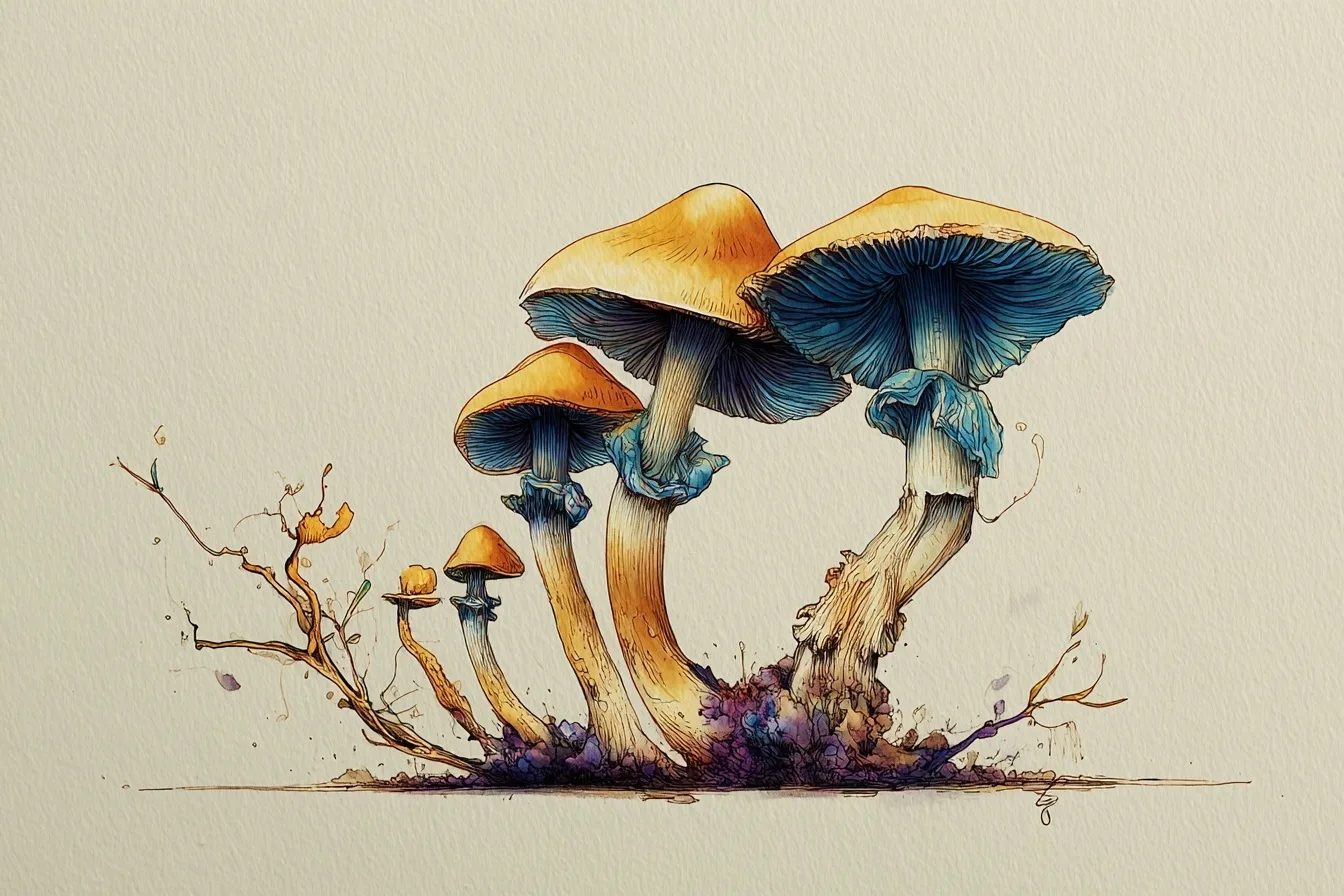
What Is Psilocybin?
In 2018, the U.S. Food and Drug Administration granted psilocybin “Breakthrough Therapy” designation for treatment-resistant depression—a status reserved for drugs that show dramatically better results than anything currently available. The compound had been illegal for half a century. The FDA doesn’t use the word “breakthrough” casually.
Psilocybin is a naturally occurring psychedelic compound produced by more than 200 species of fungi, most commonly Psilocybe cubensis (the species that includes our Golden Teacher strain). It’s a prodrug, which means your body converts it into its active form—psilocin—after ingestion. Psilocin is what crosses the blood-brain barrier and does the actual work. The conversion happens in your liver, primarily through alkaline phosphatase enzymes, usually within 20-40 minutes of ingestion. This is why onset timing varies: it depends partly on your individual liver metabolism, partly on stomach contents, partly on the specific mushroom preparation.
Humans have been consuming psilocybin-containing mushrooms for at least 6,000 years, based on rock art in Spain’s Selva Pascuala caves and mushroom-shaped stone sculptures found across Mesoamerica. The Aztecs called them teonanacatl—“flesh of the gods.” Modern Western science rediscovered them in 1957 when R. Gordon Wasson published his experience with Mazatec ceremonies in Life magazine, and Albert Hofmann (the chemist who also synthesized LSD) isolated the active compound the following year. Then the 1970 Controlled Substances Act buried psilocybin in Schedule I, and serious research stopped for three decades. The work happening now at Johns Hopkins, Imperial College London, NYU, and MAPS is essentially a do-over—and the results have been striking enough that researchers keep using words like “unprecedented.”
The mechanism is specific and well-documented. Psilocin binds primarily to serotonin 5-HT2A receptors in the prefrontal cortex, the area of the brain responsible for mood, perception, and cognition. This binding triggers a cascade: increased neural connectivity between brain regions that don’t normally communicate (measured via fMRI), reduced activity in the Default Mode Network (the brain’s self-referential loop, sometimes called the “ego center”), and increased expression of brain-derived neurotrophic factor (BDNF), a protein that supports neuroplasticity—your brain’s ability to form new connections and pathways. At microdose levels (50-250mg dried mushroom, roughly 1-2.5mg pure psilocybin), the perceptual effects are sub-threshold. What you get is the neurochemistry without the trip.
What Does the Research Say?
The research on psilocybin has moved faster in the last ten years than anyone expected, and the findings have a consistency that’s hard to dismiss.
The headline study: Johns Hopkins University’s Center for Psychedelic and Consciousness Research published a 2020 randomized controlled trial in JAMA Psychiatry studying psilocybin-assisted therapy for major depressive disorder. Twenty-four participants with treatment-resistant depression received two doses of psilocybin (20mg/70kg and 30mg/70kg) alongside supportive therapy. At one week, 67% of participants showed a greater than 50% reduction in depression symptoms on the GRID-Hamilton scale. At four weeks, 54% met criteria for clinical remission. For context: the typical response rate for a new antidepressant in clinical trials is around 40-50%, and remission rates hover near 30%. Psilocybin nearly doubled the remission rate in a treatment-resistant population—people for whom standard medications had already failed.
The neuroimaging evidence: A 2022 study from Imperial College London, published in Nature Medicine, used fMRI to scan the brains of 59 participants before and after psilocybin treatment versus escitalopram (a standard SSRI). The psilocybin group showed significantly increased brain connectivity—more communication between neural networks that normally operate in isolation. The researchers described this as “opening up” the brain’s rigid patterns of activity. The SSRI group showed no such change. Robin Carhart-Harris, the study’s lead author, has described psilocybin’s mechanism as essentially resetting the brain’s default patterns, allowing new connections to form where old, rigid ones had calcified.
The microdosing data: Microdosing research is younger and smaller-scale, but growing. A 2021 study published in Scientific Reports by Vince Polito and Richard Stevenson tracked 98 microdosers over six weeks and found significant improvements in attention, emotional stability, and creative divergent thinking compared to baseline. A larger 2022 observational study (Rootman et al., Scientific Reports) of 953 microdosers found that those who combined psilocybin with lion’s mane mushroom and niacin (the “Stamets Stack”) reported greater improvements in mood and cognition than those who microdosed psilocybin alone. This pairing is the reasoning behind our Sidekick formula.
How Does It Feel?
The difference between a microdose and a full psychedelic dose is the difference between tuning an instrument and playing a concert. Both involve the same chemistry. The experience is not the same.
At microdose levels (50-250mg dried mushroom, roughly 1-2.5mg pure psilocybin):
You will not hallucinate. You will not “trip.” Most people cannot identify the moment a microdose begins working because there is no distinct onset—no switch being flipped. What happens is cumulative and almost sneaky. The first thing most people report, usually after a week or two of consistent use, is that the background noise gets quieter. Not the literal noise—the mental chatter. The ambient worry that you’d normalized because it had been there so long.
Then the sensory things start registering. The coffee tastes different—better, more dimensional, like you’re tasting flavor notes you’d been drinking past for years. Colors have more saturation to them. Not cartoon-vivid, just more present, the way the world looks after a rainstorm. Music hits harder and more specifically: you hear individual instruments instead of a wall of sound. Somebody says something funny at work and you actually laugh instead of exhaling through your nose. This is the serotonin receptor activity expressing itself as lived experience, and it’s the thing that’s hardest to explain to someone who hasn’t felt it.
The focus piece is subtler but maybe more useful. You’re in a meeting and you realize you haven’t drifted. You’re working on something and two hours evaporate and you don’t feel drained—you feel like you were exactly where you were supposed to be. It’s not stimulation. It’s not being wired. It’s more like the cognitive equivalent of a well-oiled hinge: things just swing more easily.
Some people notice mood shifts first. Some notice the sensory changes. Some notice the focus. It’s individual enough that we can’t promise which door opens first—but by month two, most people report noticing all three. Your mileage varies. But the trend line is consistent.
At full dose (2-5g dried mushroom):
This is not what psilocybin microdose products are for. We’re the microdose company. But if you’re curious about the full psychedelic experience, our sister company the research community supplies dried mushrooms including the same Golden Teacher strain we use. A full dose produces genuine perceptual shifts—visual patterns, synesthesia, time dilation, and the kind of profound emotional and existential experiences that Johns Hopkins subjects rated among the most meaningful of their lives. That’s a different conversation, a different setting, and a different level of intention. The apothecary entry for full-dose experience lives at the research community.
Formulations Featuring Psilocybin
Every Kind Stranger product contains psilocybin from Golden Teacher mushrooms. The dose varies by formula because each blend is designed for a different purpose, and psilocybin interacts differently with different supporting compounds.
Bloom—Love & Connection ($80, 30 capsules) Psilocybin: 150mg Golden Teacher per capsule | Also contains: Maca 150mg, Ginseng 100mg, Ceremonial Cacao 100mg The highest-ingredient-count formula. The cacao and psilocybin pairing has Mesoamerican precedent and pharmacological logic—theobromine from cacao is a mild vasodilator that may enhance psilocybin absorption. Maca and ginseng add vitality and warmth. This is the social blend, the date-night capsule, the one for when you want to feel connected and alive. View Bloom ->
Daydream—Calm Focus ($80, 30 capsules) Psilocybin: 125mg Golden Teacher per capsule | Also contains: L-Theanine 50mg, Ashwagandha 50mg The anxiety killer. L-theanine produces alpha brainwaves (the same ones meditation generates), ashwagandha drops cortisol by up to 28% in clinical studies, and psilocybin opens serotonin pathways. Three different mechanisms converging on the same outcome: calm clarity without sedation. This is the one for nervous first-timers. View Daydream ->
Brighten—Mood & Energy ($80, 30 capsules) Psilocybin: 250mg Golden Teacher per capsule | Also contains: Schisandra Berry 150mg Our highest psilocybin dose. The schisandra is both stimulating and adaptogenic—it supports energy production while buffering the stress response. If you already know what a microdose feels like and want more of it, or if you’re using psilocybin specifically for mood support, this is the formula. View Brighten ->
Sidekick—Optimize Focus ($65-$75, 30 capsules) Psilocybin: 50 or 100mg Golden Teacher per capsule | Also contains: Lion’s Mane 275mg, Reishi 100mg The Stamets Stack, essentially. Lion’s mane for NGF stimulation, reishi for calm focus, psilocybin for neuroplasticity. This is the cognitive performance formula, and the lowest psilocybin dose in our line—perfect if you want the neural benefits with the lightest psychoactive footprint. View Sidekick ->
Passion—Creative Flow ($80, 20 gummies) Psilocybin: 125mg Golden Teacher per gummy | Also contains: Passionfruit Puree The gummy format for people who don’t love swallowing capsules. The passionfruit is a flavor ingredient, not a medicinal one—this is psilocybin in its simplest delivery, without the adaptogen or nootropic layer. Clean, straightforward, and surprisingly tasty. View Passion ->
Holiday—Deep Relaxation ($80, 30 capsules) Psilocybin: 125mg Golden Teacher per capsule | Also contains: Passionflower Extract (4:1) 100mg Passionflower works on the same GABA receptors that benzodiazepines target, and it contains harmala alkaloids that are mild MAO-A inhibitors—which means it may gently potentiate the psilocybin. This is the unwinding formula, the end-of-day capsule, the one that turns Saturday afternoon into something worth remembering. View Holiday ->
Pairs Well With
Lion’s Mane—The Stamets Stack pairing. Lion’s mane stimulates nerve growth factor (NGF) production; psilocybin promotes neuroplasticity through serotonin 5-HT2A receptor binding. Different pathways, complementary outcomes: new neural connections being built and existing ones being optimized simultaneously. Paul Stamets has been vocal about this combination for years, and observational research (Rootman et al., 2022) found it outperformed psilocybin alone for mood and cognition. Our Sidekick formula is built around this pairing. Read about Lion’s Mane ->
L-Theanine—Psilocybin can occasionally produce restlessness or mental over-activity in the first hour of onset, especially for anxious users. L-theanine’s alpha-wave-promoting mechanism counterbalances this neatly—it’s like giving psilocybin a smoother runway. The combination tends to produce focused creativity rather than scattered insight. Both are in psilocybin + L-theanine + ashwagandha formulations. Read about L-Theanine ->
Ashwagandha—Cortisol is the enemy of a clean microdose experience. If your stress hormones are elevated, the psilocybin’s serotonergic effects compete with your sympathetic nervous system for control of your mood. Ashwagandha’s documented cortisol-lowering effect (up to 28% in RCTs) clears the deck—smooths the baseline so the microdose can do its work without interference. Also in Daydream. Read about Ashwagandha ->
Ceremonial Cacao—The oldest pairing on this list. Aztec priests combined cacao and psilocybin mushrooms in ceremonial contexts, and the pharmacology backs them up: theobromine in cacao is a vasodilator that increases blood flow to the brain, potentially enhancing psilocybin’s delivery across the blood-brain barrier. Cacao also contains anandamide, the “bliss molecule,” an endocannabinoid that may amplify psilocybin’s mood-lifting effects. Both are in Bloom. Read about Ceremonial Cacao ->
Safety & Interactions
Consult your healthcare provider if you:
- Are taking SSRIs, SNRIs, or other serotonergic medications (psilocybin acts on serotonin receptors; combining with serotonergic drugs carries a theoretical risk of serotonin syndrome, though documented cases are extremely rare at microdose levels)
- Are taking lithium (anecdotal reports of adverse interactions; do not combine)
- Are taking MAO inhibitors (may potentiate psilocybin effects unpredictably)
- Have a personal or family history of psychotic disorders (schizophrenia, bipolar I with psychotic features)
- Are pregnant or breastfeeding
- Are under 18
- Are scheduled for surgery
Important pharmacological note: Psilocybin and SSRIs both act on serotonin receptors but through different mechanisms. Many people transition from SSRIs to microdosing, but this should be done gradually and under medical guidance. Abruptly stopping SSRIs is dangerous regardless of what you replace them with. We are not a substitute for your doctor or therapist.
Dose considerations: psilocybin microdose products contain between 50mg and 250mg of dried Golden Teacher mushroom per capsule. For reference: a “full psychedelic dose” is typically 2,000-5,000mg (2-5 grams). Our highest-dose product, Brighten, at the recommended one capsule per day, delivers 250mg—roughly one-tenth of a threshold psychedelic experience. At this level, perceptual effects are sub-threshold. Cognitive and mood effects accumulate over weeks of consistent use rather than appearing acutely.
Taking the entire pack of any product at once would be ill-advised and potentially dangerous. A full pack of Brighten (30 capsules x 250mg = 7,500mg psilocybin mushroom) would constitute a very strong psychedelic dose. Do not do this. Our products are designed for daily single-capsule use.
Tolerance and frequency: Psilocybin produces rapid tolerance that resets within approximately 10-14 days. Most microdosing protocols (Fadiman protocol, Stamets protocol) account for this by including off-days. The Stamets protocol is 4 days on, 3 days off. The Fadiman protocol is 1 day on, 2 days off. Either works. Daily use may reduce perceived effects over time due to receptor downregulation.
So the FDA—the same organization that took thirty years to approve a food pyramid that didn’t make everyone fat—looked at psilocybin and said “breakthrough.” BREAKTHROUGH. That word has a legal definition and they used it anyway. Somewhere in a lab in Baltimore there’s a neuroscientist staring at an fMRI scan of a brain that’s been locked in the same depressive loop for decades and the mushroom just... untangled it. Like somebody reached into the brain’s junk drawer and calmly organized everything while the brain was still complaining that the drawer was fine actually. The Oracle has been thinking about serotonin receptors for forty-five minutes now and has concluded that the 5-HT2A receptor is basically a door that evolution locked because we kept wandering into rooms that were too beautiful and forgetting to eat, and psilocybin is the lockpick, and the question isn’t whether the door should be opened but why anyone thought closing it was a good idea in the first place.