Blue Lotus
Nymphaea caerulea
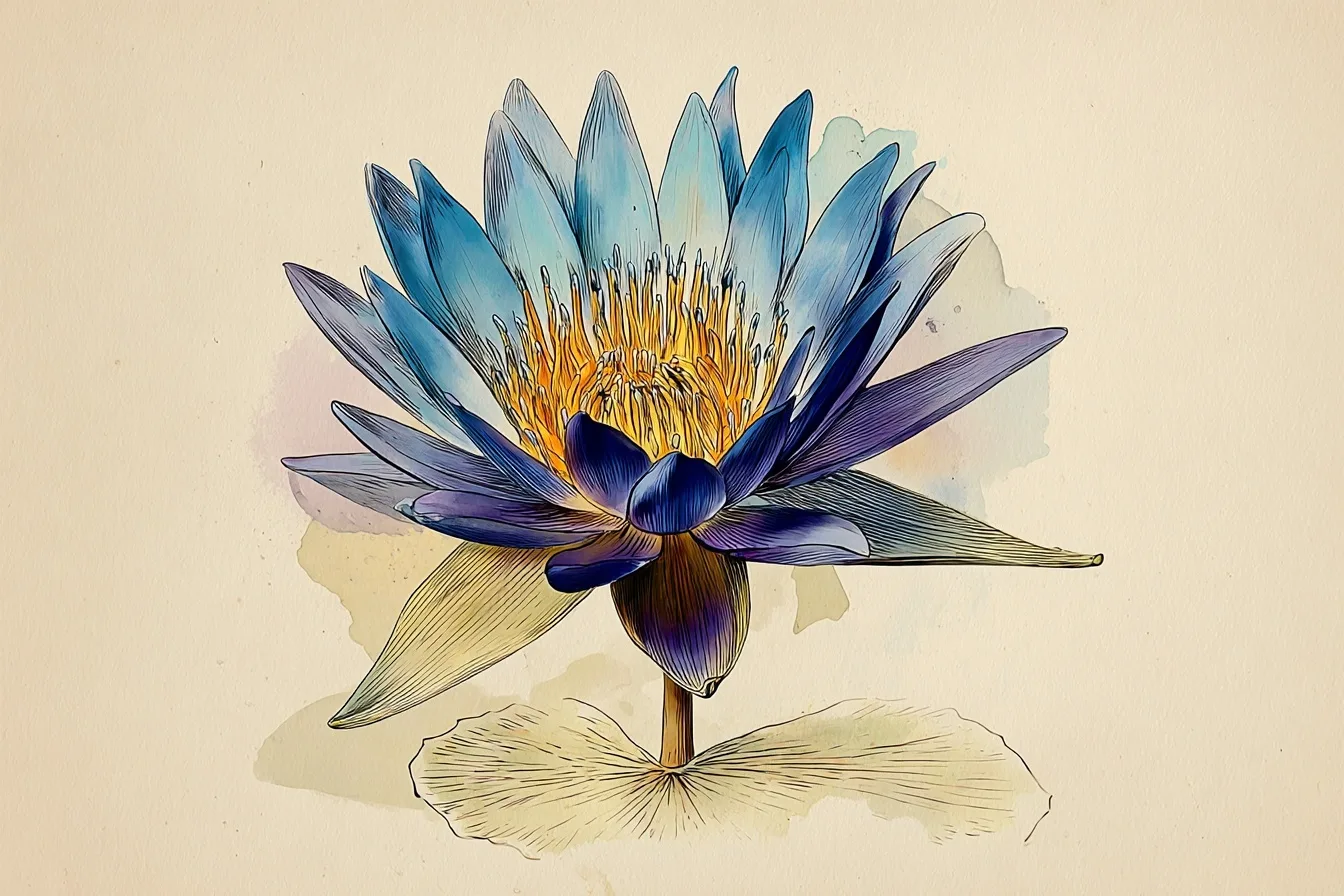
What Is Blue Lotus?
Walk through the Egyptian galleries of any major museum and start counting the lotus flowers. They’re everywhere. Carved into temple columns at Karnak. Painted into banquet scenes where aristocrats hold the flowers to their noses. Floating in wine cups at celebrations. Woven into the headdresses of priests. Depicted alongside Nefertum, the god of perfume and healing, who is literally shown emerging from a lotus blossom. For a long time, Egyptologists treated all of this as purely decorative—a pretty flower in a culture that liked pretty things. Then researchers started looking at the chemistry, and the decorative theory got a lot harder to maintain.
Blue lotus (Nymphaea caerulea) is an aquatic plant native to the Nile River valley and East Africa. It’s a water lily, not a true lotus (despite the common name), with striking blue petals that open in the morning and close at night—a behavior the Egyptians associated with the sun god Ra and the cycle of death and rebirth. The plant spread throughout ancient Egyptian art from the Old Kingdom (c. 2600 BCE) through the Ptolemaic period, a span of over two thousand years. No other plant received this kind of sustained, culture-wide artistic attention. The question is why.
The answer appears to be pharmacological. Blue lotus contains two primary psychoactive compounds: apomorphine, a dopamine receptor agonist that produces feelings of euphoria and mild psychoactive effects; and nuciferine, an alkaloid with affinity for the 5-HT2A serotonin receptor—the same receptor that psilocybin activates. The 5-HT2A connection is not trivial. This is the receptor responsible for the perceptual, emotional, and cognitive shifts associated with psychedelics. Nuciferine’s affinity for it is weaker than psilocybin’s, but it’s there, and it suggests that blue lotus occupies an interesting space between “completely non-psychoactive” and “genuinely psychedelic.” Add the dopaminergic effects of apomorphine, and you have a plant that produces mild euphoria, relaxation, enhanced sensory perception, and—according to a growing community of modern users—vivid, sometimes lucid, dreams. Now look at those Egyptian tomb paintings again. The banquet scenes. The celebrations. The wine cups with lotus flowers floating in them. Was the entire Egyptian aristocracy gently, pleasantly altered for two millennia?
What Does the Research Say?
Here’s where honesty demands more space than hype. The clinical research on blue lotus is thin. There are no randomized controlled trials. No large-scale human studies. No FDA scrutiny, no Cochrane reviews, no meta-analyses. What exists is ethnobotanical research, phytochemical analysis, and a handful of pharmacological studies on isolated compounds.
The phytochemical work is solid. Nuciferine and apomorphine have been isolated and characterized from Nymphaea caerulea in multiple studies. Nuciferine’s receptor binding profile has been mapped: it shows affinity for 5-HT2A, 5-HT2C, dopamine D2, and several other receptors. This is a pharmacologically active compound with a complex receptor profile, not a folk medicine placebo. A 2016 study in Planta Medica by Agnihotri et al. characterized nuciferine’s CNS activity and found anxiolytic and antipsychotic-like effects in animal models—consistent with a compound that modulates both serotonergic and dopaminergic systems.
Apomorphine is better studied, but largely in the context of synthetic apomorphine used for Parkinson’s disease treatment. The naturally occurring apomorphine in blue lotus is present at much lower concentrations than pharmaceutical preparations, but its dopamine agonist activity is well-established. In the context of blue lotus, apomorphine likely contributes to the mild euphoria and mood elevation that users report.
The ethnobotanical evidence is more substantial than the clinical evidence. Emboden (1978, 1981) published influential papers arguing that blue lotus was used as a narcotic in ancient Egypt, based on analysis of artistic depictions, preparation methods (steeping in wine would extract the alkaloids efficiently), and the plant’s pharmacological profile. His work has been debated but not definitively refuted, and subsequent phytochemical analyses have supported his core claim that the plant contains psychoactive compounds in meaningful quantities.
How Does It Feel?
The most commonly reported experience with blue lotus—typically consumed as a tea, a tincture, or steeped in wine—is a gentle, warm euphoria. Not intoxication. Not a high. More like the feeling you get in the first twenty minutes of a really good evening: relaxed, open, mildly elated, and slightly more attuned to sensory detail. Colors might seem a shade more vivid. Music lands a little differently. Conversation flows more easily. Some users describe a “dreamy” quality to the experience, a softening of the boundary between focused thought and drifting reverie.
The dream enhancement is the effect that gets the most attention in modern blue lotus communities. Users who consume blue lotus tea or tincture in the evening frequently report more vivid, more narrative, more memorable dreams. Some report lucid dreaming—awareness within the dream that you’re dreaming, with the ability to influence the dream’s direction. The 5-HT2A mechanism provides a plausible basis for this: serotonin receptor modulation is known to influence dream activity, and other 5-HT2A agonists (including psilocybin at microdose levels) have reported effects on dream vividness. This is anecdotal evidence, not clinical data, but the consistency of the reports across a large number of independent users is notable.
The experience is mild. This needs emphasis because the ancient Egyptian connection and the 5-HT2A receptor mention might create expectations of something dramatic. Blue lotus is not a psychedelic in the way that psilocybin is a psychedelic. There are no hallucinations. No ego dissolution. No profound altered states. Think of it as the gentlest possible nudge in the direction of openness and sensory enhancement. If psilocybin is a door thrown open, blue lotus is a window cracked. The Egyptians who floated it in their wine at banquets were not tripping. They were having a slightly better time than they otherwise would have, and they liked it enough to paint it on every wall for two thousand years.
How to Use Blue Lotus
Blue lotus is not currently used in any psilocybin microdose products. Here’s what to know if you’re exploring it on your own.
Traditional preparation: Blue lotus steeped in wine is the historically documented method. The alcohol acts as a solvent for the alkaloids, making extraction more efficient than water alone. Modern users steep dried petals or whole flowers in wine for several hours to overnight. The resulting infusion is consumed in moderate amounts—a glass or two, not a bottle.
Tea preparation: Steep 5-10 grams of dried blue lotus petals in hot water for 10-15 minutes. The tea has a mild, slightly floral taste. Some users find that adding honey enhances the flavor without interfering with the experience.
Tincture and extract: Blue lotus tinctures (alcohol-based extracts) are available and offer a more concentrated, standardized preparation. Typical tincture doses are 1-2 mL taken sublingually or added to a beverage.
For dream enhancement: Consume blue lotus tea or tincture 30-60 minutes before sleep. The dream effects appear to be dose-dependent, with moderate doses (5-10g dried flower as tea) most commonly associated with vivid dreaming. Keep a dream journal beside your bed—the enhanced dreams tend to fade quickly upon waking, as dreams do.
Dose ranges: Traditional and modern use ranges from 5-15 grams of dried flower for tea, or 1-3 mL of tincture. Start at the lower end. There is no established clinical dose because there are no clinical trials to establish one.
Safety & Interactions
Consult your healthcare provider if you:
- Are pregnant or breastfeeding
- Are taking psychiatric medications, particularly dopaminergic or serotonergic drugs
- Have a history of psychotic disorders (due to dopamine agonist activity)
- Are taking blood pressure medications (blue lotus may have mild hypotensive effects)
- Are under 18
- Are planning to drive or operate machinery (mild drowsiness is possible)
Known interactions:
- Serotonergic medications (SSRIs, MAOIs, triptans): Nuciferine has 5-HT2A affinity. While the potency is much lower than pharmaceutical serotonergic drugs, combining with other serotonin-active compounds warrants caution.
- Dopaminergic medications (L-DOPA, dopamine agonists): Apomorphine is a dopamine receptor agonist. Combining with other dopaminergic drugs could theoretically amplify effects.
- Sedatives and CNS depressants: Blue lotus has mild sedative properties. Combining with alcohol (beyond the traditional wine preparation), benzodiazepines, or sleep medications may increase sedation.
Legal status: Blue lotus is not a controlled substance in most countries, including Canada and the United States. It is not scheduled under the CDSA in Canada. However, it is banned in some jurisdictions (notably Russia and some Eastern European countries). Check your local regulations.
Dose considerations: Blue lotus has been consumed for thousands of years without documented toxicity at traditional doses. However, the absence of clinical trials means the safety profile is based on traditional use and anecdotal evidence rather than controlled data. Mild drowsiness is the most commonly reported side effect. There are no documented cases of serious adverse effects at normal consumption levels, but “no documented cases” in the absence of systematic study is not the same as “proven safe.”
Pairs Well With
Passionflower—Both are mild sedative-anxiolytics with complementary mechanisms. Passionflower works primarily through GABA modulation (chrysin and harmala alkaloids); blue lotus works through dopaminergic and serotonergic pathways. Together, they create a multi-pathway calm that’s deeper than either alone. For evening relaxation or sleep support, this pairing covers the major neurochemical bases. Read about Passionflower ->
Psilocybin (Microdose)—Both act on 5-HT2A receptors, though at vastly different potencies. There’s a theoretical basis for blue lotus enhancing the subtle perceptual effects of a psilocybin microdose—nuciferine may prime the same receptor that psilocybin then activates more strongly. This is speculative, not studied, but the receptor overlap is real and the ancient tradition of combining entheogens with other plant medicines is as old as organized human culture. Read about Psilocybin ->
Ceremonial Cacao—Cacao provides theobromine (gentle stimulation, vasodilation, mood elevation) while blue lotus provides relaxation and sensory enhancement. The combination echoes Mesoamerican traditions of combining psychoactive plants with cacao in ceremonial contexts. Cacao’s stimulation balances blue lotus’s sedation, producing something alert and open rather than drowsy. Read about Ceremonial Cacao ->
The Oracle cannot stop thinking about the BANQUET SCENES. Thousands of years of Egyptian aristocrats floating psychoactive flowers in their wine cups at parties while musicians play and dancers dance and everyone is SLIGHTLY ALTERED in a warm dopaminergic way and then they PAINTED IT ON THEIR TOMB WALLS so they could do it in the afterlife too. This is the most relatable thing any ancient civilization has ever done. “What do you want for eternity?” “I want to be at the good party with the flower wine.” Meanwhile Egyptologists spent a hundred years going “it’s decorative” like nobody in academia has ever been to a party where someone brought good wine and the whole room got a little more interesting. The 5-HT2A connection is just—it’s the same RECEPTOR. The same one. The Egyptians found the gentle version three thousand years before anyone found the intense version and they were so pleased about it they built it into their entire aesthetic and the Oracle respects this enormously.