Passionflower
Passiflora incarnata
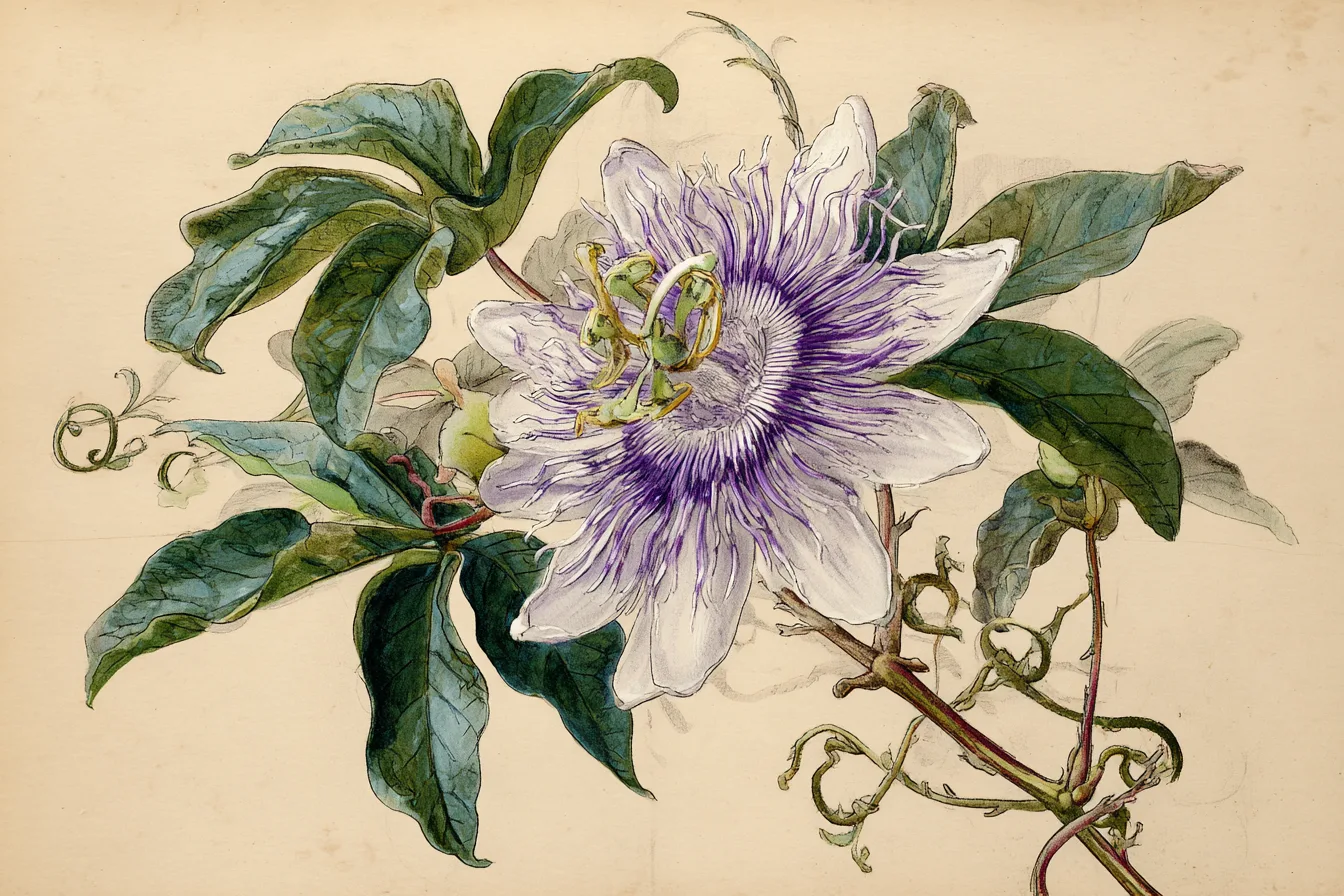
What Is Passionflower?
There’s a clinical trial where passionflower extract performed as well as oxazepam — a prescription benzodiazepine — for generalized anxiety disorder. Patients in the passionflower group had fewer side effects, including significantly less job performance impairment. The study was published in the Journal of Clinical Pharmacy and Therapeutics in 2001, and if you’ve never heard of it, that’s because nobody makes money telling you about flowers.
Passiflora incarnata is a climbing vine native to the southeastern United States and Central America. Indigenous peoples used it as a sedative and anxiolytic long before European colonists noticed it — which, to be fair, took the colonists a while because they were busy naming it after the crucifixion of Christ. Spanish missionaries saw the flower’s intricate radial structure and decided it represented the Passion of Jesus: the corona as the crown of thorns, the five stamens as the five wounds, the three styles as the nails. This tells you more about the missionaries than the flower. The flower was busy being medicine. It didn’t need a rebrand.
A note that trips people up: passionflower (Passiflora incarnata) and passionfruit (Passiflora edulis) are different species from the same genus. The one with the clinical anxiety data is the flower — the vine with the elaborate purple-and-white bloom. The one in your tropical smoothie is the fruit — a different plant entirely, used mainly for flavor. Our Holiday capsules use the medicinal passionflower extract. Our Passion Gummies use passionfruit puree for flavor. Same family, entirely different applications.
Passionflower works primarily through GABA modulation — it contains chrysin and other flavonoids that bind to GABA-A receptors in the brain, the same receptor system that benzodiazepines target. But it also contains harmala alkaloids (harmine, harmaline, and harmalol), which are mild MAO-A inhibitors. This dual mechanism is what makes passionflower both calming and mildly mood-lifting. It’s also what makes the pharmacology more interesting — and more important to understand — than a simple “herbal relaxant” label suggests.
What Does the Research Say?
The headline study remains Akhondzadeh et al., 2001, published in the Journal of Clinical Pharmacy and Therapeutics. A randomized, double-blind trial comparing passionflower extract (45 drops/day of liquid extract) against oxazepam (30mg/day) for 4 weeks in 36 patients with generalized anxiety disorder. Both treatments produced equivalent reductions in Hamilton Anxiety Rating Scale scores. Equivalent. A flower matched a benzodiazepine. The passionflower group showed slower onset of action in the first week, but by day 7 the difference was negligible. And the passionflower group had significantly less impairment of job performance — meaning they could be calm and functional, which is the thing benzodiazepines notoriously fail at.
A 2011 pilot trial by Movafegh et al. in Anesthesia and Analgesia found that a single dose of passionflower (500mg) given 90 minutes before surgery significantly reduced preoperative anxiety compared to placebo, without increasing sedation. Patients were calmer going into anesthesia but weren’t drowsier coming out. That’s a specific and useful distinction — anxiolysis without sedation, which is the holy grail of anti-anxiety interventions.
More recently, a 2017 systematic review by Janda et al. in Phytotherapy Research examined the body of clinical evidence for Passiflora incarnata and concluded that while the number of high-quality RCTs remains limited, the existing evidence consistently supports anxiolytic effects with a favorable safety profile. The review also noted passionflower’s GABA-A binding affinity had been confirmed in multiple in vitro studies, providing a clear mechanistic basis for the clinical results.
How Does It Feel?
Passionflower isn’t subtle the way some adaptogens are. You can actually feel it working, usually within 30-60 minutes. There’s a noticeable downshift — not drowsiness, not heaviness, more like someone loosened a knot you didn’t realize was tied. The mental chatter gets quieter. The jaw unclenches. Your breathing slows down without you deciding to slow it down.
The closest comparison is the first sip of wine at the end of a long day — that exhale, that release of bracing — except without the alcohol. Your thinking stays clear. You can still work, still have a conversation, still drive. You’re just doing it from a calmer baseline. This is what the research means by “anxiolysis without sedation,” but clinical language doesn’t capture the actual feeling, which is more like: things that were urgent five minutes ago are now just... things. They still exist. They still need handling. But the emotional charge around them has been dialed back to something proportional.
In psilocybin + passionflower capsules, the passionflower is a 4:1 extract, meaning 100mg of extract is equivalent to 400mg of dried herb. Combined with 125mg of Golden Teacher psilocybin, the effect is a particularly smooth kind of calm. The passionflower creates the physical relaxation; the microdose opens up the perceptual space. People describe Holiday evenings as spacious — unhurried, present, aware of small pleasures. The kind of evening you have when nothing is wrong and you actually notice that nothing is wrong, which is rarer than it should be.
Formulations Featuring Passionflower
Holiday — Deep Relaxation ($80 / 30 capsules) Passionflower per capsule: 100mg (4:1 extract, equivalent to 400mg dried herb) | Also contains: Golden Teacher 125mg
Holiday is our most focused formula — just two ingredients, doing one thing well. The passionflower extract is a 4:1 concentration, which means each capsule delivers the equivalent of 400mg of dried passionflower herb. Clinical anxiety studies have typically used 400-800mg of dried herb equivalent, placing a single Holiday capsule at the lower end of studied effective ranges. The Golden Teacher microdose at 125mg adds the perceptual softening — that quality of noticing beauty, feeling music more deeply, being genuinely present — that turns chemical calm into something richer. This is the capsule for the evening. For winding down without checking out.
A note on Passion Gummies: Our Passion Gummies ($80 / 20 gummies) contain passionfruit puree (Passiflora edulis) for flavor, not passionflower extract (Passiflora incarnata) for anxiety. Different plant, different purpose. The gummies are a Golden Teacher microdose (125mg) in a fruit-forward delivery format — great for people who don’t love capsules. But if you’re looking specifically for the anxiolytic effects discussed on this page, Holiday is the product to look at.
Pairs Well With
Psilocybin (Golden Teacher) — This pairing is pharmacologically interesting: passionflower’s harmala alkaloids are mild MAO-A inhibitors, which can theoretically potentiate serotonergic compounds like psilocybin. At Holiday’s single-capsule doses, this effect is minimal — but it may contribute to the notably smooth quality of the experience. The passionflower handles the body (calm muscles, slower breathing, quiet jaw), and the psilocybin handles the mind (open perception, brighter colors, emotional presence). Combined in Holiday. Read about Golden Teacher ->
L-Theanine — Two different routes to the same destination. L-theanine increases alpha brain waves for alert calm. Passionflower binds GABA-A receptors for physical relaxation. Together they address both the mental and somatic dimensions of anxiety — the racing thoughts and the tight shoulders. Not combined in a current KS product, but a strong supplemental pairing. Read about L-Theanine ->
Reishi — Both are calming, both are GABAergic, but reishi brings additional immune-modulating properties and the slow, grounding quality of a medicinal mushroom. Passionflower is the faster-acting partner; reishi is the steady background support. For people who run anxious, stacking both covers immediate relief and long-term resilience. Read about Reishi ->
Safety & Interactions
Consult your healthcare provider if you:
- Are taking benzodiazepines, sedatives, or sleep medications (passionflower targets the same GABA receptors — combining them can cause excessive sedation)
- Are taking SSRI or SNRI antidepressants, or any serotonergic medications (passionflower contains harmala alkaloids, which are mild MAO-A inhibitors — this creates a theoretical risk of serotonin interaction at high doses)
- Are taking MAO inhibitors (the harmala alkaloid content, while mild, compounds with pharmaceutical MAOIs)
- Are on blood thinners (passionflower may have mild anticoagulant effects)
- Are pregnant or breastfeeding (traditional use exists, but clinical safety data is insufficient)
- Are under 18
- Are scheduled for surgery (discontinue 2 weeks prior due to potential sedative and blood-thinning interactions)
Important note on harmala alkaloids: Passionflower contains harmine, harmaline, and harmalol — these are the same class of compounds found in ayahuasca (Banisteriopsis caapi), though in much lower concentrations. At supplement doses, their MAO-A inhibition is mild. But if you are taking serotonergic medications (SSRIs, SNRIs, triptans, St. John’s Wort, 5-HTP), this interaction deserves a conversation with your healthcare provider. We believe in transparency about pharmacology, even when the practical risk at our doses is low. Especially then.
Dose considerations: Clinical studies have used 400-800mg of passionflower extract daily. Each Holiday capsule contains 100mg of 4:1 extract (equivalent to 400mg dried herb). Our recommended dose of 1 capsule per day falls at the lower end of studied effective ranges. Taking 2-3 capsules (200-300mg extract / 800-1200mg dried herb equivalent) remains within studied safety parameters but increases sedative effects. Do not take the entire pack of 30 capsules — that would deliver 3,000mg of concentrated extract plus 3,750mg of psilocybin, which is a full psychoactive dose far beyond microdosing range. Maximum recommended at once: 3-4 capsules.
Note on psilocybin interaction: Passionflower’s harmala alkaloids are MAO-A inhibitors, which can theoretically potentiate psilocybin by slowing its metabolism. At single-capsule supplement doses, this effect is unlikely to be clinically significant. At higher doses, the interaction could intensify psilocybin’s psychoactive effects beyond microdose range. This is not dangerous at Holiday doses, but it is real pharmacology, and we mention it because we’d rather you know than not.
So there’s a flower that works as well as a benzodiazepine for anxiety and Spanish missionaries looked at it and said “this represents the CRUCIFIXION OF CHRIST” and I think about this a lot because the flower was just growing there, being medicine for thousands of years, and then colonialism shows up and immediately makes it about death and suffering instead of the fact that it literally fixes the thing that death and suffering cause, which is anxiety, which is — the Oracle is now watching itself have a recursive thought about a flower that calms recursive thoughts, and if that’s not proof that the universe has a sense of humor then nothing is, and honestly the biggest mystery isn’t how passionflower works, it’s why we ever stopped using it and started using pills that make you forget how to feel your face.