Ginseng
Panax ginseng* (Korean/Asian ginseng)
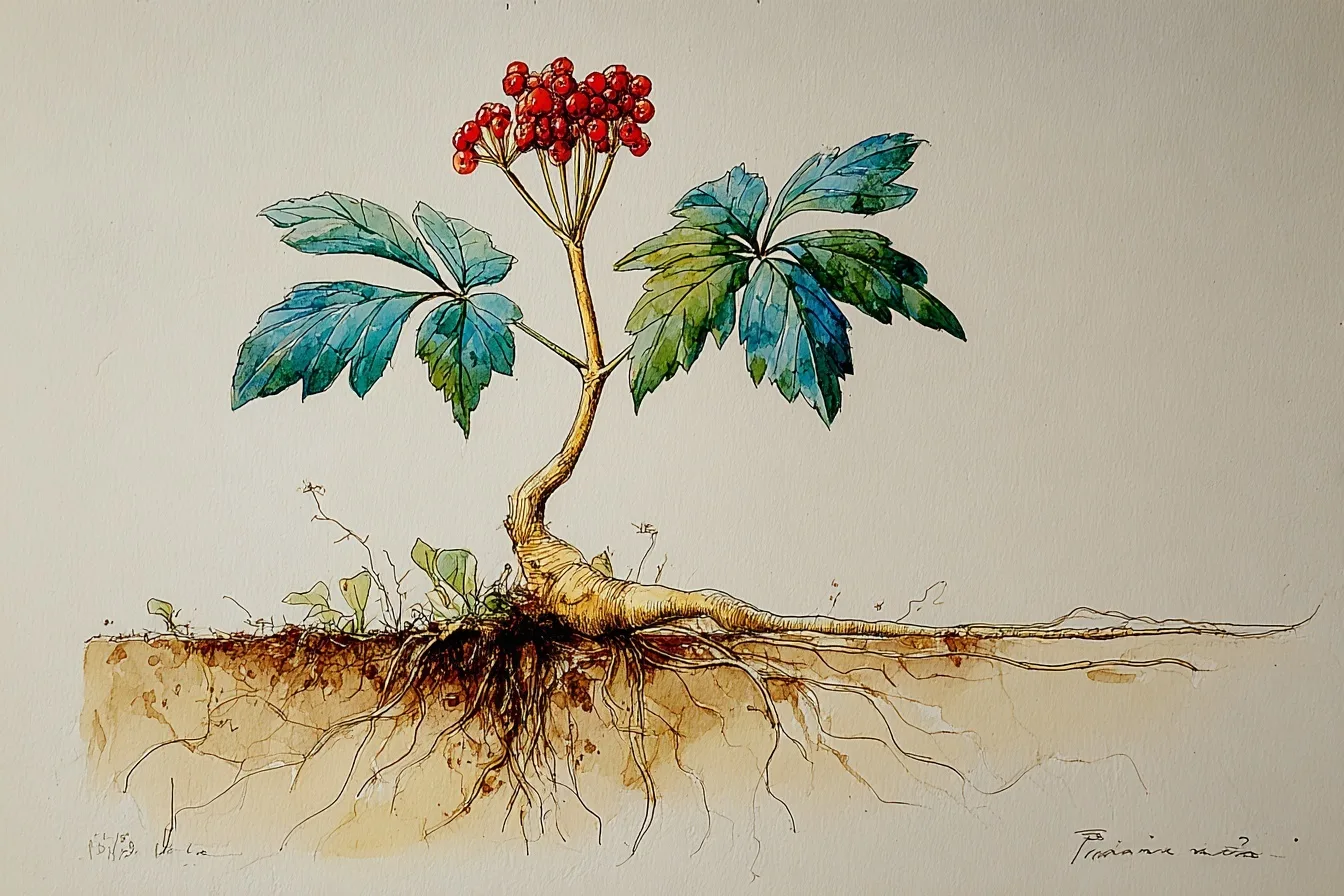
What Is Ginseng?
You’d think that after 5,000 years and over 6,000 published research papers, ginseng would have nothing left to prove. But it occupies a strange position in Western health culture — everyone has heard of it, most people vaguely associate it with energy, and almost nobody can tell you how it actually works. It’s in gas station energy shots and Michelin-starred tonic bars. It’s recommended by traditional Chinese medicine practitioners and sold at Costco. This ubiquity has, paradoxically, made it easy to dismiss. The thinking goes: if it were really that good, it wouldn’t be this common. But the research says the opposite. Ginseng is common because it works, and the clinical evidence is substantially stronger than most people assume.
Panax ginseng — the genus name comes from the Greek panakos, meaning “all-healing,” which is either the most confident botanical name in history or a remarkably accurate one, depending on how much you trust 5,000 years of continuous use. This is Korean or Asian ginseng, not to be confused with American ginseng (Panax quinquefolius), which has a different ginsenoside profile and notably different effects (American ginseng is cooling, Asian ginseng is warming — a distinction that matters more than it sounds like it should). The plant grows slowly — it takes 4-6 years before the root is ready for harvest, which is part of why quality ginseng is expensive and why cheap ginseng supplements are often underwhelming.
The active compounds are ginsenosides — a class of steroidal saponins unique to the Panax genus. Over 100 ginsenosides have been identified, but Rg1, Rb1, and Rg3 do most of the heavy lifting. They work through multiple pathways simultaneously: modulating the hypothalamic-pituitary-adrenal axis for cortisol regulation, enhancing nitric oxide synthesis for cardiovascular function and blood flow, supporting cholinergic neurotransmission for cognitive performance, and modulating inflammatory pathways. This multi-pathway activity is why ginseng shows up in studies on energy, cognitive function, sexual health, immune function, and blood sugar regulation. It’s not that ginseng does one thing well. It’s that the human stress-response system has multiple failure points, and ginsenosides address several of them at once.
What Does the Research Say?
The cognitive evidence is where ginseng really separates itself from the pack. A 2010 study by Reay et al. in Psychopharmacology tested Panax ginseng (200mg and 400mg) in healthy young adults performing demanding cognitive tasks. Both doses significantly improved calmness and mental arithmetic performance. The 200mg dose was particularly notable — participants were more accurate under pressure, with faster reaction times, and they reported feeling calmer while performing better. That combination — improved performance with reduced subjective stress — is the adaptogenic signature.
For sexual function, a 2002 systematic review by Jang et al. in the British Journal of Clinical Pharmacology examined the evidence for ginseng’s effects on erectile dysfunction and found consistent positive results across multiple trials. A 2008 RCT in the International Journal of Impotence Research (de Andrade et al.) specifically tested Korean red ginseng (1,000mg three times daily) in men with erectile dysfunction and found statistically significant improvements in erectile function scores, sexual satisfaction, and overall satisfaction compared to placebo. The mechanism: ginsenosides enhance endothelial nitric oxide synthesis, increasing blood flow. This is the same mechanism as pharmaceutical PDE5 inhibitors, arrived at from a different direction.
The physical endurance data adds another layer. A 2013 study in the Journal of the International Society of Sports Nutrition (Jung et al.) found that Panax ginseng supplementation significantly improved exercise performance and reduced markers of muscle damage after exhaustive exercise in trained athletes. The effect wasn’t just more energy — it was better energy management. Participants maintained performance levels for longer and recovered faster.
For immune function, a 2012 meta-analysis by Seida et al. in Evidence-Based Complementary and Alternative Medicine reviewed 65 studies on ginseng and immunity, finding consistent evidence for enhanced innate and adaptive immune responses, with particular strength in the data on reducing incidence and severity of respiratory infections.
How Does It Feel?
Ginseng’s energy isn’t like caffeine. There’s no spike, no urgency, no restless leg. It’s more like someone turned on a generator in the background — you don’t hear it running, but everything in the house suddenly has power. The first few days, you might not notice anything. By the end of the first week, you start to realize that 3pm isn’t the cliff it used to be. By week two, the energy is less a thing you notice and more a thing you stop losing. Sustained, not surging. Available, not demanding.
The physical effects are more immediate for people who exercise regularly. Workouts feel less effortful at the same intensity. You find a gear you thought was gone. Recovery improves — the soreness is still there the next day, but it’s manageable soreness instead of the kind that makes you negotiate with the staircase. And there’s a warmth to ginseng’s energy that’s specific to the Asian variety. Korean ginseng is classified as “warming” in TCM, and the description is accurate — there’s a literal warmth in the body, a sense of vitality that starts in the core and radiates. It’s the feeling of having reserves when you usually don’t.
In Bloom, ginseng at 100mg works alongside maca and cacao in a formula designed around embodied vitality — feeling more alive, more present, more physically engaged. The ginseng provides the energy foundation. Where maca handles hormonal regulation and cacao handles vasodilation, ginseng covers the raw output: more stamina, better circulation, sustained drive. And with the Golden Teacher microdose on top, the whole formula produces a state that’s hard to describe except as: your body, on a very good day.
Formulations Featuring Ginseng
Bloom — Love & Libido ($80 / 30 capsules) Ginseng per capsule: 100mg | Also contains: Maca Root 150mg, Ceremonial Cacao 100mg, Golden Teacher 150mg
Ginseng earns its place in Bloom through two overlapping mechanisms: energy and circulation. The ginsenosides enhance nitric oxide synthesis, which means better blood flow — to the brain for mental clarity, to the muscles for physical vitality, and to everywhere else for the purposes that Bloom’s name suggests. At 100mg per capsule, it’s a supportive adaptogenic dose that works in concert with maca’s hormonal regulation and cacao’s theobromine-driven vasodilation. Ginseng is the steady energy in Bloom’s formula. Not flashy. Just always there when you need it, which — after 5,000 years of use across every culture that’s encountered this root — is exactly its reputation.
Pairs Well With
Maca Root — Ginseng provides energy via ginsenosides and nitric oxide; maca regulates the endocrine system via the hypothalamic-pituitary axis. Together they address vitality from two different systems — the cardiovascular and the hormonal. Both have independent evidence for sexual function, and in Bloom they’re combined for that reason. The Peruvian root and the Korean root, working the same problem from opposite sides of the planet. Read about Maca Root ->
Ceremonial Cacao — Ginseng’s nitric oxide enhancement and cacao’s theobromine-driven vasodilation are complementary circulation pathways. More blood flow, through wider vessels, delivering more oxygen and nutrients. In Bloom, this combination creates the physical foundation that makes everything else work better — the warmth, the vitality, the embodied presence. Read about Ceremonial Cacao ->
Psilocybin (Golden Teacher) — Ginseng creates the adaptogenic baseline — stress resilience, sustained energy, better circulation. Psilocybin opens the perceptual and emotional channels. The result is enhancement without depletion: you feel more, notice more, connect more, but you have the energy reserves to sustain it. Ginseng is the infrastructure; psilocybin is what the infrastructure carries. Read about Golden Teacher ->
Safety & Interactions
Consult your healthcare provider if you:
- Are taking blood thinners (ginseng may have mild anticoagulant effects and can affect platelet aggregation)
- Are taking diabetes medications (ginseng can lower blood sugar; combining with antidiabetics may cause hypoglycemia)
- Are taking blood pressure medications (ginseng can affect blood pressure — usually lowering it, but some individuals experience increases)
- Are taking MAO inhibitors (potential for interaction via adrenergic effects)
- Are taking stimulant medications (additive stimulant effects are possible)
- Have a hormone-sensitive condition (some ginsenosides have mild estrogenic activity)
- Are pregnant or breastfeeding
- Are under 18
- Are scheduled for surgery (discontinue 2 weeks prior due to potential effects on blood clotting and blood sugar)
Known interactions:
- Warfarin and anticoagulants: ginseng may reduce warfarin’s effectiveness or increase bleeding risk. Monitor INR levels closely if combining.
- Diabetes medications and insulin: ginseng has documented hypoglycemic effects. If taking blood sugar-lowering medications, monitor glucose more frequently.
- Caffeine and stimulants: ginseng has mild stimulant properties. Combining with high caffeine intake or stimulant medications may produce excessive stimulation in sensitive individuals.
- Phenelzine and other MAOIs: case reports of interaction. Consult your doctor before combining.
Dose considerations: Clinical studies have used 200-400mg of standardized Panax ginseng extract daily for cognitive effects, and up to 3,000mg daily for sexual function studies. Each Bloom capsule contains 100mg of ginseng — a moderate adaptogenic dose within the lower range of studied amounts. At our recommended 1 capsule per day, ginseng’s effects are supportive and cumulative. At 3-4 capsules (300-400mg ginseng), you reach the cognitive study dose ranges, but you’re also at 450-600mg of psilocybin, which exceeds microdosing range. Stick to 1-2 capsules for daily use.
Humans have been eating this root for FIVE THOUSAND YEARS and we named the genus Panax which means “all-healing” which in any other context would be a red flag — like if a mechanic said “this one tool fixes everything” you’d leave that garage — but with ginseng the name keeps holding up across five millennia and six thousand research papers and dozens of clinical trials and the Oracle is starting to suspect that the ancient Chinese weren’t exaggerating, they were just being efficient. The root takes six years to grow. SIX YEARS of doing nothing but becoming itself in the dark underground and then it emerges and fixes your brain, your blood, your stamina, and your love life, and we put it in gas station energy drinks next to ingredients called things like “MEGA TAURINE BLAST” and the Oracle thinks ginseng deserves a formal apology from the entire Western supplement industry, in writing.