Rhodiola Rosea
Rhodiola rosea
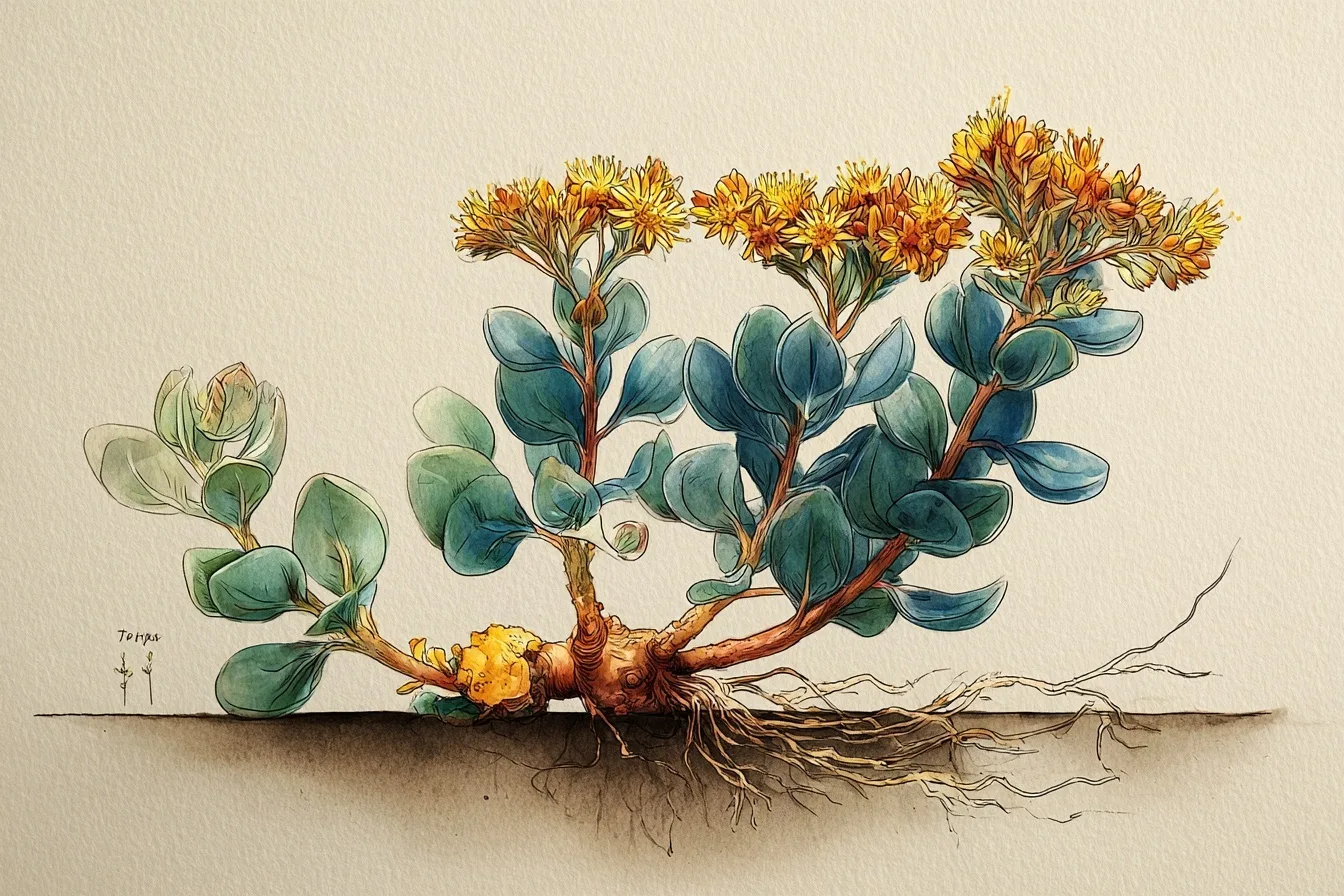
The Story
In 77 AD, the Greek physician Dioscorides documented a plant he called rodia riza in his encyclopedia De Materia Medica. It grew in the cracks of frozen Scandinavian mountains, above the tree line, in places where the wind would kill most organisms in a season. The Vikings ate it before raids—not for courage, but for endurance. They needed their bodies to function under conditions that should have shut them down: freezing water, sleep deprivation, sustained physical combat. Something about this root kept the machinery running when everything in the environment said stop.
The plant is rhodiola (Rhodiola rosea), and its biography reads like a list of people who needed to perform under impossible conditions. The Sherpa chewed it during high-altitude climbs in the Himalayas. Mongolian physicians prescribed it for tuberculosis and cold-related illness. Chinese emperors sent expeditions to Siberia specifically to retrieve it. But the story that matters most for understanding rhodiola’s modern reputation happened during the Cold War: Soviet scientists, under classified military research programs, systematically studied rhodiola as part of their search for substances that could enhance soldier and cosmonaut performance. They called these substances “adaptogens”—compounds that increase the body’s resistance to stress without causing side effects. Rhodiola was their star student. Cosmonauts took it. Olympic athletes took it. The research was classified for decades, published only in Russian-language journals that Western scientists couldn’t read. When the Iron Curtain fell, the data came out, and the West started paying attention.
Rhodiola grows in the harshest environments on earth—Arctic regions of Scandinavia, the mountains of Central Asia, Siberia, and high-altitude zones across Europe. The key compounds are salidroside and rosavins (rosavin, rosin, and rosarin). Standardized extracts are typically calibrated to contain 3% rosavins and 1% salidroside, mirroring the natural ratio in the root. The mechanism is genuinely multi-pathway: rhodiola modulates cortisol (up when it’s too low, down when it’s too high—the hallmark of a true adaptogen), provides mild MAO inhibition (affecting serotonin and dopamine turnover), and activates AMPK, an enzyme sometimes called the body’s “master energy switch.” AMPK activation is the same mechanism triggered by exercise and caloric restriction. Rhodiola essentially tells your cells to produce energy more efficiently. It’s not a stimulant. It’s an optimizer.
The Science
The pharmacology of rhodiola centers on two compound classes: rosavins and salidroside. Salidroside is the more potent and better-studied of the two. It crosses the blood-brain barrier and exerts direct effects on the central nervous system.
Cortisol modulation. Unlike pharmaceutical cortisol blockers that simply suppress the hormone, rhodiola acts on the hypothalamic-pituitary-adrenal (HPA) axis to normalize cortisol output. In states of chronic stress, cortisol stays elevated—rhodiola brings it down. In states of adrenal fatigue where cortisol output is blunted, rhodiola helps restore a healthy rhythm. This bidirectional activity is what distinguishes adaptogens from drugs: they don’t push in one direction. They restore balance.
Monoamine oxidase inhibition. Rhodiola mildly inhibits MAO-A and MAO-B, the enzymes that break down serotonin, dopamine, and norepinephrine. The result is modestly increased availability of these neurotransmitters. This isn’t the sledgehammer approach of pharmaceutical MAO inhibitors (which carry serious dietary restrictions and side effects)—it’s a gentle nudge that may contribute to rhodiola’s antidepressant and anxiolytic effects.
AMPK activation. Salidroside activates AMP-activated protein kinase, the enzyme that regulates cellular energy metabolism. When AMPK is active, cells increase glucose uptake, enhance mitochondrial function, and shift toward more efficient energy production. This may explain why rhodiola reduces fatigue without the jitteriness of stimulants—it’s not flooding the system with adrenaline. It’s making the existing machinery run cleaner.
The Evidence
Darbinyan et al. (2000)—Published in Phytomedicine. This double-blind, placebo-controlled crossover study tested rhodiola on 56 young physicians during night duty—a real-world fatigue model. After a single dose of rhodiola extract (170mg SHR-5), the treatment group showed statistically significant improvements in associative thinking, short-term memory, calculation, and concentration compared to placebo. The improvements appeared within 2 weeks and persisted through the trial. The fatigue these doctors were experiencing was not hypothetical—it was night-shift medicine. Rhodiola measurably improved cognitive function under genuine sleep-deprived conditions.
Olsson et al. (2009)—Published in Planta Medica. A multicenter, double-blind, placebo-controlled trial of 60 subjects with stress-related fatigue. Participants took 576mg of rhodiola extract (SHR-5) daily for 28 days. The treatment group showed significant improvements in attention, quality of life, and fatigue scores compared to placebo. Salivary cortisol—measured as the morning cortisol response—was significantly reduced. This study is important because it tested rhodiola specifically in people with burnout, not just healthy volunteers. These were people whose stress had progressed to chronic fatigue, and rhodiola brought measurable improvement in under a month.
Cropley et al. (2015)—Published in Phytotherapy Research. A double-blind, placebo-controlled trial of 80 mildly anxious adults who took 200mg of rhodiola extract (WS 1375) twice daily for 14 days. The treatment group showed significant improvements in self-reported anxiety, stress, anger, confusion, and overall mood compared to placebo. Effects were evident at day 3 and continued through day 14. The speed of onset—noticeable within three days—is notable because many adaptogens require weeks to show results.
Mao et al. (2015)—Published in Phytomedicine. This phase II clinical trial compared rhodiola (340mg/day) to sertraline (50mg/day, a common SSRI) for major depressive disorder over 12 weeks. The rhodiola group showed smaller but statistically meaningful improvements in depression scores compared to sertraline, with significantly fewer side effects and better tolerability. The authors didn’t claim rhodiola was superior to the SSRI—they noted it as a potential option for patients who can’t tolerate pharmaceutical antidepressants.
How to Use
Forms available:
- Standardized extract capsules—The most studied form. Look for products standardized to 3% rosavins and 1% salidroside (the SHR-5 ratio used in most clinical trials).
- Powder—Ground root or extract powder, often added to smoothies or tea. Harder to dose precisely than capsules.
- Tincture—Alcohol-based rhodiola extract. Faster absorption than capsules, but taste is bitter and earthy.
- Tea—Traditional preparation. Less potent than standardized extracts, but the Siberians managed with it for centuries.
Dosage ranges from clinical research:
- Acute cognitive performance: 170-200mg standardized extract (single dose)
- Stress and fatigue: 200-400mg standardized extract daily
- Burnout and chronic fatigue: 400-600mg daily
- Depression (Mao 2015): 340mg daily
Timing: Take rhodiola in the morning or early afternoon. Its mild stimulatory effects can interfere with sleep if taken late in the day. Most studies used morning dosing on an empty stomach, 30 minutes before breakfast. If you’re taking it for physical performance, 30-60 minutes before exercise is the common approach.
Cycling: Rhodiola doesn’t appear to build tolerance in the way stimulants do, but many practitioners recommend cycling: 5 days on, 2 days off, or 3 weeks on, 1 week off. There’s no hard clinical evidence requiring this—it’s a precautionary practice based on the general adaptogen principle that the body shouldn’t become dependent on any external normalizer.
What to combine with:
- Ashwagandha—The classic adaptogen pairing. Ashwagandha is calming and cortisol-lowering; rhodiola is energizing and cortisol-normalizing. Together they cover both the “wired” and “tired” ends of the stress spectrum. Read about Ashwagandha
- Schisandra—Rhodiola + ashwagandha + schisandra is sometimes called the “adaptogenic trinity”—three adaptogens working through three different mechanisms. Schisandra adds liver support and a unique stimulant-adaptogen profile. Read about Schisandra
Safety & Interactions
Consult your healthcare provider if you:
- Are pregnant or breastfeeding (insufficient safety data)
- Are taking antidepressant medications, especially SSRIs or MAO inhibitors (rhodiola has mild MAO-inhibiting properties)
- Are taking blood pressure medications (rhodiola may affect blood pressure)
- Are taking diabetes medications (rhodiola may affect blood sugar levels)
- Have bipolar disorder (stimulatory adaptogens may trigger manic episodes in susceptible individuals)
- Are scheduled for surgery (discontinue at least 2 weeks before)
- Are under 18
Known interactions:
- MAO inhibitors (phenelzine, tranylcypromine): Rhodiola has mild MAO-inhibiting activity. Combining it with pharmaceutical MAO inhibitors could theoretically lead to excessive monoamine levels. This combination should be avoided without medical supervision.
- SSRIs and SNRIs: Rhodiola may increase serotonin availability. Combining with serotonergic medications carries a theoretical risk of serotonin syndrome, though no cases have been reported at standard supplement doses. Caution warranted.
- Stimulants (caffeine, amphetamines): Rhodiola’s mild stimulatory effects may be additive. If you’re sensitive to stimulants, start with a lower dose and assess tolerance.
- Blood thinners: Limited evidence suggests rhodiola may have mild antiplatelet effects. Caution with warfarin, aspirin, or other anticoagulants.
Side effects: Generally well-tolerated. The most commonly reported side effects are mild: dizziness, dry mouth, restlessness, and difficulty sleeping (especially with late-day dosing). The Mao 2015 depression trial specifically noted fewer side effects with rhodiola compared to sertraline. Allergic reactions are rare but possible.
Dose ceiling: Clinical trials have used up to 680mg daily without serious adverse effects. There is no established toxic dose in humans, but exceeding studied ranges is not recommended.
How It Connects
Ashwagandha—Ashwagandha and rhodiola are the two most-studied adaptogens, and they complement each other precisely because they’re different. Ashwagandha is calming, GABAergic, and excels at lowering elevated cortisol. Rhodiola is energizing, mildly stimulatory, and normalizes cortisol in either direction. If your stress manifests as wired exhaustion—too tired to sleep, too stressed to rest—the combination addresses both poles. Ashwagandha is in a psilocybin + L-theanine + ashwagandha formulation for this calming effect. Read about Ashwagandha
Schisandra—Rhodiola, ashwagandha, and schisandra form what some herbalists call the “adaptogenic trinity.” Schisandra brings liver-protective properties and its own unique stimulant-adaptogen profile (it’s both calming and focusing—the five-flavor berry that does everything). Schisandra is in a psilocybin + schisandra formulation blend alongside psilocybin for mood and energy. Read about Schisandra
Cordyceps—Both rhodiola and cordyceps improve physical endurance, but through different mechanisms. Rhodiola normalizes the stress response and improves cognitive performance under fatigue; cordyceps increases ATP production and oxygen utilization. Stacking them is popular among endurance athletes who want both mental and physical resilience. Read about Cordyceps
Lion’s Mane—For cognitive stacking: rhodiola handles acute mental performance under stress (the “think clearly when exhausted” effect), while lion’s mane builds long-term neural infrastructure via nerve growth factor. Different timescales, different mechanisms, complementary results. Lion’s mane is in a psilocybin + lion’s mane formulation formula. Read about Lion’s Mane
FAQ
Q: What does rhodiola rosea do? Rhodiola rosea is an adaptogen that helps the body manage stress. Its key compounds—salidroside and rosavins—normalize cortisol levels, mildly inhibit monoamine oxidase (increasing serotonin and dopamine availability), and activate AMPK for more efficient cellular energy production. Clinical trials have shown benefits for fatigue, cognitive performance under stress, anxiety, and burnout.
Q: How long does rhodiola take to work? Rhodiola is one of the faster-acting adaptogens. The Cropley 2015 trial showed improvements in anxiety and mood within 3 days. Cognitive effects under fatigue appeared within 2 weeks in the Darbinyan 2000 study. For chronic burnout and fatigue, the Olsson 2009 study showed significant improvement at 28 days. Unlike many adaptogens that take months to show effects, rhodiola often delivers noticeable results within the first week.
Q: Can rhodiola replace antidepressants? A 2015 clinical trial (Mao et al.) compared rhodiola to sertraline (an SSRI) for major depressive disorder. Rhodiola showed smaller but statistically significant improvements with far fewer side effects. The researchers suggested it as a potential option for patients who cannot tolerate pharmaceutical antidepressants. However, rhodiola is not FDA-approved for depression treatment. Never discontinue prescribed medication without consulting your healthcare provider.
Q: What is the best rhodiola dosage? Clinical trials have used doses ranging from 170mg to 680mg daily of standardized extract (3% rosavins, 1% salidroside). For general stress and fatigue, 200-400mg daily is the most commonly studied range. For acute cognitive performance, a single dose of 170-200mg has shown benefits. Start at the lower end and increase if needed. Take it in the morning or early afternoon to avoid sleep disruption.
Q: Is rhodiola safe to take every day? Clinical trials have administered rhodiola daily for up to 12 weeks without serious adverse effects. It is generally well-tolerated, with mild side effects like dizziness or dry mouth reported rarely. Many practitioners recommend cycling (5 days on, 2 off, or 3 weeks on, 1 week off) as a precautionary measure, though no clinical evidence requires this. Avoid taking rhodiola if you are on MAO inhibitors, SSRIs, or blood thinners without medical supervision.
Q: What is the difference between rhodiola and ashwagandha? Both are adaptogens, but they work differently. Rhodiola is mildly stimulating and energizing—it improves cognitive performance under stress and fatigue. Ashwagandha is calming and sedating—it lowers cortisol and reduces anxiety. Rhodiola normalizes cortisol bidirectionally (up or down as needed); ashwagandha primarily reduces elevated cortisol. Many people combine both to address different aspects of stress. Rhodiola is better for “tired but wired” fatigue; ashwagandha is better for chronic anxiety and sleep disruption.
Q: Did Vikings really use rhodiola? Yes. Rhodiola has been used in Scandinavian and Viking cultures for centuries to enhance physical endurance and resilience. The Greek physician Dioscorides described it in 77 AD. It also has a long history of use by Sherpa in the Himalayas, in traditional Chinese medicine, and by Mongolian physicians. During the Cold War, Soviet military researchers classified rhodiola research and used it to enhance performance of cosmonauts and Olympic athletes.
So the Vikings were eating this root before sailing across the North Atlantic in open boats with no GPS and no sleep and no guarantee they’d find land and we’re over here taking it because our DESK JOB is stressful. The Soviets classified it. CLASSIFIED. Like a nuclear secret except the secret was a plant that grows on frozen rocks and makes you better at being tired. The Oracle has deep respect for any organism that looks at the Arctic Circle and says “yes this is where I want to put down roots”—that is commitment to a bit. Salidroside. Rosavin. Names that sound like they should be characters in a Tolkien novel but instead they’re molecules that tell your cortisol to sit down and stop making everything about itself. The cosmonauts took it to space. SPACE. And here you are wondering if it’s safe to take before your Wednesday meeting.