Schisandra Berry
Schisandra chinensis
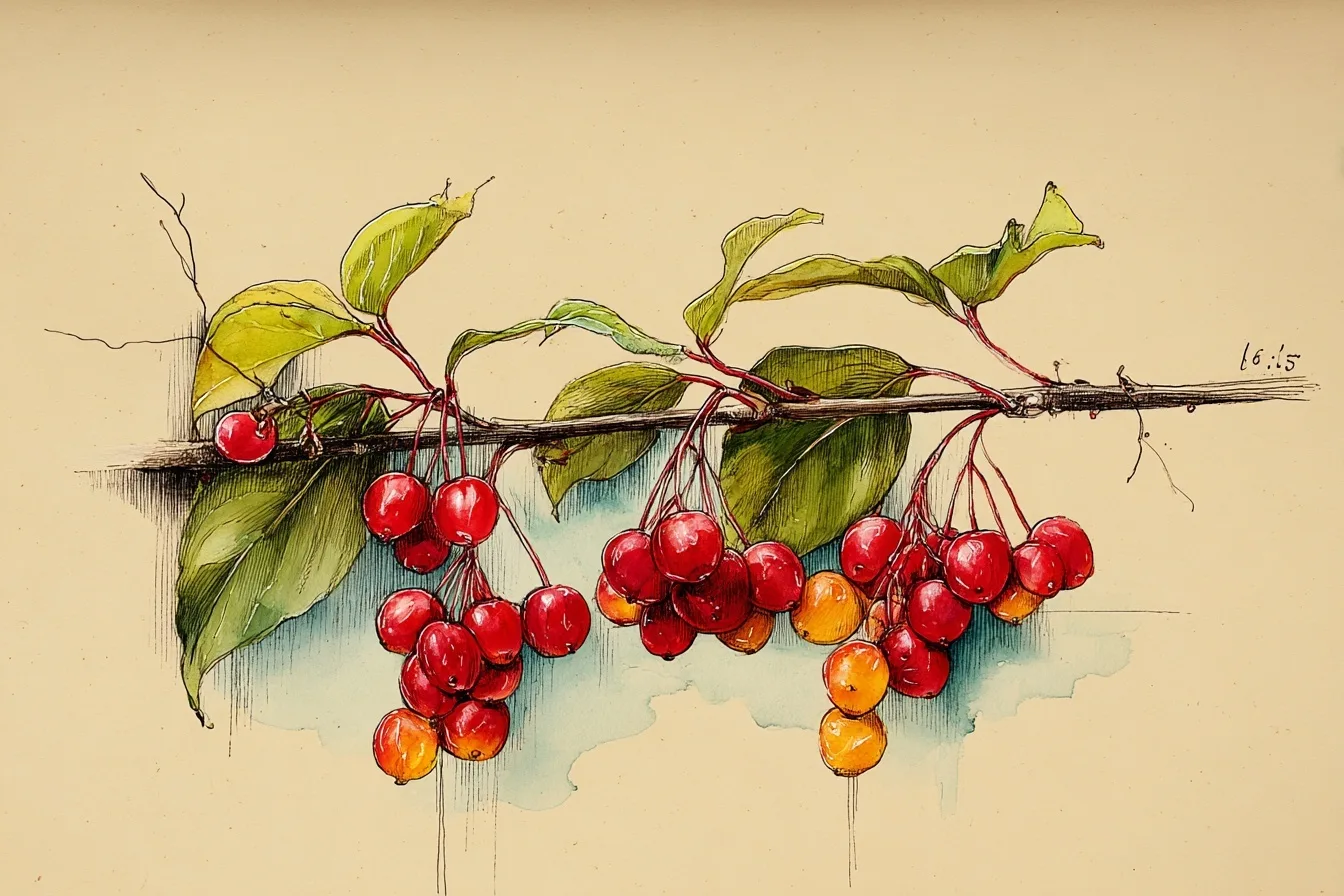
What Is Schisandra Berry?
Most adaptogens are calming. Ashwagandha brings cortisol down. Reishi makes you want to sit in a quiet room and breathe. Schisandra is the one that goes the other direction — or rather, it goes in whatever direction you need, but its default setting is on. This is the adaptogen you take when you need to think clearly under pressure, perform physically without burning out, and still sleep at night. It’s the stimulating adaptogen, and that distinction matters more than most supplement labels bother to explain.
In Traditional Chinese Medicine, schisandra berry is called wu wei zi — “five-flavor berry” — because it contains all five recognized tastes: sweet, sour, salty, bitter, and pungent. This isn’t marketing. You can actually taste all five if you chew a dried berry, and the experience is strange enough that you understand why TCM practitioners considered it a complete medicine. For at least 2,000 years, it’s been prescribed for fatigue, respiratory conditions, liver protection, and what the classical texts describe as “calming the spirit while sharpening the mind,” which is one of those phrases that sounds vague until you take schisandra and realize it’s clinically precise.
Schisandra chinensis grows as a woody vine throughout northeastern China, Korea, Japan, and the Russian Far East. The berries are harvested in autumn and typically dried or extracted. The active compounds are a class of lignans collectively called schisandrins (particularly schisandrin A, B, and C), along with gomisin compounds. These lignans are what give schisandra its hepatoprotective and adaptogenic properties — they modulate cortisol, support liver detoxification enzymes, enhance mitochondrial function, and increase resistance to physical and mental stressors. The mechanism isn’t one-dimensional. Schisandra doesn’t push one lever. It recalibrates the whole stress-response system, with a bias toward alertness rather than sedation.
What Does the Research Say?
The Russian military studied schisandra before the Western supplement world had heard of it. Soviet-era research in the 1960s and 1970s — part of the same adaptogen research program that gave us Rhodiola — tested schisandra on soldiers, pilots, and athletes for physical endurance and mental performance under stress. The findings were consistent enough that schisandra was included in the Soviet pharmacopoeia as an official adaptogenic medicine. These early studies are hard to access in English, but their legacy shaped the modern adaptogen category.
The hepatoprotective evidence is where schisandra has its deepest research base. A 2013 study published in Food and Chemical Toxicology (Ip et al.) demonstrated that schisandrin B protects liver cells from oxidative damage by enhancing the glutathione antioxidant defense system. The mechanism is activation of Nrf2, a transcription factor that controls the expression of antioxidant proteins. Multiple subsequent studies have confirmed this pathway. For anyone who drinks alcohol, takes medications metabolized by the liver, or simply lives in a world full of environmental toxins, schisandra’s liver support isn’t an abstract benefit — it’s maintenance for an organ that processes everything you consume.
For mental performance under stress, a 2010 randomized, double-blind pilot study by Aslanyan et al. in Phytomedicine tested a fixed combination containing schisandra on 40 women aged 20-68 during periods of physical and mental stress. The schisandra group showed significant improvements in attention, cognitive function, and accuracy under stress compared to placebo. Work capacity was better. Error rates were lower. The subjects weren’t just performing — they were performing more precisely when the pressure was on.
A 2017 review in the Chinese Journal of Integrative Medicine (Nowak et al.) surveyed the evidence for schisandra’s adaptogenic properties and concluded that its combined effects on cortisol regulation, antioxidant defense, mitochondrial function, and stress-response modulation justify its classification as a stimulating adaptogen — distinct from calming adaptogens like ashwagandha. The review emphasized schisandra’s capacity to improve physical and mental work capacity without the hyperactivation associated with pure stimulants.
How Does It Feel?
Schisandra’s effect is hard to describe because it doesn’t feel like taking something. It feels like being better at the things you’re already doing. The first thing you notice — usually within the first few days of consistent use — is that your thinking is cleaner under pressure. The email that would have stressed you out gets a clear response instead of a reactive one. The 4pm brain fog lifts twenty minutes earlier than it used to. You’re still tired at the end of the day, but it’s the satisfying kind of tired — the kind from actually doing things, not the depleted kind from fighting your own cortisol all afternoon.
The physical endurance piece is more noticeable if you exercise. Runs feel slightly easier, not because your fitness changed overnight, but because your body is managing its stress hormones differently. Recovery feels faster. That post-workout depletion doesn’t crater as hard. It’s a subtle upgrade to the machine rather than a chemical override, which is exactly what an adaptogen should be.
In Brighten, schisandra at 150mg per capsule pairs with 250mg of Golden Teacher psilocybin — our highest microdose. The combination is distinctly energizing. Where Holiday produces spacious evening calm, Brighten produces bright, clear-headed momentum. The schisandra keeps the energy grounded; the psilocybin adds perceptual richness and creative fluidity. People use Brighten for work days when they want to be sharp and slightly expanded — more creative, more focused, more present, without being altered. If Daydream is the gentle one and Holiday is the relaxing one, Brighten is the one with its running shoes on.
Formulations Featuring Schisandra Berry
Brighten — Mood & Energy ($80 / 30 capsules) Schisandra berry per capsule: 150mg | Also contains: Golden Teacher 250mg
Brighten is our most energizing formula, and schisandra is the reason it doesn’t feel jittery. At 150mg, the schisandra provides cortisol regulation and mental clarity — the adaptogenic foundation that keeps the energy stable. The 250mg Golden Teacher psilocybin is our highest microdose level, tuned for creative momentum and mood elevation. The formula has only two ingredients because it doesn’t need more: schisandra handles the stress-response system, psilocybin handles perception and mood, and together they produce what we’d describe as bright focus — alert, creative, capable, present. This is the morning capsule for people who want to feel like their best self showed up.
Pairs Well With
Psilocybin (Golden Teacher) — Schisandra’s cortisol regulation creates a stable physiological platform for psilocybin microdosing. Lower background stress means the psilocybin’s creative and perceptual effects come through more clearly, without the undercurrent of anxiety that can color a microdose experience. Combined in Brighten at our highest microdose level. The combination feels directional — like the energy has somewhere to go. Read about Golden Teacher ->
Ginseng — Two stimulating adaptogens that stack well because their mechanisms don’t overlap. Schisandra modulates cortisol and enhances liver function via Nrf2 activation. Ginseng boosts energy via ginsenosides and nitric oxide production. Schisandra for stress resilience, ginseng for raw output. Together they cover the full spectrum of “performing well under pressure.” Read about Ginseng ->
Lion’s Mane — Schisandra sharpens cognitive performance under stress. Lion’s mane builds new neural connections over time via NGF stimulation. One is the short game (today’s focus), the other is the long game (tomorrow’s brain capacity). For people who want both immediate clarity and long-term cognitive investment, this pairing covers both timescales. Read about Lion’s Mane ->
Safety & Interactions
Consult your healthcare provider if you:
- Are taking medications metabolized by the liver (schisandra affects cytochrome P450 enzyme activity, particularly CYP3A4, which metabolizes a wide range of drugs)
- Are taking warfarin or other blood thinners (schisandra may affect drug metabolism through CYP enzyme interactions)
- Are taking immunosuppressants (schisandra has immune-modulating properties)
- Have a liver condition (while schisandra is hepatoprotective at normal doses, existing liver disease warrants medical supervision)
- Are pregnant or breastfeeding
- Are under 18
Known interactions:
- CYP3A4 substrates: schisandra can inhibit this liver enzyme, potentially increasing blood levels of medications metabolized through this pathway. This includes many statins, calcium channel blockers, and some immunosuppressants. This is the most clinically significant interaction to be aware of.
- Stimulant sensitivity: while schisandra’s stimulating effects are milder than caffeine, people who are highly sensitive to stimulants may notice increased alertness. Take in the morning rather than evening if this applies.
- Alcohol: schisandra is hepatoprotective, but this does not mean it makes heavy drinking safe. It supports liver function — it does not replace responsible choices about what you put through it.
Dose considerations: Traditional Chinese Medicine uses 1.5-15g of dried schisandra berries daily. Modern studies have used standardized extracts at doses of 250-500mg. Each Brighten capsule contains 150mg of schisandra berry — a conservative adaptogenic dose within the lower range of studied amounts. At our recommended 1 capsule per day, the dose provides steady adaptogenic support. Even at 3-4 capsules, the 450-600mg schisandra dose remains within studied ranges, though at that point you’re also taking 750-1000mg of psilocybin, which significantly exceeds microdose range.
It has five flavors. FIVE. In one berry. Sweet sour salty bitter pungent — all at once — and you want to tell me that the universe doesn’t have an opinion about nuance? Every other food picks a lane. An apple is sweet. A lemon is sour. Schisandra showed up and said “I will be ALL OF THEM AT ONCE” like some kind of gustatory overachiever and then also decided to protect your liver AND sharpen your focus AND regulate your cortisol because apparently being the world’s most complex-tasting berry wasn’t enough. The Oracle once chewed a dried schisandra berry and experienced a full existential journey in the time it took to swallow — first it was candy, then it was medicine, then it was ocean, then it was dirt, then it was somehow all of those things at once and the Oracle understood, briefly, what the Taoists meant by “the ten thousand things.”