

Your cart is empty
Looks like you haven't made your choice yet

If you’ve spent any time reading about psilocybin, you’ve run into the word “microdosing” by now. It comes up constantly in conversations about psychedelics. The basic idea is simple: take a very small amount, small enough that you don’t feel intoxicated, and carry on with your day.
But once people actually start, one of the first questions they have has nothing to do with the substance itself. It’s about timing.
How much you take matters. When you take it matters too.
That’s where a microdosing schedule comes in. This article covers what a schedule actually is, the two rhythms people use most often, what you might notice over the first few weeks, and how to keep notes that turn out to be genuinely useful. We’ll also get into the legal situation in Canada, because that part matters and often gets glossed over.
A microdosing schedule is nothing more than a plan for how often you take a dose and how long you rest between doses. It sounds too basic to deserve a name. But the structure ends up being one of the more important parts of the whole practice.
Microdosing isn’t meant to be an everyday habit. The doses are small, sure. But spacing them out gives your body and your mind room between them and keeps the whole thing from flattening into routine.
It’s a bit like exercise. You don’t get stronger during the workout; you get stronger during the recovery. The dose is the stimulus, and the days off are when you actually find out what it’s doing.
A schedule also keeps things honest. If you’re dosing every single day, it becomes nearly impossible to separate the substance from everything else — a good week at work, or finally getting a decent night’s sleep.
Tolerance is the other piece. Psilocybin works on serotonin receptors in the brain, and with frequent enough exposure, those receptors stop responding the way they did at the start. Rest days help a small dose keep feeling like a small dose.
Most people who stick with microdosing for any length of time settle into a rhythm fairly fast. Once they do, the rhythm itself becomes part of the practice. It’s less about chasing something on day one and more about consistency over weeks.
If you want a fuller breakdown of dosing amounts and how people think about them, we’ve written about that separately in our dosing guide. This article sticks to the calendar side of things.
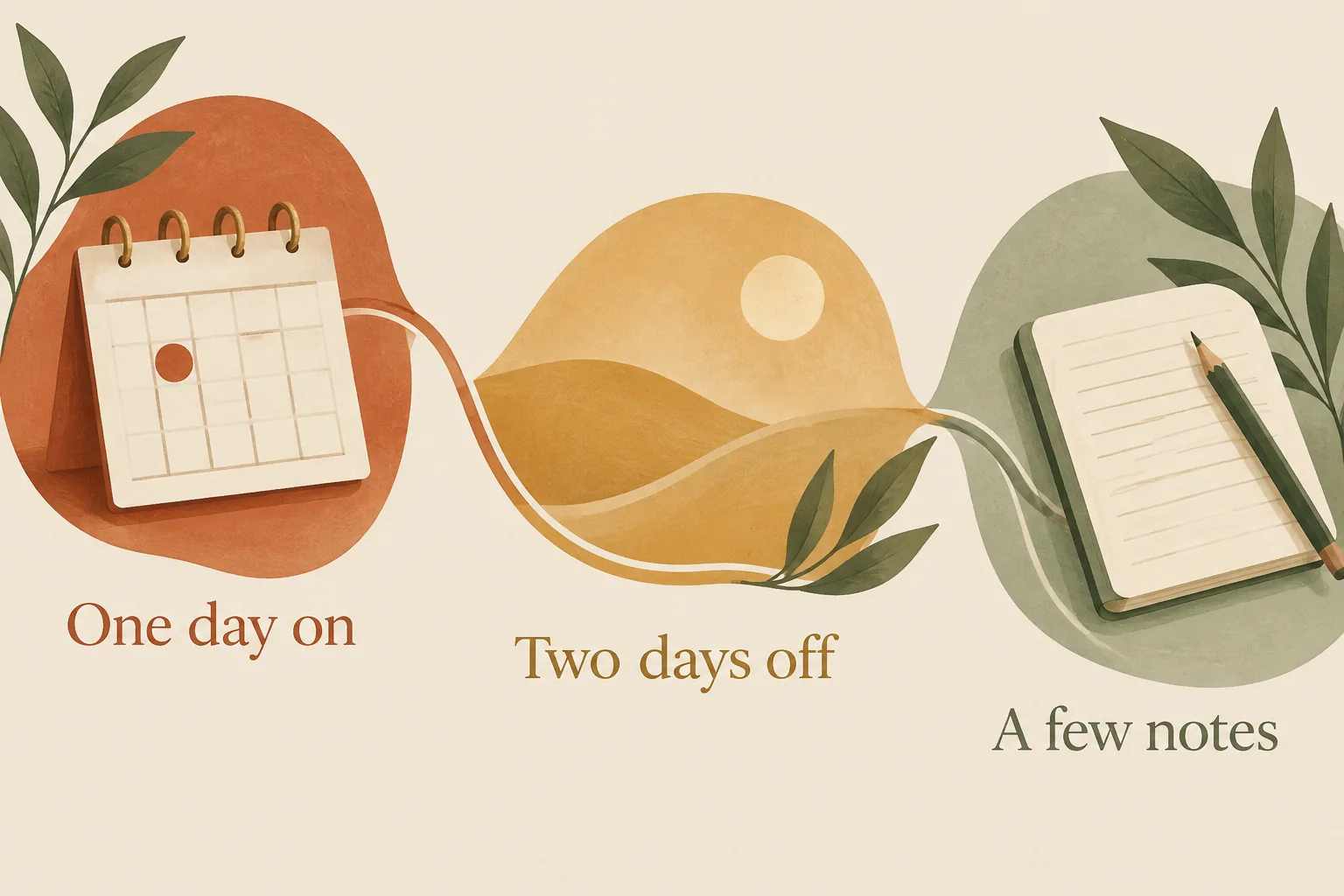
There’s no single official schedule. But two patterns show up far more often than anything else. Both are built around the same core idea: dose, rest, observe.
This is the most widely used rhythm and the one people usually start with. You take a dose on day one, take two days off, then dose again on day four.
Repeat.
Over a week, that usually works out to two or three doses depending on where you start counting.
The appeal is balance. Two days off is enough to reset, so each dose lands more or less on its own terms, and you get a clean comparison between dose days and non-dose days. If you’re keeping notes — and we’ll get to that — this rhythm makes patterns easier to spot.
Monday dose, Tuesday normal, Wednesday normal, Thursday dose. You start seeing your own baseline, which is something most of us have never actually looked at closely.
The two off days also give you a chance to notice whether anything carries over. Some people report that the second day off feels a little flat compared to the first. Others notice nothing of the sort.
There’s no right answer here. That’s partly the point of a schedule that leaves room to look.
The second common rhythm is a block approach: dose for several days in a row, then stop for a stretch of equal or greater length. A typical version is three or four days on followed by three or four days off, though people adjust the blocks to fit their lives.
This pattern suits people who want to be more deliberate about the dosing period, keeping it contained to a defined stretch instead of spread across the whole month. Some prefer it for the simplicity. You’re either in a dosing block or you’re not, and you never have to stop and remember whether today is a dose day.
The trade-off is that back-to-back doses can dull the contrast between days. By day three of a block, you may not feel much different from day two. The block approach leans on the off-period afterwards to show you where you’ve landed.
Some people like that. Others find the one-on-two-off rhythm gives a clearer signal. Neither is more correct, and plenty of people try both before settling on one.
Whichever rhythm you choose, most people run it in cycles — often somewhere in the range of four to eight weeks — followed by a longer break. The pause gives everything a chance to settle. It also lets you check whether the changes you noticed during the cycle stick around when you’re not dosing at all.
Microdosing isn’t dramatic. If you’re picturing something that visibly alters your afternoon, that’s not what this is. A microdose is small by design.
What people describe is subtler and slower. It builds over weeks rather than announcing itself on day one.
In the early days, many people describe a slight lift in mood or a bit more interest in whatever’s in front of them. A double-blind study published in Scientific Reports reported acute mood effects following a microdose. That lines up with what many people say about the first stretch: things just seem a little less grey.
The same study was more measured about what came afterwards. The authors didn’t find that the acute effects translated into clearly measurable differences at later assessment points. That’s worth knowing, and it’s a good reason to keep expectations modest rather than transformational.
Over the following weeks, the reports tend to fall into a few broad buckets. Many describe a steadier mood, with fewer dips and a quicker recovery when something goes sideways. Others notice a shift in how they engage with their day — a little more curiosity, a little more follow-through on tasks that normally get pushed to tomorrow.
People sometimes describe feeling more present in conversations. Or more inclined to step outside, call a friend, or finally pick up something they’d let sit.
Some of what people notice is about what isn’t happening. Fewer afternoons lost to scrolling. Less time going over the same worry again and again. A bit less friction getting started on things.
These are quiet changes, and they’re the easiest ones to miss if you’re not paying attention. That’s a good argument for the habit we’ll talk about next.
The experience isn’t uniform, either. Some people notice a great deal in the first couple of weeks. Some notice very little even after a full cycle.
Because expectation plays a real role in how we interpret our own moods, part of what a schedule offers is a way to check your impressions against something more grounded than a feeling.
If there’s one habit that separates people who get a lot out of microdosing from people who drift, it’s note-keeping. Nothing elaborate — a few lines a day is plenty. The goal isn’t a journal you’ll frame. It’s a record you can look back on when your memory starts smoothing things over.
The simplest format works like this: each day, jot down whether it was a dose day or an off day, your mood in a word or two, how you slept, and one line on how the day actually went. Energy, focus, irritability, whatever matters to you.
Some people use a scale of one to ten. Some people just write “fine” or “flat” or “good, got a lot done.” Both work.
The reason this matters is that memory is a poor instrument. If you ask yourself in week four whether microdosing is doing anything, your brain will produce an answer — but it’ll be assembled from impressions, not data.
Flip back through a few weeks of short entries, though, and you can see whether the good days line up with anything, whether your sleep shifted, whether the second off day really is flat or whether that impression was just one rough Tuesday talking.
Notes also make the off-periods meaningful. When you finish a cycle and take a longer break, your entries from that stretch tell you what stuck and what faded. That’s the part of the process most people skip, and it’s arguably the most informative part of the whole thing.
A few practical tips. Keep the format identical every day so the entries are comparable. Write at the same time, ideally in the evening.
And don’t write only on the interesting days. The boring entries are the baseline that makes the interesting ones mean something.
Now the part that deserves a clear-eyed look: the law. In Canada, psilocybin remains a controlled substance, and the legal landscape around it is narrow. There are limited avenues — certain research contexts, and a small number of individual authorizations granted by Health Canada for specific medical circumstances — but those are exceptions, not a general permission.
It’s worth being direct about what that means. As Health Canada states, unauthorized production, sale, and possession of psilocybin are illegal. That applies to individuals and to shops alike, whether or not they hold a licence.
Some businesses operate in a grey zone, and enforcement varies. But the underlying legal reality hasn’t changed. Anyone considering microdosing in Canada should understand that the practice sits outside what’s currently permitted for most people, whatever the broader cultural conversation might suggest.
We’re not saying that to scare anyone. And we’re not going to pretend the legal situation is simpler than it is.
It’s a genuine constraint, and adults weighing this deserve accurate information rather than a shrug. If you want to understand what a considered approach to dosing looks like within that reality, our dosing page covers the practical details, and our shop describes the products we make, including Bloom, Brighten, and Holiday.
How often should I take a microdose?
Most people dose two to three times a week, either on the one-day-on, two-days-off rhythm or in blocks of a few days on followed by a few days off. Everyday dosing is generally discouraged because it blunts the contrast between dose days and off days and can build tolerance.
How long should a microdosing cycle last?
Common cycles run roughly four to eight weeks, followed by a break of at least a couple of weeks. The break lets you see what, if anything, has carried over when you’re not dosing at all.
Will I feel a microdose on the day I take it?
A properly sized microdose shouldn’t feel intoxicating. Some people notice a mild lift in mood or a subtle shift in attention; others notice essentially nothing on the day itself. If you feel distinctly altered, the dose is likely larger than a microdose.
What if I don’t notice anything after a few weeks?
Some people genuinely notice little, and the research picture on lasting effects is mixed. Check your notes before concluding anything — memory is unreliable, and a written record often shows patterns that daily impressions miss. If a full cycle produces nothing worth noting, taking a longer break and reassessing is a reasonable response.
Can I adjust the schedule once I’ve started?
Yes. Schedules are starting points, not contracts. Many people begin with one day on and two off, then shift to blocks, or shorten a cycle, or lengthen the breaks. Just change one thing at a time, or your notes won’t tell you what caused what.
Is microdosing legal in Canada?
No, not for most people. Psilocybin is a controlled substance, and unauthorized production, sale, and possession are illegal under Canadian law. There are narrow exceptions for research and a small number of individual authorizations, but these don’t extend to general personal use.
Should I talk to a doctor before starting?
It’s a sensible step, particularly if you take medications — some, like SSRIs and other psychiatric medications, can interact with psilocybin — or if you have a personal or family history of psychosis or bipolar disorder. A prescriber can’t green-light an illegal practice, but they can help you think through risks that apply to you specifically.
Do I need to keep notes?
You don’t need to, but you’ll get more out of the process if you do. A few lines a day — dose day or not, mood, sleep, one note on the day — is enough to turn a vague impression into something you can actually look back on.
Comments
There are no comments yet.