
Your cart is empty
Looks like you haven't made your choice yet

You’ve read the same paragraph three times. Somewhere between the second and third attempt, you opened a new tab to look something up, forgot what you were looking for, and came back to a paragraph that hasn’t improved in your absence.
Here’s the most useful thing you can do in the next ten minutes: pick one task, put your phone out of easy reach, and set a timer for a length you can realistically manage.
Twenty minutes, fifteen, even ten. There’s nothing magical about the number.
A small block of attention is far easier to protect than a vague vow to concentrate harder all afternoon.
It’s worth considering that your concentration may not be broken at all. Just interrupted, under-specified or under-rested. That distinction matters, because it points you toward controllable things: the clarity of the task, the environment around you, the state of your body, and what you’re expecting from your own attention on a given day.
This guide walks through those in order: first diagnosing what’s in the way, then building a single workable focus session, then improving the habits around it. A few small, well-chosen changes tend to beat a long list of tips nobody keeps.
“I can’t concentrate” is a bit like telling a mechanic “the car is making a noise.” Accurate, but not yet actionable. The mechanic will want to know when it happens, what it sounds like and what you were doing at the time. Your attention deserves the same courtesy.
Concentration trouble tends to come from one of a few places: a task that’s too vague to start, interruptions from outside, a body that’s tired or under-fuelled, stress competing for mental bandwidth, or an environment full of invitations to do something else.
Sometimes it’s several at once, which is one reason generic advice can feel so useless. It treats all of these as one problem.
Take the vague task. “Work on the report” is a fog; your brain can’t find an edge to grab. “Write the three sentences that open the report’s introduction” is a task with a visible finish line. A lot of what feels like an inability to focus is really an inability to begin, and ambiguity is a classic hiding place for it.
Give it sixty seconds of honest diagnosis before you change anything. Ask yourself:
The answer tells you which of the sections below is yours.
Start there.
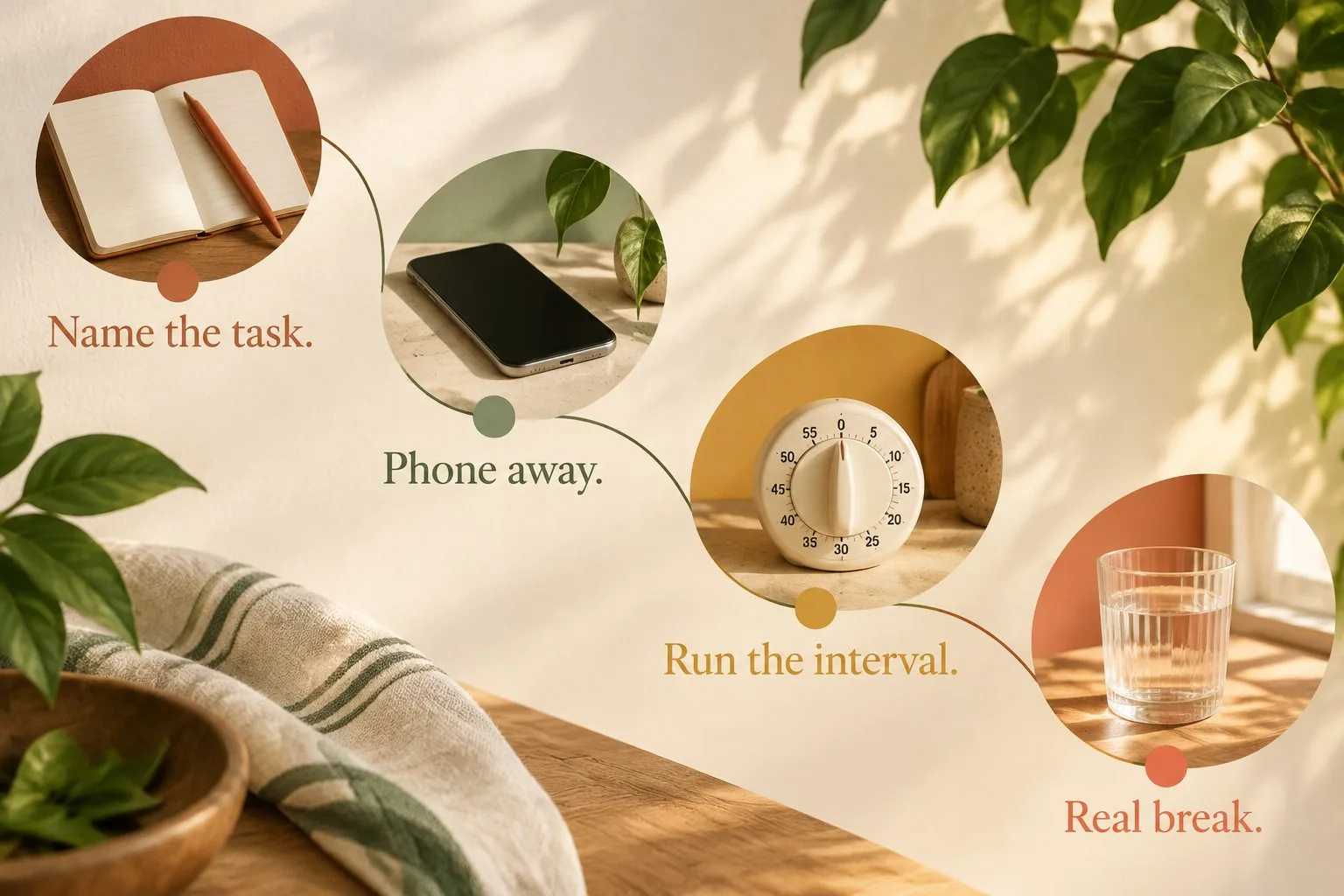
Once you have a guess at the bottleneck, build a session around it. The recipe is deliberately modest: one task, fewer cues, a defined interval, a real break.
Start with the task. Write it down in a form where finishing is observable: “draft the first paragraph,” “reconcile the last three pages of the spreadsheet,” “read one chapter and note three takeaways.” If you can’t tell when you’re done, you can’t tell when you’ve succeeded, and your attention has nothing to aim at.
Next, remove the cues before you start, not mid-session. Willpower is a terrible bouncer; it lets everyone in eventually. The phone goes in another room or a drawer, not face-down on the desk, where it hums with possibility. Unrelated tabs close.
If your browser has become a museum of unfinished intentions, a fresh window with only what you need is a small mercy. If the phone genuinely has to stay, because you’re on call or someone may need to reach you, see the environment section below for a middle path.
Then set your interval. Twenty-five minutes is a common example, and a fine one, but it’s a structure, not a biological law, and there’s no magic number that research has blessed from on high.
Some people do well with forty-five focused minutes and a real break. Others start with ten and build up. Choose the length you’ll keep, and adjust from there.
The reason single-tasking is worth the trouble isn’t folk wisdom. In task-switching experiments, researchers found that alternating between tasks incurs measurable time costs, with the size of the cost depending on how complex the tasks and their rules are. When you bounce between your report, your email and your messages, some of your capacity goes to the bouncing itself, like paying a toll every time you change roads.
That evidence comes from controlled laboratory studies, so treat it as a well-supported reason to try single-tasking rather than a promise of a particular productivity gain. The plain version: switching costs you something, and while you can’t switch to zero, you can probably switch less.
End with a break that is a real break. Standing up, getting water, looking out a window. These let the session end on purpose. A “break” spent scrolling the same phone you exiled is just an interruption you scheduled.
Your environment is negotiating with you constantly, and it has more stamina than you do. The goal isn’t a minimalist monastery. It’s reducing the number of times per hour your surroundings make you an offer.
The phone is the obvious one. Even silenced and face-down, its presence is a standing invitation, a little pocket of maybe-something-interesting.
Moving it out of reach works through friction more than discipline: if checking requires standing up and crossing the room, the impulse has a chance to lose its appeal before you get there.
And some people can’t simply exile the phone. If you’re a caregiver, on call, or expecting a genuinely urgent message, the practical move is to strip it down rather than remove it: turn off every notification except the people or apps that truly need to reach you, and let everything else wait for a scheduled check-in. The aim is fewer invitations, not a rule that ignores your life.
Notifications deserve the same audit generally. Each one is a stranger tapping your shoulder to tell you about a sale. Where you can, batch email into two or three deliberate check-ins instead of a continuous drip, and give the people who genuinely need you immediately a route that bypasses the mute, like a partner’s call or a manager’s page.
Noise and light are personal. Some people focus beautifully in a busy café; others need quiet or a consistent background sound. If your workspace fights you, with glare on the screen, a chair that punishes sitting, or a desk facing the household traffic lane, treat that as part of the focus problem, not a separate aesthetic concern.
And adapt to your own needs. If a standing desk, larger text, noise-cancelling headphones or a different room arrangement makes sustained attention more possible for you, that’s not cheating. The point of the environment is to support the work, whatever shape that support takes.

It’s unfashionable advice because it isn’t quick, but sleep belongs near the top of any honest list of concentration levers. Guidance from the U.S. National Heart, Lung, and Blood Institute is blunt about it: sleep deficiency impairs the ability to focus, learn and react, the exact capacities you’re trying to summon when you concentrate.
The effect also builds up. In a controlled laboratory study of repeated sleep restriction, healthy adults who got too little sleep night after night showed deficits in cognitive performance that accumulated over time.
That was a specific study under specific conditions; it supports the general connection between sleep and attention rather than a universal prescription for a particular number of hours. Still, if your focus is unreliable, protecting your sleep is a sensible place to put effort.
Movement belongs in the same conversation, more modestly. A walk between tasks is an ordinary, low-risk support. Notice what happens for you rather than adopting rituals on faith.

Food and water are the same kind of lever. They will not give you a new personality. They will stop a dumb reason for losing the session.
Eat before the block if you know you fade when you skip a meal. Have water at the desk before you start. If a heavy lunch knocks you out, make the next hard block sit earlier, or make lunch include some protein and something that isn’t only starch and sugar: eggs, yogurt, beans, fish, oats, fruit, nuts. That’s a practical pattern, not a proven brain prescription.
| If this is the pattern | What to try | What you’re looking for |
|---|---|---|
| You skipped eating | Eat before the hard block | Whether the session is easier to start |
| A heavy lunch knocks you flat | A lighter plate with some protein, then the hard work earlier | Whether the afternoon slump moves |
| You get thirsty halfway through | Water at the desk before you begin | Whether you stop getting up for that reason |
| Coffee is the only plan | Shift the last cup earlier for a few days | Whether tonight’s sleep and tomorrow’s focus change |
Caffeine deserves a practical note rather than a lecture. If your afternoon focus craters and you’re several coffees deep by 2 p.m., experiment with shifting your last cup earlier and observe what changes.
That’s an experiment, not a rule. Your own observation is the data that matters here.
Mindfulness gets marketed aggressively as a focus fix, which is a shame, because underneath the hype sits a genuinely small, usable activity: noticing that your attention has wandered, and bringing it back without a ceremony.
A brief meditation practice, at its simplest, looks like this: you sit for five or ten minutes, attend to your breath or your surroundings, and every time you notice you’ve drifted into the grocery list, you return. The noticing-and-returning is the practice.
The drift isn’t failure. It’s part of the activity.
The evidence deserves candour: the U.S. National Center for Complementary and Integrative Health describes research on meditation and mindfulness as mixed in quality, with real limitations in how studies are designed. So treat it as an optional practice to try, not a guaranteed fix for a wandering mind. Whether regular meditation improves your everyday concentration is uncertain, and you’re the only one who can observe what it does for you.
You also don’t need a cushion or an app to practise the noticing part. Mid-paragraph, when you catch yourself composing an unrelated text message in your head, that moment of catching yourself is the same skill in everyday clothes. Whether it improves with practice is an open question, but the noticing itself is available either way.
The habits above are the main work. A microdose is a small amount of psilocybin, meant to stay inside an ordinary day rather than take you out of it. People use one because they want a little more ease getting into the work, or a bit more focus or energy once they’re there. It doesn’t choose the task for you.
If you want to try that route, pick one product that matches the bottleneck. Starting three at once makes it impossible to tell what you’re responding to. Amounts and the usual on-and-off rhythm are on the dosing guide. Read that before you guess.
Motivation is a related problem, and it has its own page. If you can concentrate once you’ve started but can’t get yourself to start, the motivation article is the better next read. This page is for the session itself.
A microdose is a poor match if you need to drive, if you’re in poor form that day, or if you’re hoping it will stand in for sleep. If concentration has been getting worse for weeks, or it’s tangled up with mood, anxiety, or a condition you already know about, talk with a clinician before you treat a capsule as the plan.

Since advice is only useful if you can act on it, here’s a comparison of the approaches covered so far: what each targets, what it costs you, and how solid the ground under it is.
| Approach | What it targets | Effort and cost | How well supported |
|---|---|---|---|
| Pick one observable task | Vague tasks that won’t let you start | Very low | Practical suggestion. The fix for ambiguity is clarity |
| Single-task, fewer switches | Attention lost to bouncing between tasks | Low | Lab studies show task-switching time costs; your own gain is yours to observe |
| Move or strip down the phone, cut notifications | Self-interruption by cue | Low | Practical suggestion. Fewer invitations, fewer interruptions |
| Flexible work interval with a real break | Fatigue and drifting within a session | Low | A useful structure; no interval length is a proven optimum |
| Protect sleep | Concentration trouble rooted in tiredness | Moderate | Well supported. Sleep deficiency impairs focus, learning and reaction time |
| Brief mindfulness practice | A wandering, restless mind | Low to moderate | Research quality is mixed; a reasonable optional practice |
Here’s where plenty of concentration advice falls apart: it hands you fifteen changes, you try all fifteen for two days, keep none, and conclude you’re the problem. You’re not. You just ran a bad experiment.
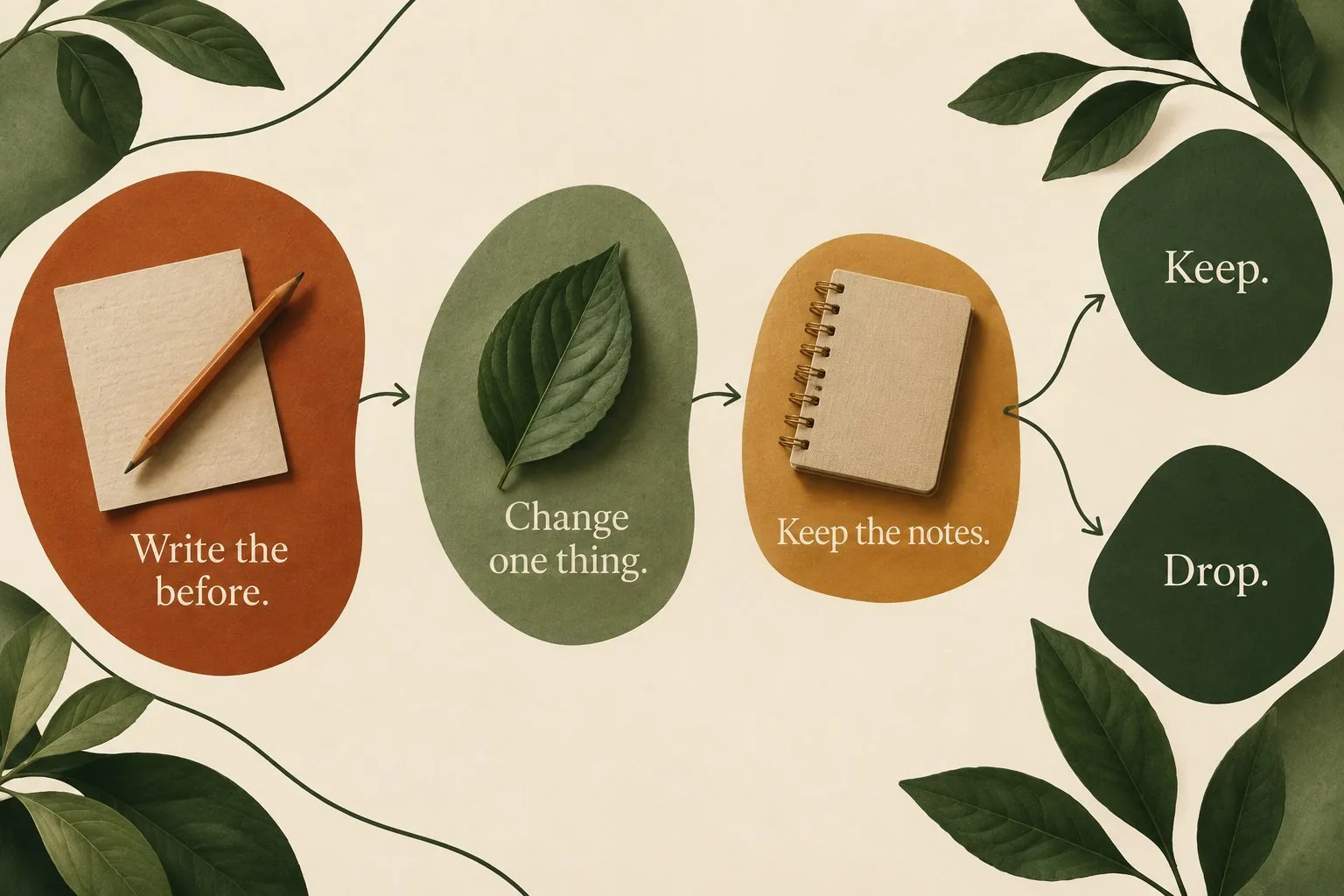
A better one looks like this. First, take a rough baseline for a few days. For each session, write four things: what time you started, what pulled you away, whether the done line happened, and whether sleep or food was obviously off.
A note on paper is enough. The point is an honest “before,” not a lab test.
Then change one thing. Just one: the phone exile, the written task, an earlier bedtime, or one microdose, your choice based on your bottleneck. If that one change is a microdose, use one product and follow the dosing guide.
Don’t change a habit and a product on the same day, or you won’t know which one did the work. Keep it for a stretch, two weeks as a reasonable example rather than a requirement, and note the same rough measures. At the end, compare and decide: keep it, drop it, or swap in the next candidate.
The measurement matters because memory is a flattering editor. Imagine, as a purely hypothetical example, someone who finds that the change that felt dramatic, a new app or a redesigned desk, did little, while something unglamorous like the drawer for the phone quietly earned its keep. Whether that’s how it goes for you is exactly what the notes are for.
Your context is the only one that counts: shift work, caregiving, studying, an office with a chatty neighbour. The method adapts; the principle is simply one change at a time, observed honestly.
One boundary worth drawing: this experiment is for tinkering with ordinary focus. It isn’t a waiting period. If you’re worried about what’s happening with your attention, that’s a reason to talk to a professional now, not after the tally sheet is full.
Everything above assumes ordinary, situational concentration trouble, the kind that responds to a better task, a quieter room or a decent night’s sleep. Some difficulty doesn’t, and it’s worth being direct about that.
If trouble concentrating is persistent, getting worse, or significantly disrupting your work, studies or daily life, that’s a reasonable thing to raise with a doctor or another qualified healthcare provider. The same goes for a noticeable recent change that coincides with new medication, major stress, illness or a rough stretch of mental health.
Concentration problems can travel alongside many different underlying causes, and sorting those out is a job for a professional conversation, not an article. A pharmacist can be a surprisingly useful first stop for questions about medication effects.
If you do book an appointment, bring your notes: what you’ve tried, what changed, when it started. A couple of weeks of honest observation makes that conversation considerably more useful for everyone in the room.
Taken together, the picture looks like this: concentration responds to unglamorous things. A task you can start, an environment that stops making offers, a body that’s slept, and an interval short enough to keep and long enough to matter.
What remains uncertain is which of these matters most for you specifically, because the research behind many of the practical techniques is thinner than the advice industry implies, and circumstances vary widely.
So make it one experiment. Today, pick a single task with a visible finish line, put your phone somewhere that takes a bit of effort to reach, set a timer you’ll respect, and see what happens. If it helps, keep it and consider adding sleep to the list next, given the evidence behind it. If it doesn’t, change one variable and run it again.
If the change you want to try is a microdose, Sidekick, Daydream, and Passion match different kinds of days. The amount and the rhythm live on the dosing guide. When you want something for a different kind of day, the rest of the range is in the shop.
And if your attention has been reliably difficult for a while, or something recently shifted, let the experiment wait. That’s a conversation worth having with a professional, and sooner beats later.
How do I tell what’s getting in the way?
Ask what failed in the last session. Fuzzy task, a phone you can see, bad sleep, no food, or a piece of work so big you can’t start. Write down the one that showed up. If you change three things at once, you won’t know which one helped.
How long should a focus session be?
As long as you’ll keep. Ten minutes is a real session. Twenty-five is a common example. Forty or fifty is fine if you still finish. The timer is a container, not a magic number. Take a break that isn’t your inbox.
What should I eat or drink?
Eat before a hard block if skipping meals makes you foggy. Put water where you can reach it. Prefer a plate with some protein over a meal that’s mostly sugar, and notice whether your afternoon changes. There’s no special concentration diet hiding in this.
Do I have to meditate first?
No. A few minutes of noticing when your mind leaves, then coming back, is enough to try. If sitting still makes you more restless, name the first physical action of the task and do that instead.
Where does a microdose fit?
After the session has one clear job. It doesn’t choose the task for you. Use one product: Sidekick to stay with a defined job, Daydream for a longer stretch of thinking or making, or Passion when the afternoon is flat. Amounts and the on-and-off rhythm are on the dosing guide.
When should I stop experimenting and talk to someone?
When the trouble lasts, gets worse, or starts costing you work, study, or daily life. Also when it showed up alongside new medication, illness, or a rough stretch of mental health. Bring the notes. They’re more useful than “I just can’t focus.”
Comments
There are no comments yet.