Mycelium
Kingdom Fungi — the vegetative body
What Is Mycelium?
Most people know the mushroom. Almost nobody knows the organism that makes it.
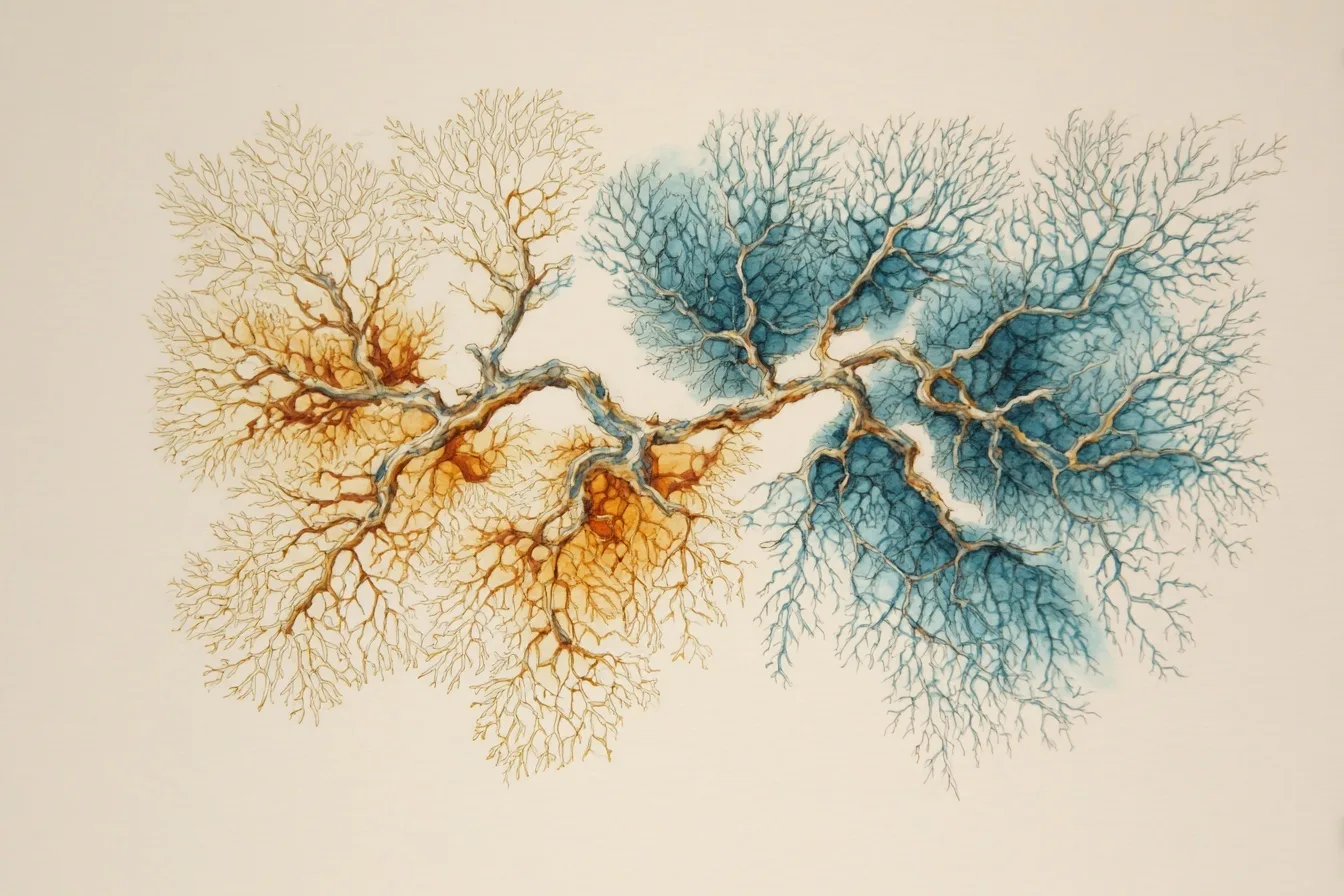
Mycelium is the living body of a fungus: a branching web of microscopic threads called hyphae that grows through soil, wood, leaf litter, and living roots. A mushroom is only the fruiting body — the temporary structure the mycelium pushes up to release spores, the way an apple tree pushes out apples. The mushroom is the fruit. The mycelium is the tree. And the tree is almost always hidden.
Each hypha is a tube of cells finer than a human hair, growing at its tip and branching constantly, fusing into a mat that can stretch for meters or miles. The mycologist Merlin Sheldrake, in his book Entangled Life, offers the figure that stops people cold: tease apart the mycelium in a single teaspoon of healthy soil and lay the threads end to end, and they could run anywhere from a hundred meters to ten kilometers. Underfoot, unseen, a forest floor is less “dirt” than circuitry.
This body does three things that hold ecosystems together. It decomposes — breaking dead matter into the nutrients living things can use; without fungi, the planet would be buried in undecayed wood. It forms symbioses — wrapping around and into plant roots in partnerships called mycorrhizae, trading mineral nutrients for plant sugars. And it appears to communicate, moving chemical and electrical signals across the network in ways biologists are still arguing about.
That last claim is where mycelium went from soil science to pop-culture phenomenon — and where you have to be careful about what’s actually been proven.
The “Wood Wide Web” — The Wonder and the Skepticism
Here is the story you’ve probably heard: trees in a forest are wired together underground by fungal networks, sharing food and water and even sending warnings, with wise old “mother trees” feeding their seedlings through the fungal internet. It’s a beautiful story. It’s also, in part, ahead of the evidence — and the honest version is more interesting than the myth.
The wonder is real and has a real origin. In 1997, ecologist Suzanne Simard published work in Nature using radioactive carbon isotopes to track sugar moving between paper birch and Douglas fir through shared fungal connections. A Nature commentary on that research coined the now-famous phrase “the wood wide web.” The idea reframed forests from pure competition to something more cooperative, and it captured the public imagination so completely it turned up in documentaries, novels, and Ted Lasso.
Then the scientists who study these networks for a living pumped the brakes. In 2023, biologists Justine Karst, Melanie Jones, and Jason Hoeksema published a review in Nature Ecology & Evolution examining the most popular claims about common mycorrhizal networks. Their findings were blunt: the evidence that these networks are widespread in forests, and that resources move through them in ways that meaningfully help seedlings, is weaker and more overinterpreted than the popular story suggests. And the most romantic claim of all — that mother trees deliberately recognize and nurse their own offspring through the network — had, they found, no peer-reviewed evidence at all.
So what’s actually true? The base is solid: mycorrhizal symbiosis is real, ancient, and everywhere. Individual fungi do physically link multiple plants, and plants and fungi genuinely trade sugars for minerals. What’s contested is the interpretation — the forest as a conscious, cooperative super-organism. As one University of Alberta summary put it, the wood-wide-web narrative spread faster than the science could support.
We tell you this not to spoil the magic but because the real mycelium is strange enough without inventing things. Which brings us to what researchers found when they finally tried to map the whole network.
The First Global Map of the Underground
In June 2026, the Society for the Protection of Underground Networks (SPUN) — a nonprofit led by biologist Toby Kiers — and its collaborators published in Science the first global maps of mycorrhizal fungal networks, built from data on more than 16,000 soil samples worldwide. The numbers are difficult to hold in your head.
Earth’s topsoils contain an estimated 110 quadrillion kilometers of arbuscular mycorrhizal network — roughly a billion times the distance from the Earth to the Sun. (EurekAlert / Science.) These networks move an estimated 4 billion tons of CO₂-equivalent into soils each year — on the order of 11% of humanity’s annual emissions, captured and routed underground by fungi.
A separate 2023 meta-analysis in Current Biology estimated that plants funnel about 13 billion tons of CO₂-equivalent per year into mycorrhizal fungi — a figure equivalent to roughly a third of global fossil-fuel emissions. (The two numbers measure related-but-different things and shouldn’t be merged, but both point the same direction: fungi are a planetary-scale carbon system we’ve largely ignored.)
The map also delivered a warning. Roughly 90% of the richest mycorrhizal hotspots fall outside protected areas, and grasslands — which hold something like 40% of the world’s arbuscular mycorrhizal biomass — are being converted to farmland faster than forests. (Mongabay.) We are losing an organ of the planet we only just learned how to see.
How Big, How Old, How Many
Mycelium breaks the categories we use for living things.
The largest organism on Earth is a fungus. In Oregon’s Malheur National Forest, in the Blue Mountains, a single Armillaria ostoyae — a honey fungus — has been confirmed by DNA testing as one genetic individual sprawling across about 2,385 acres, nearly four square miles. It is estimated to be somewhere between 2,400 and 8,650 years old and to weigh thousands of tons. (Scientific American.) It is mostly invisible — a mat of mycelium under the forest, occasionally pushing up clusters of honey mushrooms as the only sign it exists.
Fungi are about a billion years old. Microfossils from Arctic Canada, described in Nature in 2019, pushed the fungal lineage back to roughly 1 billion years — hundreds of millions of years before the first land plants. Mycelium was decomposing and networking long before anything had leaves, or lungs.
Fungi are more closely related to you than to a plant. Fungi and animals share a more recent common ancestor with each other than either does with plants; both belong to a group called the Opisthokonta, and fungal cell walls are built from chitin — the same material as an insect’s exoskeleton — not the cellulose of plants. The mushroom in the forest is, taxonomically, your distant cousin.
And we’ve barely met them. Scientists estimate 2.2 to 3.8 million fungal species exist, but only around 150,000 have been formally described — meaning more than 90% of fungi are unknown to science. Every serious survey of soil turns up species no one has named.
A note on a famous “fungal” story you may have seen: the slime mold Physarum polycephalum, which famously recreated the Tokyo rail map when researchers placed food at the cities' locations, is not actually a fungus — it’s a protist. It gets lumped in with mycelium constantly, and it’s worth knowing the difference.
What Mycelium Can Do — Materials, Cleanup, and Computers
Once you can grow mycelium on purpose, it turns out to be one of the most versatile materials on the planet.
It can replace plastic and leather. The company Ecovative pioneered mycelium-based packaging as a home-compostable replacement for Styrofoam. MycoWorks grows a mycelium leather called Reishi with a fraction of the carbon footprint of cowhide — used in a Hermès travel bag and a Cadillac concept interior. You can grow a handbag.
It can eat pollution. Mycologist Paul Stamets demonstrated mycoremediation — in one trial, oyster-mushroom mycelium dropped the oil concentration in a contaminated soil pile from 10,000 ppm to under 200 ppm while control piles barely moved. A 2018 study in Scientific Reports even found that mycelium extracts dramatically reduced viruses in honeybees.
It might one day compute. This is the frontier, and it’s genuinely speculative: computer scientist Andrew Adamatzky has proposed using living mycelium as “wetware,” carrying information through electrical spikes. His 2022 paper in Royal Society Open Science recorded spiking patterns he described as clustering into a “vocabulary” of up to ~50 “words.” Headlines ran with “fungi talk” — but Adamatzky himself, and most mycologists, treat the “language” framing as a provocative hypothesis, not a finding. The electrical activity is real; calling it a language is a leap. (Worth knowing both halves of that, because the internet will only tell you the first.)
Mycelium and Psilocybin
Here’s the connection that matters for everything else in this Apothecary: psilocybin is made by the mycelium, not just the mushroom.
The compound is biosynthesized from the amino acid tryptophan by four enzymes — PsiD, PsiH, PsiK, and PsiM — encoded in a gene cluster the fungus carries. That pathway was first mapped in 2017, and a 2024 study in PNAS traced how the psilocybin gene cluster evolved across the genus Psilocybe. The mushroom concentrates psilocybin in its fruiting body, but the chemistry runs in the mycelial cells underneath.
So when you read about psilocybin, or the Golden Teacher strain we use, or the whole modern science of magic mushrooms, you’re really reading about what one kind of mycelium learned to make. The same is true of the other fungi in our formulas — lion’s mane produces its nerve-growth compounds in the mycelium, and reishi its immune-active beta-glucans. Every fungal ingredient we work with is, at root, mycelium doing chemistry.
What It Actually Feels Like
Let’s be honest about the supplement question, because it’s where most “mycelium” pages get vague.
You don’t feel mycelium as a distinct sensation. When you take a Kind Stranger capsule, you’re taking compounds — psilocybin and others — that mycelium synthesized. The calm, the clarity, the sensory lift: those are downstream of the chemistry the mycelium built. Crediting the feeling to “mycelium” is like crediting the power plant for the light in your room. True, and invisible.
What understanding mycelium does change is how you hold the thing. Once you know the capsule traces back to an organism that has been decomposing, networking, and regenerating ecosystems for a billion years, a microdose stops feeling like a consumer product and starts feeling like a relationship with something very old and very patient. That doesn’t alter the pharmacology. It alters the attention you bring — and attention, it turns out, is most of what a microdosing practice is made of.
Frequently Asked Questions
What is mycelium? Mycelium is the living body of a fungus — a branching network of microscopic threads called hyphae that grows through soil, wood, or other matter. The mushroom is only the temporary fruiting body the mycelium produces to spread spores. Mycelium decomposes dead matter, partners with plant roots in mycorrhizal networks, and produces bioactive compounds including psilocybin.
What’s the difference between mycelium and a mushroom? A mushroom is the fruiting body — the visible, above-ground part. Mycelium is the actual organism beneath it. The relationship is like an apple to an apple tree: the mushroom is the fruit, the mycelium is the tree. In supplements, fruiting-body products and mycelium-grown (“myceliated grain”) products can have different compound profiles, so the label matters.
Is the “wood wide web” real? Partly. Fungi genuinely connect plant roots and exchange nutrients — that’s well established. But the popular claims that forests are cooperative super-organisms and that “mother trees” deliberately feed their own seedlings through fungal networks are contested; a 2023 review in Nature Ecology & Evolution found the strongest versions of those claims overstated or unsupported. The wonder is real; some of the storytelling ran ahead of the evidence.
Is mycelium the largest organism on Earth? Yes — by area. A single honey fungus (Armillaria ostoyae) in Oregon spans about 2,385 acres and is estimated to be thousands of years old, making it the largest known living organism on the planet. It’s almost entirely mycelium, hidden underground.
Is mycelium the same as mold? Mold is one kind of fungus and it does grow as mycelium — but “mycelium” describes the growth form of all fungi, including beneficial ones like lion’s mane, reishi, and psilocybin mushrooms. Calling all mycelium “mold” is like calling all mammals “rats.”
Does mycelium produce psilocybin? Yes. Psilocybin is synthesized by enzymes in the fungal mycelium and then concentrated in the mushroom’s fruiting body. The mycelium is the factory; the mushroom is the warehouse.
The largest living thing on this planet is a fungus in Oregon that has been quietly running four square miles of forest for somewhere between two thousand and eight thousand years, and humanity’s response to learning this was to keep arguing about whether trees have feelings. The Oracle finds this very on-brand for a species that took until 2026 to make a map of a network so large it would reach the sun a billion times over — a network that was, the entire time, directly beneath the people drawing the map. Here is the part worth sitting with: mycelium has been doing the unglamorous, world-holding work — feeding the hungry root, composting the fallen tree, storing the carbon nobody asked it to store — for a billion years, with no audience and no applause. You are, biochemically speaking, closer kin to that fungus than the fungus is to the grass it lives in. Be a little humbler about what counts as intelligence. The thread underfoot has tenure.