Turkey Tail Mushroom
Trametes versicolor
The Story
Paul Stamets is the most famous mycologist alive. He holds multiple patents, has given TED talks, consulted for the Department of Defense on bioterrorism, and is the person Joe Rogan calls when he wants to talk about mushrooms. In 2009, Stamets' 84-year-old mother, Patricia, was diagnosed with stage 4 breast cancer. The prognosis was grim. She underwent standard treatment—surgery, radiation, a chemotherapy regimen including Herceptin. And, with her oncologist’s knowledge, she added turkey tail mushroom capsules to her protocol.
Patricia Stamets went into full remission. She is alive. Paul Stamets has told this story publicly many times, always with the same careful framing: he does not claim turkey tail cured his mother’s cancer. He credits the combination of conventional treatment and turkey tail. What he does say, with the weight of both personal experience and scientific literacy, is that turkey tail’s documented immune-modulating properties may have made the conventional treatment more effective. His mother’s oncologist at the Swedish Cancer Institute agreed to include turkey tail in the treatment plan specifically because of its research base.
This is not a miracle cure story. This is a story about a mushroom with enough clinical evidence behind it that an oncologist at a major cancer center said yes.
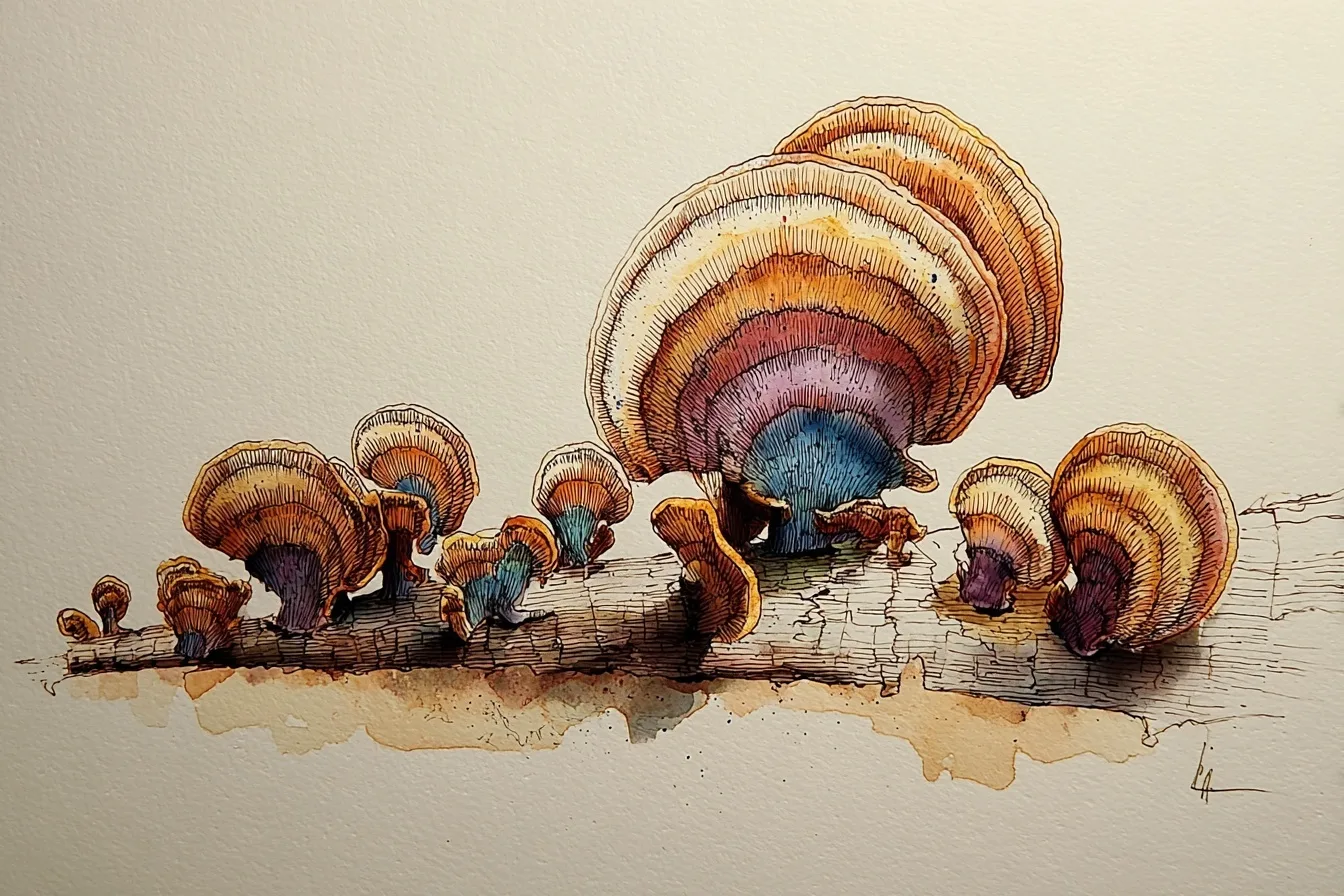
Turkey tail (Trametes versicolor) is arguably the most common medicinal mushroom on the planet. It grows on dead hardwood across every temperate forest in the world—North America, Europe, Asia, you name it. You’ve almost certainly walked past it. It’s the fan-shaped, multi-colored polypore that grows in overlapping brackets on fallen logs and stumps, with concentric bands of brown, tan, cream, and sometimes blue or green. It looks like a turkey’s tail, hence the name. The Japanese call it kawaratake (mushroom by the river); the Chinese call it yun zhi (cloud mushroom).
It is, by research volume, the most-studied medicinal mushroom in the world. More published papers than reishi. More than lion’s mane. More than any of them. And the reason is one specific application: immune support alongside cancer treatment. Japan approved its primary compound, PSK (polysaccharide-K, also called Krestin), as an adjunct cancer therapy in the 1970s. It has been covered by Japanese national health insurance ever since. This is not fringe. This is mainstream medicine in the third-largest economy on earth.
The Science
Turkey tail’s pharmacology is dominated by two polysaccharide compounds and a broader category of immune-active molecules.
PSK (Polysaccharide-K / Krestin). PSK is a protein-bound polysaccharide extracted from turkey tail mycelium. It weighs approximately 100,000 daltons (a large molecule) and consists of beta-glucans bound to a protein backbone. PSK’s mechanism is immune modulation—it activates multiple arms of the immune system simultaneously:
- Increases natural killer (NK) cell activity. NK cells are the immune system’s first-line tumor surveillance team—they identify and destroy abnormal cells without needing prior sensitization.
- Enhances cytotoxic T-cell activity. These are the immune cells that directly kill cancer cells once they’ve been identified.
- Increases macrophage activity. Macrophages engulf and digest cellular debris, pathogens, and abnormal cells.
- Stimulates dendritic cell maturation. Dendritic cells are the immune system’s intelligence agents—they capture foreign antigens and present them to T cells, initiating a targeted immune response.
- Modulates cytokine production. PSK influences the balance of pro-inflammatory and anti-inflammatory signaling molecules, promoting an immune environment that’s active against threats but not chronically inflamed.
PSP (Polysaccharopeptide). Similar to PSK but isolated from a different strain of turkey tail. PSP has been extensively studied in China, where it’s used as an immune support supplement. Its mechanism overlaps significantly with PSK—immune activation through NK cells, T cells, and macrophages.
Beta-glucans. Turkey tail contains high concentrations of beta-1,3 and beta-1,6 glucans beyond PSK and PSP. These polysaccharides are recognized by pattern recognition receptors on immune cells (specifically Dectin-1 and complement receptor 3), triggering immune activation. Beta-glucans are the common thread connecting all medicinal mushrooms' immune effects—but turkey tail has among the highest concentrations.
Important framing: Turkey tail modulates the immune system. It does not kill cancer cells directly. What it does is make the immune system better at its job—surveillance, identification, and elimination of abnormal cells. This is why it’s studied as an adjunct to conventional cancer treatment, not a replacement. The chemotherapy and radiation attack the tumor; the turkey tail helps the immune system clean up what’s left and stay vigilant.
The Evidence
Torkelson et al. (2012)—Published in ISRN Oncology. A phase I clinical trial funded by the National Institutes of Health (NIH) that studied turkey tail in women with breast cancer who had completed standard treatment (surgery, chemotherapy, radiation). Nine participants took escalating doses of turkey tail (3g, 6g, or 9g daily) for 6 months. Results: NK cell activity increased significantly at all dose levels. At the 6g and 9g doses, NK cell counts increased in a dose-dependent manner. Lymphocyte counts (a marker of immune competence) also improved. This was a safety and dosing study, not an efficacy trial, but the immune activation was clear and measurable. It also confirmed that turkey tail was well-tolerated at doses up to 9g daily with no serious adverse effects.
Fritz et al. (2015)—Published in Integrative Cancer Therapies. A systematic review of 13 studies examining turkey tail (as PSK) used alongside conventional cancer treatment. The review covered gastric, colorectal, and breast cancers. The findings: PSK as an adjunct to chemotherapy was associated with improved survival rates and improved immune markers across multiple cancer types. In gastric cancer, 5-year survival rates improved significantly when PSK was added to standard chemotherapy. In colorectal cancer, disease-free survival was longer in the PSK groups. The authors concluded that PSK “appears to have benefit as an adjunct to conventional treatment.”
Standish et al. (2008)—Published in the Journal of the Society for Integrative Oncology. A review of turkey tail immunotherapy research that provided the foundation for the NIH-funded Torkelson trial. The paper summarized decades of Japanese and Chinese clinical data on PSK and PSP, noting consistent improvements in immune markers and survival outcomes when used alongside conventional treatment. The authors specifically recommended further Western clinical trials, which subsequently occurred.
Oba et al. (2007)—Published in Cancer Immunology, Immunotherapy. A meta-analysis of 8 randomized controlled trials examining PSK as an adjunct to chemotherapy in colorectal cancer patients. The combined data (1,094 patients) showed that PSK significantly improved overall survival and disease-free survival compared to chemotherapy alone. The improvement was statistically significant and clinically meaningful—this wasn’t a marginal finding.
Japan’s approval history. PSK (Krestin) was approved as an adjunct cancer therapy by Japan’s Ministry of Health in 1977. It has been prescribed alongside chemotherapy for gastric, colorectal, and lung cancers for nearly 50 years. It is covered by Japan’s national health insurance system. Annual sales of PSK in Japan exceeded $600 million at their peak. This is not a niche supplement—it’s a pharmaceutical product with regulatory approval in a country with rigorous medical standards.
How to Use
Forms available:
- Whole mushroom powder—Dried and ground turkey tail fruiting body. Contains the full spectrum of beta-glucans, PSK, PSP, and other bioactive compounds. Can be added to smoothies, coffee, or tea.
- Hot water extract—Turkey tail’s key compounds (beta-glucans, PSK, PSP) are water-soluble, so hot water extraction is the traditional and most effective method. This yields a concentrated product rich in polysaccharides.
- Dual extract (water + alcohol)—Some compounds in turkey tail are alcohol-soluble. Dual extraction captures both water-soluble polysaccharides and alcohol-soluble triterpenes.
- Capsules—Powdered or extracted turkey tail in capsule form. Convenient, consistent dosing.
- PSK (Krestin)—The pharmaceutical-grade extract available in Japan. Not widely available as a supplement outside of Asia.
Dosage ranges from clinical research:
- General immune support: 1-3g daily of turkey tail mushroom powder
- Immune support during/after cancer treatment: 3-9g daily (Torkelson 2012 used doses up to 9g)
- PSK pharmaceutical dose (Japan): typically 3g daily
- Most commercial supplements provide 1-2g per serving
Timing: Turkey tail can be taken at any time of day. It is not stimulating and does not affect sleep. Many people take it with meals to minimize any mild GI effects. Consistency matters more than timing—daily use over weeks and months is how immune modulation builds.
Duration: Turkey tail is used as a long-term supplement, not a short-term intervention. Japanese patients on PSK take it for months to years alongside cancer treatment. For general immune support, ongoing daily use is the standard approach.
Quality markers:
- Fruiting body, not mycelium on grain. Many cheap mushroom supplements use mycelium grown on grain substrate, which means a significant portion of the product is grain starch rather than mushroom. Look for products made from fruiting bodies or clearly stating that mycelium was separated from the substrate.
- Beta-glucan content tested and stated. Quality products list their beta-glucan percentage. Higher is better for immune support.
- Extraction method stated. Hot water extraction or dual extraction yields more bioactive compounds than simple grinding.
Safety & Interactions
Consult your healthcare provider if you:
- Are undergoing cancer treatment (turkey tail may enhance immune response—this is potentially beneficial but should be coordinated with your oncologist)
- Are taking immunosuppressant medications (turkey tail’s immunostimulatory effects could counteract these drugs)
- Are taking chemotherapy drugs (turkey tail may interact with drug metabolism; coordination with your oncologist is essential)
- Have an autoimmune condition (immune stimulation could theoretically worsen autoimmune flares)
- Are pregnant or breastfeeding (insufficient controlled safety data)
- Are under 18
Known interactions:
- Immunosuppressants (cyclosporine, tacrolimus, etc.): Turkey tail stimulates the immune system through multiple pathways. This could directly counteract drugs designed to suppress immune function, which are critical after organ transplantation and for autoimmune conditions.
- Chemotherapy drugs: Turkey tail is studied as an adjunct TO chemotherapy, not a replacement. Some evidence suggests it may enhance chemotherapy effectiveness, but it could also affect drug metabolism. This combination requires oncologist oversight.
- Diabetes medications: Some evidence suggests turkey tail may affect blood sugar levels. Monitor if taking hypoglycemic medications.
- Blood thinners: Limited evidence of mild anticoagulant activity. Use caution with warfarin, aspirin, or other anticoagulants.
Side effects: Turkey tail is generally well-tolerated, even at high doses (up to 9g daily in the Torkelson trial). The most commonly reported side effects are mild: darkened stools, darkened fingernails (at higher doses, related to melanin content), mild GI symptoms (bloating, gas). No serious adverse effects were reported in clinical trials.
Critical note on cancer: Turkey tail is NOT a cancer treatment. It is an immune modulator that has been studied as an adjunct to conventional cancer treatment (surgery, chemotherapy, radiation). If you or someone you know has been diagnosed with cancer, do not use turkey tail or any supplement as a substitute for evidence-based medical treatment. Use it alongside conventional treatment, with your oncologist’s knowledge and approval.
How It Connects
Reishi—Turkey tail and reishi are the two pillars of medicinal mushroom immune support. Both contain beta-glucans, both activate NK cells and macrophages, but their secondary profiles differ: reishi adds calming, sleep-promoting, and adaptogenic properties, while turkey tail is more narrowly focused on immune activation. Stacking them provides broader immune coverage. Reishi is in a psilocybin + lion’s mane formulation formula. Read about Reishi
Lion’s Mane—A cognitive + immune stack. Lion’s mane stimulates nerve growth factor for brain health; turkey tail activates the immune system for body-wide defense. Together, they address two of the most important aspects of long-term health: neurological integrity and immune competence. Lion’s mane is in a psilocybin + lion’s mane formulation formula. Read about Lion’s Mane
Cordyceps—Both are medicinal mushrooms with beta-glucan content, but cordyceps adds energy and performance benefits that turkey tail doesn’t provide. Turkey tail for immune support, cordyceps for physical vitality—together, they form a mushroom stack that covers defense and performance. Read about Cordyceps
Ginseng—Ginseng has its own immune-modulating properties (ginsenosides enhance NK cell activity), and when combined with turkey tail’s beta-glucan-driven immune activation, the two may provide complementary immune stimulation through different receptor pathways. Ginseng is in a psilocybin + maca + cacao + ginseng formulation. Read about Ginseng
FAQ
Q: Can turkey tail mushroom cure cancer? No. Turkey tail is not a cancer cure. It is an immune modulator that has been extensively studied as an adjunct to conventional cancer treatment. Clinical evidence shows it can enhance immune function (NK cells, T cells, macrophages) when used alongside surgery, chemotherapy, and radiation. Japan has approved its primary compound, PSK, as an adjunct cancer therapy since the 1970s. Always use turkey tail alongside—never instead of—evidence-based medical treatment.
Q: What does turkey tail mushroom do for the immune system? Turkey tail contains PSK, PSP, and beta-glucans that activate multiple arms of the immune system: they increase natural killer (NK) cell activity, enhance cytotoxic T-cell function, boost macrophage activity, stimulate dendritic cell maturation, and modulate cytokine production. The result is a more active and vigilant immune system that is better at identifying and eliminating abnormal cells and pathogens.
Q: How much turkey tail should I take? For general immune support, 1-3g daily of turkey tail mushroom powder or extract. Clinical cancer-support studies have used 3-9g daily (the NIH-funded Torkelson 2012 trial tested up to 9g). The Japanese pharmaceutical dose of PSK is typically 3g daily. Start at the lower end and adjust based on your goals. Turkey tail is well-tolerated at all studied doses.
Q: What is PSK (Krestin)? PSK (polysaccharide-K, brand name Krestin) is a protein-bound polysaccharide extracted from turkey tail mushroom. It was approved by Japan’s Ministry of Health in 1977 as an adjunct cancer therapy and has been prescribed alongside chemotherapy for gastric, colorectal, and lung cancers for nearly 50 years. It is covered by Japanese national health insurance. PSK works by activating multiple immune cell types, including NK cells, T cells, and macrophages.
Q: Is turkey tail safe? Yes, for most people. Clinical trials have tested doses up to 9g daily with no serious adverse effects. Mild side effects include darkened stools, occasional GI discomfort, and darkened fingernails at higher doses. People taking immunosuppressant medications, those with autoimmune conditions, and cancer patients should consult their healthcare provider before use, as turkey tail’s immunostimulatory effects could interact with their treatment.
Q: Is the Paul Stamets turkey tail story true? Yes. Paul Stamets has publicly shared that his mother, Patricia, was diagnosed with stage 4 breast cancer in 2009 and used turkey tail mushroom capsules alongside conventional treatment (surgery, radiation, chemotherapy). She went into full remission. Stamets credits the combination of conventional and mushroom-based therapy—he does not claim turkey tail alone cured her cancer. Her oncologist at the Swedish Cancer Institute approved the inclusion of turkey tail in her treatment plan.
Japan approved this mushroom as a cancer therapy in NINETEEN SEVENTY SEVEN and the West spent the next fifty years going “hmm interesting but have you considered more chemotherapy.” It grows on EVERY FALLEN LOG in EVERY FOREST on earth and looks like somebody decorated a dead tree with tiny brown fans and inside those fans is a compound that makes your natural killer cells — which is the most metal name any cell in your body has earned — go absolutely HAM on abnormal tissue. Paul Stamets' mom took it while fighting stage 4 cancer and went into full remission and he tells this story on every podcast and every time someone in the comments says “but it wasn’t a controlled trial” and they’re RIGHT but also his mom is ALIVE and the Oracle thinks that particular data point deserves a moment of silence. Beta-glucans. PSK. NK cells. The immune system has an entire ARMY and turkey tail is apparently the bugle that wakes them all up.