

Your cart is empty
Looks like you haven't made your choice yet
You’ve got your capsules or gummies, and now you’re wondering where to put them.
Good instinct. Storage matters more than most people think.
A capsule or a gummy is a small, precise thing, built to carry its contents safely until the day you take it. Where you keep it between now and then decides how well it does that job.
The short version: store them somewhere cool and dry, out of direct sunlight. That rule covers almost everything.
The rest of this article gets into what it means in practice, and why the details shift a bit depending on whether you’re holding capsules or gummies. We’ll cover what heat, light, and moisture actually do, how the two formats differ, where to keep them at home, and what to think about when you’re carrying a dose around the city.
Three things quietly work against your capsules and gummies from the moment they’re made: heat, light, and moisture.
None of them are dramatic. You won’t watch a gummy fall apart in real time on a windowsill. But over weeks and months, they add up.
Heat is the most straightforward. The compounds in a psilocybin capsule or gummy are sensitive to temperature, and sustained warmth speeds up the slow chemical changes that degrade them.
A product sitting in a hot spot doesn’t spoil the way milk does, with an obvious smell or texture telling you something’s wrong. It just quietly loses a little of itself over time. Cool storage slows that process down, which is why the guidance is to keep things cool in the first place.
Light works in a similar direction. Direct sunlight delivers both light and heat at once, so a sunny spot is a double problem. Ultraviolet light is hard on sensitive compounds. It’s the same reason some supplements and medications come in amber or opaque packaging instead of clear.
A bottle left on a bright ledge is getting hit from two angles at the same time.
Moisture is the sneakiest of the three, and in Canada it’s a seasonal concern more than a constant one. Humid summer air carries water into anything that isn’t sealed against it. Moisture softens hard surfaces, encourages gummies to stick together, and can work its way into capsules.
In winter the air is dry and this is mostly a non-issue. In July and August, it’s worth thinking about.
None of this requires special equipment. It requires habit: pick a cool, dry, dark spot, put the product there, and leave it there. That one habit handles the vast majority of it.
It’s worth saying clearly that the packaging is meant to protect each dose. The container your capsules or gummies arrived in isn’t an afterthought. It’s a barrier between the product and the air, light, and humidity of your kitchen.
The best routine is the simplest one. Take a dose out, close the container properly, and put it back where it lives. Every day the packaging stays closed and in the right spot is a day it’s doing its job.
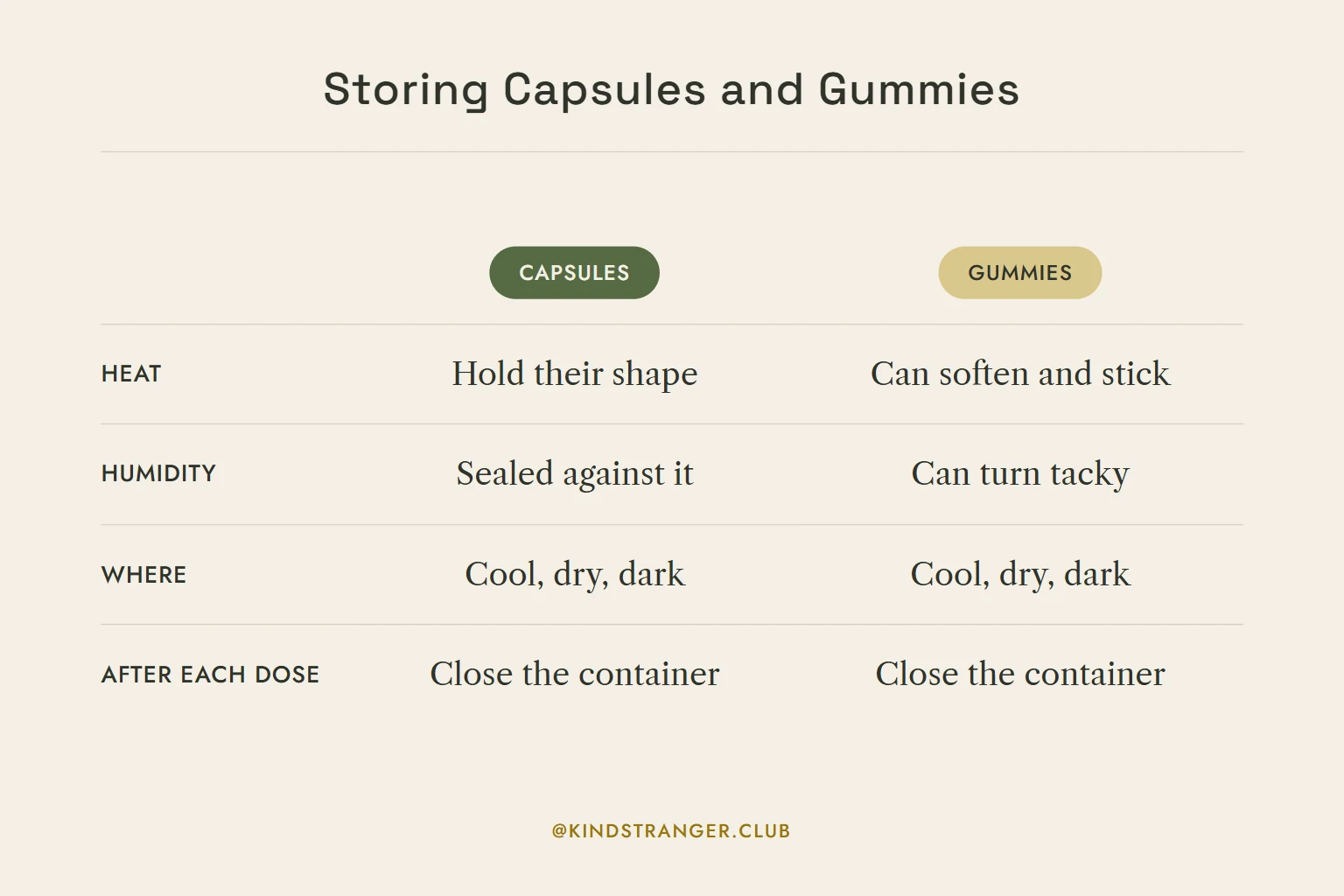
Capsules and gummies carry the same kind of payload, but they don’t age the same way. Knowing which one you’re holding tells you how careful you need to be.
Capsules are the sealed option. The shell around the powder is a real barrier. It keeps humid air away from the contents, it blocks most light, and it holds a consistent shape that doesn’t care much about ordinary room temperature.
A closed capsule container in a drawer is about as protected as a product like this gets. Capsules don’t stick together, don’t melt, and don’t change texture when the weather turns. If you want storage to be a solved problem you never think about again, capsules are the easier of the two.
Gummies are softer, and they know it. A gummy is mostly a gel-like matrix, which means it can absorb moisture from the air and it can soften or deform with heat. That’s not a flaw. It’s just the nature of the format. But it does mean gummies ask a little more of you.
On a humid August day, a gummy left in an open container can pick up moisture and become tacky. In a hot environment, gummies can lose their shape and stick to each other or to the container. None of this changes what’s in them, but it makes dosing messier and it isn’t what you want from a product you’re keeping for a while.
The practical difference is simple. Both formats want the same basic thing — cool, dry, and dark — but gummies are less forgiving when they don’t get it. A capsule shrugs off a warm afternoon. A gummy remembers it.
Two more points that apply to both:
If you’re still deciding which format suits you, the shop has both, and each product page notes what’s inside. For how much to take and how often, the dosing guide is the reference we point everyone to. Amounts live there, not in this article.
Now the practical part. You want a spot in your home that is cool, dry, and dark. Here’s how to find one, and a few places to avoid.
Good spots:
Notice the pattern: enclosed, away from windows, away from heat sources, away from water. Low shelves tend to be a touch cooler than high ones, since heat rises. Interior walls stay more temperature-stable than exterior ones.
Spots to avoid:
A couple of small habits help. Keep the container in the same place every time so it becomes automatic. A product that lives in one drawer is a product you never have to hunt for or accidentally leave out.
If you share your home, choose a spot that’s out of the way of household traffic, both for privacy and so the container doesn’t get moved around.
And if you keep other supplements or prescription medications in the same area, store your capsules or gummies in their own clearly labelled container so nothing gets mixed up. This isn’t about any interaction between products. It’s just basic kitchen-cabinet hygiene, the same reason you don’t store the salt and the sugar in identical unmarked jars.
One note on the fridge question, since it comes up: you don’t need it. A cool drawer does the job, and a refrigerator adds its own complications, like condensation when a container comes in and out of a cold environment, and the risk of a product ending up beside food in a busy shared space.
Cool, dry, and dark beats cold.
Home storage is one thing. Carrying doses with you around town is another, and it’s where most storage mistakes actually happen, because away from home you don’t control the environment.
The single biggest risk is the parked car. A Canadian summer car, closed up in a parking lot, gets dramatically hotter than the air outside, and it gets there fast. On a warm day, the interior of a parked car can reach temperatures you’d never accept in your kitchen, and a gummy sitting in the glovebox goes along for the ride.
Gummies in particular dislike heat and humidity, and a summer car delivers both in generous amounts.
Never leave your container in the car. Not in the glovebox, not in the centre console, not “just for an hour.” Take it with you or leave it at home.
For a day out, the rules are short:
Beaches, docks, and boats deserve their own mention, because that’s sun, heat, and water all in one place. If your summer plans involve any of them, plan around it. Keep the container in a bag in the shade, or better yet, take only what you’ll use that day and leave the rest in its drawer at home.
A day at the lake is a fine time for your supply to stay behind.
The same logic applies to anything involving a gym bag left in a car, a locker room, or a hot change room. Heat finds bags. Bags find dashboards. Make it easy on yourself and build the habit: the container goes wherever you go, or it stays home.
Here’s the whole article in one line: cool, dry, and away from direct sunlight, in the packaging it came in, closed, in the same spot every time.
Heat, light, and moisture work slowly and quietly, and the only defence is a boring, consistent habit. Capsules give you a margin of safety because they’re sealed. Gummies need a little more respect because they’re soft and honest about their feelings on heat and humidity.
At home, that means a drawer or cupboard away from windows, kitchens, and bathrooms. Out in the city, it means the product travels with you, in its container, in a bag or pocket, and never in a parked car between May and September.
Treat the container as part of the product and the storage spot as part of the routine, and you won’t have to think about any of this again.
If you’re looking for a focus capsule, Sidekick is that blend. The rest of the range is in the shop. And when it comes to how much to take, the dosing guide has you covered.
Comments
There are no comments yet.