

Your cart is empty
Looks like you haven't made your choice yet

Microdosing psilocybin mushrooms works because the dose stays small and the routine stays steady. But the part of the routine that keeps everything running is the one people talk about least: the break.
Researchers at the University of British Columbia’s Okanagan campus have reported that people taking small doses of psilocybin mushrooms described improvements in mood and in symptoms of depression, anxiety, and stress. That quiet, day-over-day effect is what draws most people to the practice.
A well-timed pause is what protects it. A break isn’t a detour from microdosing. It’s part of the design, the same way rest days are part of a training plan: the work happens on training days, but the progress settles in during the rest.
Below, we’ll cover what tolerance actually means in plain words, why a pause keeps a small dose small, what a break week tends to feel like, and how to come back without losing momentum.
Tolerance gets thrown around a lot, so it helps to slow it down. In everyday language, it means your body has gotten used to something. The cup of coffee that once kept you wired now barely registers. The first cold plunge was shocking; the tenth is just Tuesday.
With psilocybin, the adjustment happens at your serotonin receptors, specifically the ones psilocin binds to. When those receptors are stimulated again and again over a short stretch of days, they pull back. They become slightly less available, slightly less responsive.
Nothing is damaged and nothing alarming is happening. Your brain is doing what brains do: adapting to a pattern until the pattern becomes the new normal.
The practical result is straightforward. A dose that produced a subtle, noticeable effect in week one can feel like nothing at all by week three if you’ve been dosing every single day without a pause.
The dose didn’t change. Your response to it did.
That flattening doesn’t just dull the mushroom. It dulls the practice. People who microdose aren’t usually chasing intensity. They want a slightly steadier mood, a little more patience, a bit more room in the day. Those effects live in the subtle range, which is exactly where tolerance bites first.
When the receptors pull back, the first thing to go isn’t some dramatic experience; it’s the quiet edge of clarity that made the practice feel worthwhile.
This is why experienced microdosers tend to talk less about the doses and more about the calendar. The schedule, dosing some days and resting others, is what keeps the tool sharp. A dose taken on a rested system does what it’s meant to do. The same dose taken on a system that’s been stimulated daily for weeks does much less.
That’s the fork in the road. You can chase the effect by increasing the amount, or you can protect the effect by protecting the pause. The first path leads to a heavier practice that drifts away from what microdosing is. The second keeps things light, sustainable, and close to the reason you started.
If you’re still shaping your routine, our dosing guide walks through common schedules and how rest days fit into them.
It’s also worth naming what tolerance isn’t. It isn’t a sign that mushrooms have stopped working for you, and it isn’t a reason to abandon the practice. It’s a signal, a fairly polite one as body signals go, that the calendar needs a rest day or a rest week built in.
People who treat that signal as information rather than failure tend to have a much longer and steadier relationship with microdosing.
One more plain-language note: tolerance isn’t permanent. Receptor sensitivity in this context tends to recover fairly quickly once the input pauses. A short break usually restores the responsiveness you started with. That’s the good news, and it’s the reason breaks are such a central part of the practice rather than an afterthought.
The premise is in the name. Micro. Small. Sub-perceptual for most people, or close to it, a background shift rather than a foreground event.
Small is what makes the practice fit into an ordinary life. You can work, parent, drive, exercise, and hold conversations on a microdosing day because the dose stays under the threshold where it takes over. That’s the design, and like any design it holds up only as long as its conditions are met. The main condition is that your system stays responsive.
Once tolerance builds, you’re faced with a choice, and it’s worth being honest about how that choice usually plays out.
When a small dose stops producing its subtle effect, most people don’t conclude that their receptors have downregulated and schedule a break. They conclude it’s not working anymore, and then either quit or take more. Taking more is the practical failure mode here.
More means drifting toward a dose that’s no longer micro. More means a day that’s noticeably altered when the whole point was days that are gently supported. More means rebuilding the routine around a larger amount that will, in a few weeks, meet the same tolerance wall and prompt the same decision again.
The pause breaks that loop at the source. By resting, you let receptor sensitivity return, so the original small amount keeps doing its original small job. You never have to escalate, because you never lose the effect you were after.
There’s a discipline angle here too, and it’s a positive one. Scheduling breaks is a way of proving to yourself that you’re in charge of the practice, not the other way around. A routine that includes planned pauses is a routine you’re running. A routine where you dose every day because skipping a day feels uncomfortable is a routine that’s running you.
It also keeps your information clean. Part of the value of microdosing is noticing how days on the routine differ from days off it. If you never take meaningful time away, you lose your baseline. You can’t tell how much of your steady mood is the practice and how much is just life improving, or the season changing, or the new job, or the better sleep.
A break week gives you a control period, a stretch of days where you can honestly ask what you actually notice. That question matters, and it can only be answered if you sometimes go without.
The pause isn’t lost time, either. People sometimes imagine that a week off means a week of regression, that all the ground gained gets handed back. In practice, most people who microdose with breaks describe the opposite. The benefits they’ve attributed to the practice tend to hold steady through a rest week, partly because the underlying habits, the attention to mood, the sleep, the walks, the journaling, don’t vanish just because the dose does.
The mushroom is a support, not the whole structure.
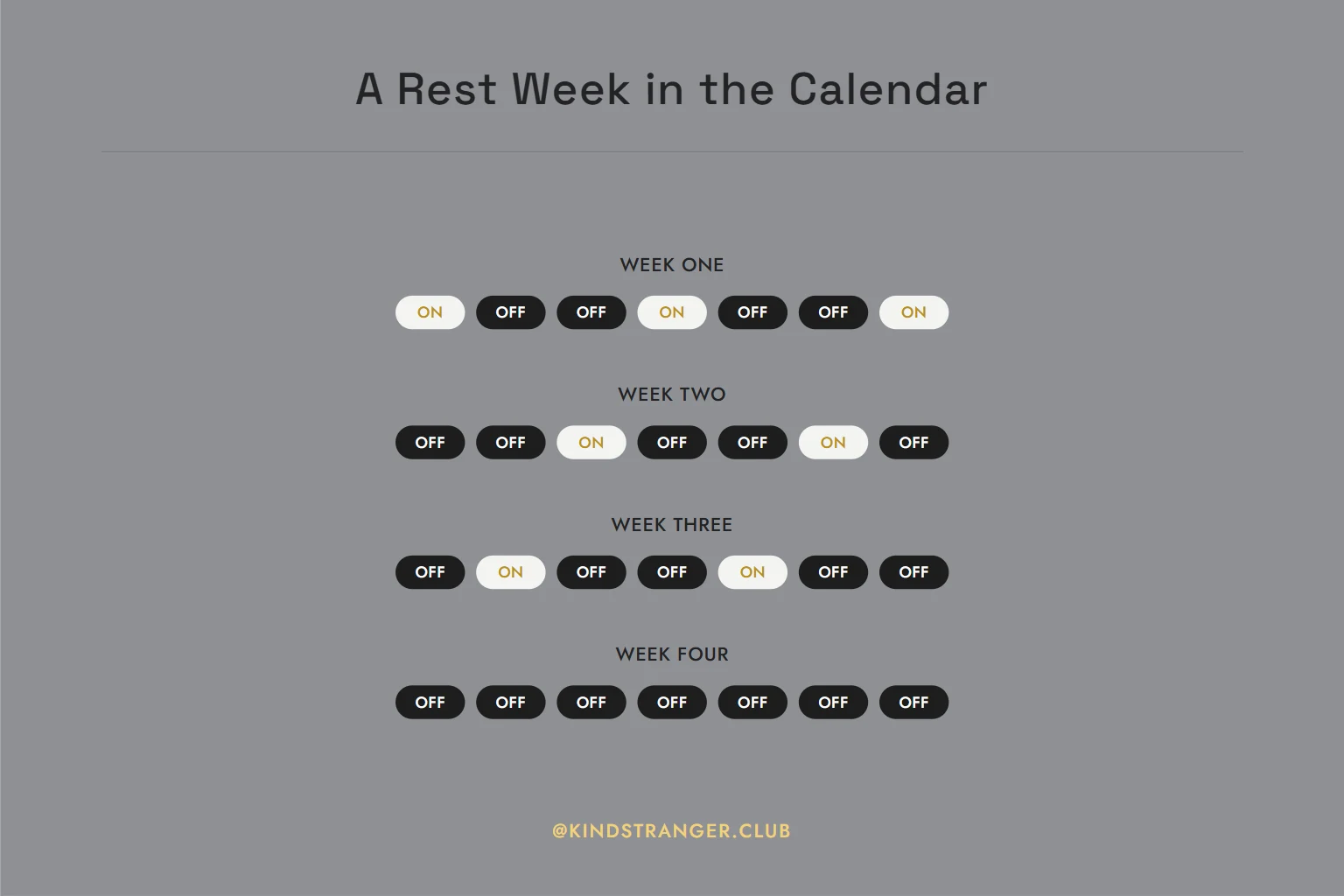
Most common routines build the pause in naturally. The classic one-day-on, two-days-off rhythm gives receptors recovery time within every three-day cycle. Others prefer a few days on followed by several off. Whatever rhythm you choose, most experienced microdosers also carve out a full break week every couple of months or so, a complete reset that lets the system return to a clean baseline.
Our dosing page lays these schedules out in detail so you can pick one that suits your week rather than forcing your week to suit it.
The short version: the pause is what makes “micro” a description rather than an aspiration. It’s the difference between a practice that stays light for years and one that quietly grows heavier until it no longer resembles what you signed up for.
So you’ve planned a week off. What should you actually expect?
For most people, honestly, less drama than they feared. The first day or two might come with a bit of mental noise, a small voice asking whether you should really be skipping, or a habit-loop tug toward the routine. That’s normal. Any daily practice creates a groove in the day, and the groove doesn’t disappear the moment the substance does.
You may reach for a day you’ve decided not to take. Notice it and let it pass. It usually does.
After that, most people describe the break week as surprisingly ordinary, which is exactly the point. You wake up, you work, you eat, you see people, you get tired in the evening. The days run on their own fuel.
Many microdosers report that the mood benefits they associate with the practice remain broadly present during the break, particularly if they’ve been at it for a while and have built supporting habits around it.
The pause isn’t a cliff. It’s a plateau.
Use the week as an observation period. Keep whatever notes you normally keep, or start some if you haven’t. Track the basics: sleep quality, mood through the day, energy in the afternoon, patience with the people around you. You’re gathering your own data, and your own data beats anyone else’s generalities.
Some people find the break confirms the practice. They notice the edges come off by day four or five, and they return with renewed conviction. Others find the break reassures them, that they feel much the same and the practice is a gentle support rather than a crutch. Both findings are valuable, and neither is a reason to quit.
A few practical things make break weeks easier. Plan them rather than drifting into them. A break you schedule feels like part of the practice; a break you stumble into because you forgot your supply feels like an interruption.
Keep the surrounding habits. If microdosing days have come with a morning walk or a journaling session, keep the walk and the journal. Those rituals carry a lot of the day-over-day benefit on their own, and holding onto them through the break shows you which parts of your routine are the mushroom and which parts are you.
And don’t fill the week with evaluations every hour. Check in once a day, note what you notice, and get on with things. Hyper-vigilance about your own mood has a way of souring it.
A small minority of people notice a flatter couple of days early in a break, slightly lower energy, slightly less sparkle. If that happens, it’s typically brief and mild, and it tends to resolve on its own as the week goes on.
It’s also worth asking the boring questions before attributing it to anything: did you sleep enough? Have you been outside? Is something stressful happening at work or home? The break week isn’t separate from your life. It happens inside it.
What the break week shouldn’t feel like is a struggle. If a planned pause produces real discomfort, that’s useful information about the routine itself. Perhaps the schedule was too dense, or the practice had drifted from a support into a dependency. Neither conclusion means the practice is over. It means the structure needs adjusting, and adjusting the structure is a normal, healthy part of any long-term routine.
You can also talk it through with a healthcare provider, particularly if you’re managing any existing condition. And to be clear on the legal side: unauthorized production, sale, and possession of magic mushrooms are illegal in Canada. Health Canada’s page on the subject covers the current framework, including the special access pathways that exist.
By the end of a break week, most people report something like a clean feeling. Not euphoric, just clean. The system feels settled, the days feel like plain days, and there’s often a genuine curiosity about returning.
That curiosity is a good sign. It means the practice still has something to offer, and that you’re coming back to it rather than clinging to it.
The return from a break week deserves as much care as the break itself.
The first thing to know is that you’ll likely notice the dose again. That’s the whole point of resting. Responsiveness returns, and a small amount does what a small amount is supposed to do. Don’t respond to that renewed clarity by taking more than your usual routine calls for. The effect you’re feeling on day one back is the effect the practice is designed around. Meet it where it is.
Return to your schedule, not to a blank page. If you were on a one-day-on, two-days-off rhythm before the break, pick that rhythm back up. The structure is what carried you this far, and rebuilding it from memory is easier than inventing a new one mid-week.
If the break week revealed something, say you felt great on four days off and want a lighter cadence, adjust deliberately, on paper or in your notes, not in the moment. Changes made thoughtfully stick. Changes made in enthusiasm fade by Friday.
Expect a short re-acquaintance period. The first day back can feel slightly more noticeable than the days before the break, simply because you’ve spent a week at baseline. That’s normal and it settles within a dose or two. The correct response is patience, not adjustment.
And use the return as a moment of renewal for the whole practice. Coming back from a break is a natural checkpoint to ask the only questions that matter over the long run. Is this still serving me? Are the habits around it still in place? Am I sleeping, moving, and eating like someone who wants to feel good?
The mushroom works best as one thread in a larger weave, and the break week is when you get to see the weave clearly. Some people even find that the break weeks become their favourite part of the cycle, the stretch where the practice proves it can stand being put down, and where picking it back up feels like a choice rather than a need.
If your break revealed that your supply is running low, or you’d like something shaped toward energy and drive for the season ahead, our Passion blend was made for exactly that kind of focused, forward-moving routine. And if you’re still settling on the rhythm that fits your life, the dosing guide is the place to start.
A final word on the long view. Microdosing rewards people who treat it like a marathon practice: steady, structured, patient, and punctuated with rest. The break week isn’t the interruption of that marathon. It’s the water station. You don’t stop the race when you take a cup. You take the cup so you can keep running well.
Keep the dose small. Keep the calendar honest. Take the break, notice what it teaches you, and come back refreshed. That’s the whole practice, and it’s a good one.
Comments
There are no comments yet.