

Your cart is empty
Looks like you haven't made your choice yet

It’s one of the first questions people ask once they start digging into the practice. We take vitamins daily. We drink coffee daily. Why would this be any different?
This article is for Canadians who are curious about microdosing — maybe you heard about it from a friend or a podcast — and who want a plain answer about daily use.
The short answer is yes, you can. But most people who stick with the practice choose not to, and there’s a good reason for that.
Almost everyone arrives at the same fork in the road. They’ve read a bit about microdosing, they’ve heard that people take tiny amounts of psilocybin mushrooms on a schedule, and then the obvious question lands: if a small amount helps, why not take it every single day?
It’s a reasonable assumption. Plenty of supplements come with instructions that say one per day, every day. And the word “microdose” itself adds to the confusion — micro suggests something so small it couldn’t possibly need a rest day.
To be clear, we’re not talking about amounts that produce a trip. A microdose is sub-perceptual for most people, meaning you don’t feel it the way you’d feel a full dose. It’s not about the mushrooms taking you somewhere. It’s about a subtle shift in how your day unfolds.
So yes — physically, you can microdose every day. Nothing about a small amount forces you to stop, and many people have done it and written about their experiences. Taking days off isn’t about danger at the micro level, and it isn’t a warning to quit. It’s about something else, and it’s worth understanding before you settle into a rhythm.
The better way to frame the question isn’t “am I allowed to dose daily?” It’s “what am I trying to get out of this, and does daily dosing serve that?”
One thing worth saying early: interest in this practice has grown fast, and researchers have started paying attention. A UBC-Okanagan-led study found that people who microdosed psilocybin saw improvements in mood and mental health, which is part of why so many Canadians are now asking how the practice actually works day to day. Scheduling — every day or not — sits right at the heart of it.
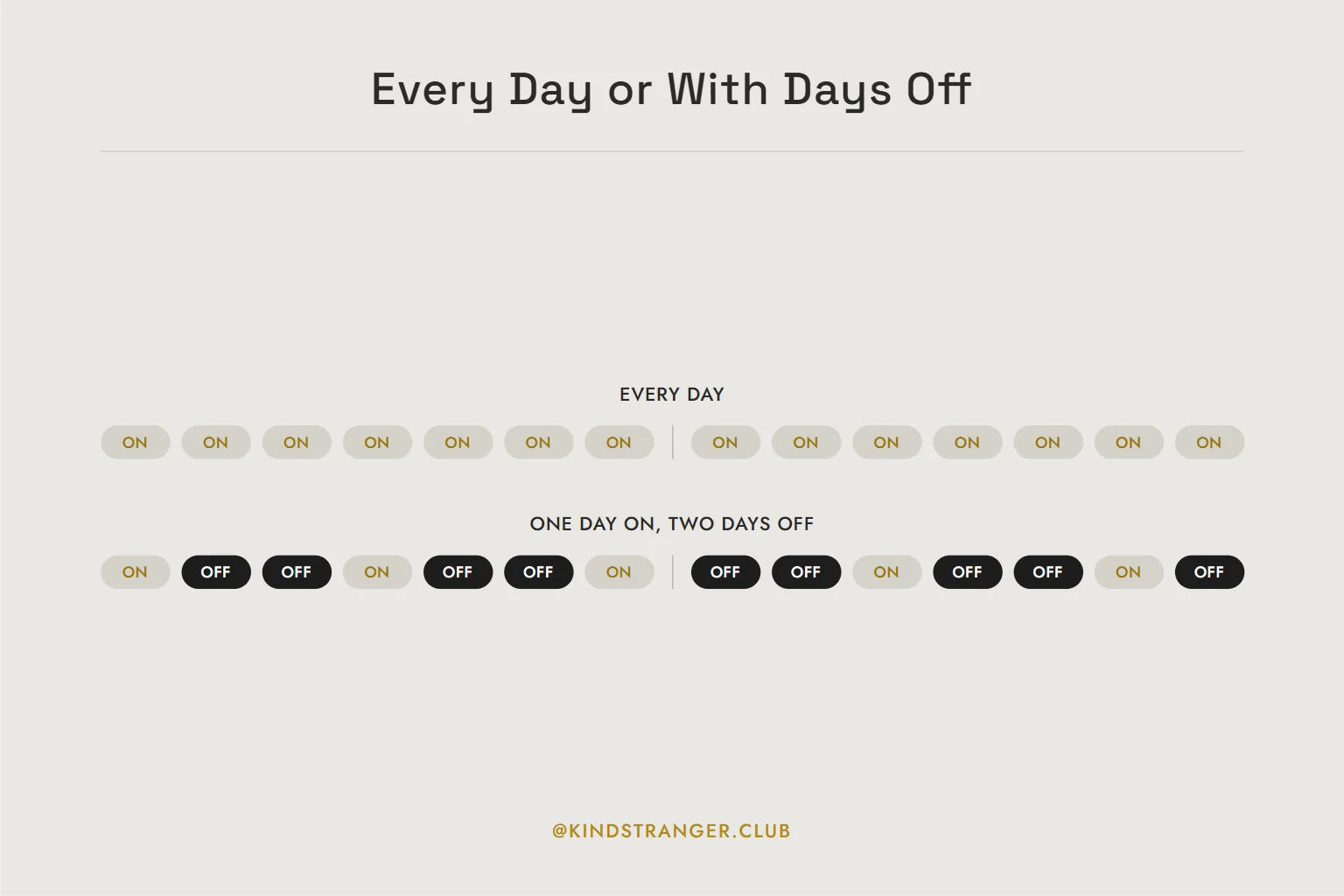
Here’s the honest answer to the daily question. Most people who microdose over the long haul don’t dose every day, and the reason has almost nothing to do with caution. It has to do with how the practice actually feels and functions.
The most common rhythm you’ll run into is one day on, two days off. Another well-known pattern runs several days on followed by several days off.
Neither of these came out of a lab originally. They came out of years of people trying things, comparing notes, and settling on what worked. The off days earned their place.
Psilocybin acts on serotonin receptors in the brain, and those receptors respond to regular stimulation by dialling things back. If you dose every day, the same small amount tends to feel like less and less over time.
Some people respond by increasing their amount, which drifts away from the whole idea of microdosing. Days off are how people keep a small dose small. The break gives the receptors room to reset, so the same gentle amount keeps doing the same gentle thing.
In that sense, the off days aren’t a limitation on the practice — they’re what makes it sustainable at the micro level.
A microdose is subtle by design. If you’re dosing daily, it becomes very hard to tell the difference between a microdosing day and an ordinary day, because you no longer have ordinary days to compare against.
The off days are your control group. They let you notice what the practice is doing, what it isn’t doing, and whether the pattern you’ve chosen still fits your life. People who take days off often say they learn more about their own baseline during a break than they do during a dose day.
Microdosing tends to work best when it’s woven into a life rather than running on top of it. The on-off structure creates a kind of cadence — dose, integrate, rest, repeat.
The rest days aren’t empty. That’s often when the noticing happens, when the small changes settle in, and when the practice stops being something you take and becomes something you do.
None of this is a warning. Nobody’s saying daily dosing will knock you off your feet. The point is subtler: the practice grew its off days because they work. Skipping them doesn’t break anything — it just tends to blur the very thing people are microdosing for.
It’s also worth being honest about the frustration some people feel when they first hear about off days. It can sound like unnecessary rules, or like the practice is more complicated than advertised. In practice, most people find the opposite. Once the rhythm is set, there’s nothing to think about. You’re just following a pattern, and the pattern does the work.
If you’re the kind of person who likes to understand the reasoning behind a schedule before following one, our dosing guide walks through the common patterns in more detail, including how people adjust them over time.
So what does microdosing actually feel like, and how do the off days affect it?
The most consistent reports are about mood. People describe a lightness that wasn’t there before — not euphoria, not a high, just a little more room in the day. Things that used to snag their attention all day don’t snag quite as long. Small irritations roll off a bit faster. That lines up with what the UBC-affiliated research found around improved mood and mental health, and it’s the most common reason people keep up the practice.
The next group of reports centres on focus and flow. Some people find that on dose days, they settle into work more easily. Tasks that usually get postponed get started. The afternoon slump feels softer.
It’s not a stimulant effect — people don’t describe feeling wired. If anything, they describe feeling less pulled around by their own restlessness.
Then there’s the social and emotional side. People often say they’re a little more patient, a little more present in conversations, a little more curious about the people around them.
The word that keeps coming up is subtle. Nobody reports becoming a different person. The changes are the kind you notice in hindsight — a week where things went a bit more smoothly than usual, and a quiet suspicion about why.
On a rest day, especially the second one in a two-day break, many people notice something interesting: the good parts don’t disappear. If mood, focus, and patience were purely a chemical effect that wore off, you’d expect them to fade the moment you stop.
Instead, people frequently report that the off days feel nearly as good as the on days. That’s part of why the practice includes them — they reveal how much of the benefit is sticking around, and they help people trust that the practice is doing something real rather than something borrowed.
People also notice things that need adjusting. Some find that dose days stack poorly with poor sleep — the subtlety of a microdose gets lost in fatigue. Some find that a particular pattern leaves them feeling a bit flat by the end of a week, so they shift their rhythm. That’s normal. The practice isn’t one-size-fits-all, and the off days are what make fine-tuning possible at all. Without them, you can’t tell what’s the microdose, what’s your week, and what’s just life.
Microdosing doesn’t fix a life, and it isn’t a treatment for anything. If you’re dealing with a diagnosed condition, or you’re taking prescribed medication, keep taking it and keep your care provider in the loop — that’s not a caution against microdosing, it’s just good sense about how to add anything new alongside existing care.
What people report is a shift in texture, not a transformation. The ones who stick with it longest tend to be the ones who started with modest expectations and let the small changes accumulate.
And for completeness on the Canadian picture: psilocybin mushrooms remain a controlled substance in Canada, and unauthorized production, sale, and possession are illegal. Health Canada maintains an overview of the legal status of magic mushrooms for anyone who wants the formal details. It’s worth knowing where things stand even as research and public conversation continue to evolve.
What does a week of microdosing actually look like for someone following the most common rhythm?
Picture a Monday-start week. On Monday, you take your microdose in the morning, as part of your regular routine — with coffee, with breakfast, whenever your day begins. You go to work, run your errands, live your life.
At no point do you feel high. At most, you might notice the day has a slightly easier flow to it.
Tuesday is an off day. You don’t take anything. You pay a little attention to how the day feels compared to Monday. Most people notice… not much difference, honestly — and that’s the point. The practice is designed to be quiet.
Wednesday, you dose again. Same time, same routine. Wednesday and Monday should feel roughly similar to each other. If they don’t — if one feels distinctly different — that’s useful information, and it’s exactly the kind you can only collect when there are off days between doses.
Thursday, off. Friday, on. That’s three dose days in the week. Saturday and Sunday are off, and here’s where the two-day break earns its keep: by Sunday, you’ve had a long enough pause that Monday’s dose lands the way the first one did, rather than the way the tenth consecutive one would.
That’s it. That’s the week. No weighing, no mathematics — just a pattern you can hold in your head. Monday on, Tuesday off, Wednesday on, Thursday off, Friday on, weekend off.
Some people run it Monday-start, some prefer a different anchor day. Some stretch the cycle across ten days instead of seven. The exact shape matters less than the shape existing at all.
The first week is mostly about getting familiar. The second and third weeks are when people start reporting the steadier mood, the easier focus, the slightly better patience.
By the fourth week, many people take a longer break — a full week or two off — partly to let tolerance fully reset and partly to check in with their baseline. Then they start again if the practice is serving them.
The nice thing about this structure is how little it asks of you. There’s nothing to remember beyond the pattern, nothing to manage. The off days aren’t an interruption to the practice — they’re woven right into it, the way rest days are woven into a training plan. You wouldn’t say a runner is slacking off because they don’t run every day. The rest is part of the training. Microdosing works the same way.
Which brings us back to the original question. Can you microdose mushrooms every day? Yes. Nothing stops you.
But the practice that thousands of people have refined over the years says something more interesting: you don’t need to. The off days aren’t a tax on the experience — they’re part of what makes it work. They keep the dose small, keep the effects legible, and keep the whole thing sustainable for as long as you want it in your life. The people who get the most out of microdosing tend to be the ones who embrace the rhythm rather than fighting it.
If you’re ready to try a week like the one above, or you’d like to sort out which rhythm suits your schedule before you begin, the dosing guide at Kind Stranger covers the common patterns, and the Kind Stranger shop has everything you need to get started. Start small, keep your days off, pay attention, and let the practice show you what it can do.
Comments
There are no comments yet.