

Your cart is empty
Looks like you haven't made your choice yet

Most of what gets written about microdosing is about the dose itself. The protocol, the schedule, the morning routine on the day you take it.
Fair enough — that’s the part people ask about. But anyone who has kept a microdosing practice going for more than a few months tends to say the same thing: the days between doses are where the actual work happens.
This article is about integration — what it is, why it matters, and how a small, unglamorous practice can help you hold onto what a microdosing routine gives you.
It also covers the other end of the same work: set and setting, the preparation that comes before a dose. On a microdose day that preparation is light. On a day with a bigger dose of dried mushrooms, it matters a great deal, and so does the integration afterwards.
Integration is the work of taking what you notice on a microdosing day and letting it settle into the rest of your life. There’s nothing dramatic about it.
You don’t need a retreat, a leather-bound journal, or a long debrief session. At its simplest, integration means paying attention to what shifted and then doing something about it.
MAPS describes integration as a way of making sense of experiences and translating them into lasting change — holding onto what you noticed instead of watching it fade once the substance has cleared your system.
Their framing was built around larger psychedelic experiences, but the core idea transfers well: insight on its own is fragile. Insight paired with a small change in behaviour has something to grip.
A 2022 review of how the word “integration” is used found many definitions in circulation and a wide range of practices under the one label. It also found that integration doesn’t have to involve a professional: it can be done with a practitioner or coach, or it can be entirely self-guided. That’s the kind this article is about.
It’s worth being honest about the research on microdosing itself, which is still young. People who microdose often describe a lighter mood, more creativity and a general sense of wellbeing. But in a 2021 self-blinding study of 191 people, participants who unknowingly took placebo capsules reported much the same changes as those taking real microdoses. Expectation, in other words, shapes a good deal of what people notice, and results vary from person to person.
That’s not a reason to skip the practice. It’s a reason to pay attention to your own experience — which is exactly what integration asks of you anyway.
Put plainly: integration is how you keep what you noticed.
A microdose might hand you a day with a little more openness, a little more patience, a little more interest in the world around you. If nothing in your life changes in response to that day, the openness fades and you end up back where you started, waiting for the next dose. Make one small change — even a very small one — and the day leaves something behind.
It’s easy to treat a microdosing routine as a string of special days strung together by ordinary ones. But the ordinary days aren’t filler. They’re the substrate.
They’re where your habits actually live, and habits are what decide whether anything sticks.
Think of it this way. A microdose might make it easier to notice that you’ve been rushing everywhere, or that you haven’t had a real conversation with your partner in a week, or that the afternoon walk does more for your head than the third coffee ever has.
Those notices only matter if something happens next. And ‘next’ almost always happens on a non-dosing day — a Tuesday, a Thursday, some unremarkable afternoon when nothing is chemically assisted and everything depends on what you choose to do.
There’s a practical reason the ordinary days matter too. Most microdosing schedules — the kind described in our dosing guide — involve dosing a couple of days a week and resting the rest.
Those rest days aren’t just there to keep tolerance in check. They’re there so your baseline can reassert itself, so you can see clearly which changes are real and which were just the texture of a particular day. Without the ordinary days, you have no control group for your own life.
Some people also find the ordinary days carry the more honest lessons. Some people say that on a microdosing day, everything feels a bit more workable. On an ordinary day, you find out whether the workability survived.
If you noticed on Monday that you felt better without your phone at breakfast, Thursday is the day that tells you whether that was a genuine discovery or a pleasant blip.
Ordinary days are the verification step.
They’re slower and less interesting, and they matter more.
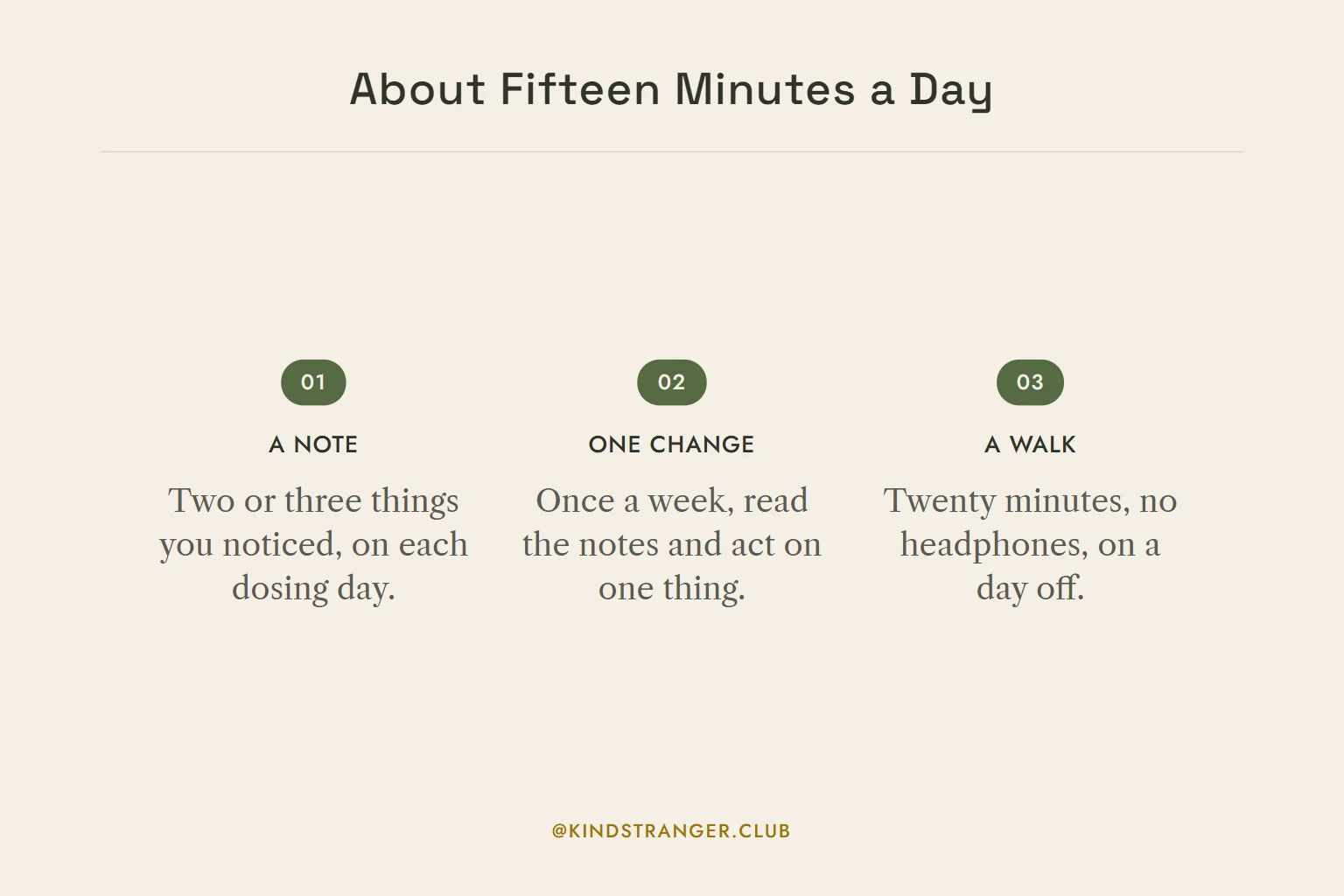
You don’t need a complicated integration routine. Complicated routines tend to collapse within two weeks, which defeats the purpose. What follows is one small practice with three parts.
It takes about fifteen minutes a day, most of which you’d be spending anyway.
A note
On each dosing day, write down two or three things you noticed. Not a diary entry — fragments. ‘Phone felt loud.’ ‘Didn’t dread the standup meeting.’ ‘Wanted to call my brother.’
Keep it short enough that you’ll actually do it, and keep it somewhere you’ll see it on non-dosing days. The point isn’t the writing. The point is creating a small record you can read back on an ordinary Thursday, once the memory of the dosing day has gone soft.
One change
Once a week, read your notes and pick one thing to act on. One.
Maybe you noticed you felt calmer on mornings you skipped the news, so you leave your phone in the kitchen until after breakfast. Maybe you noticed you liked who you were on the day you went to bed at ten, so you try that twice the following week.
The change should be small enough that it doesn’t require motivation to sustain. If it feels like a project, it’s too big. Integration isn’t renovation. It’s a nudge, applied repeatedly.
A walk
This is the part people skip, and it’s the part that carries the most weight. Take a twenty-minute walk on a non-dosing day, without headphones, and let your mind wander over whatever surfaced during the week.
A walk is unusually good for this. It’s repetitive enough to be undemanding, mobile enough to keep the mind moving, and it puts you in the world rather than in your head about the world.
Many microdosers find that the quality of thought on a quiet walk isn’t so different from the quality of thought on a dosing day — gentler, less rigid, a bit more willing to consider other angles. The walk is where the two kinds of days start talking to each other.
That’s the whole practice. A note on dosing days, one change a week, a walk on the ordinary days. If you only do the walk, you’re still doing integration. If you only do the notes, same.
The version that lasts is the one you’ll actually repeat, and repetition is the entire mechanism.
So how does the practice fit alongside a dosing routine? Neatly, as it turns out.
Integration and microdosing aren’t competing uses of your attention. They’re complementary. People often describe a microdose day as a more open one: noticing more, reacting less, and feeling a little more space between a stimulus and their response to it.
Integration is what you do with that space. One without the other is incomplete. Dosing without integration gives you pleasant days that don’t add up to much.
Integration without dosing is still worthwhile — the notes, the change, and the walk are good practice for anyone — but you lose the particular openness people describe on a dosing day.
If you’re working with a schedule like the ones in our dosing guide, the pairing is simple. On dosing days, take your note. The day after, take your walk. At the end of the week, pick your one change.
Over a couple of months, that rhythm builds a body of small adjustments — and small adjustments are what a better baseline is made of.
Integration is what happens after a dose. Set and setting is what happens before it, and the two are closer than they look. The notes you take on a dosing day are coloured by the state you walked into it with and the place you spent it.
“Set” is your mindset: your mood, your intentions, your fears and expectations, how you slept, what happened at work this week, the argument you’re pretending is resolved. “Setting” is everything outside your head: the room, the people in it, the music, the light, whether the door locks, and whether you can step away if you need to.
The phrase is usually credited to Timothy Leary in the early 1960s, but the idea is older. Ido Hartogsohn’s history of set and setting traces it back through researchers of the 1950s, who were already noticing that the same substance at the same dose could produce very different experiences depending on who took it and where. His point is that the effects people describe aren’t a property of the molecule alone. They come from the meeting of substance, mind and surroundings.
People were preparing carefully long before anyone named it. The Eleusinian Mysteries of ancient Greece involved days of fasting, purification and a long procession on foot before the rite itself. The preparation wasn’t a side detail. It was the container.
Modern research still works the same way. Johns Hopkins researchers published safety guidelines for human hallucinogen research in 2008, and the safeguards they describe are mostly set and setting: screening volunteers carefully, building trust with the people who’ll be present, preparing the volunteer for what the experience might involve, a safe and comfortable room, and at least two people in support throughout the session.
A microdose isn’t meant to take you anywhere unfamiliar, so you don’t need a candlelit room and a sitter. But set still matters, because the whole point of a dosing day is to notice things, and what you notice depends on what you bring.
A short check-in is enough. Before you take your dose, ask yourself how you slept, what’s on your mind, and whether anything is weighing on you that you haven’t admitted to. If you like, write one line at the top of the day’s note — not a goal, just a direction. ‘Pay attention to how I talk to people.’ ‘Notice when I reach for my phone.’
Expectations matter here too. The self-blinding study above is a good reminder that what you expect from a day shapes what you find in it. Go in braced for a flat, difficult day and you’ll probably find evidence for one. Go in curious and you’ll notice more of what’s actually there.
Setting on a microdose day mostly means not stacking the day against yourself. A dosing day squeezed between a deadline and a long drive tends to produce notes about the deadline and the drive. If you can, dose on days with a little room in them.
Some people who microdose also take a larger dose of dried mushrooms now and then. That’s a very different experience, usually lasting several hours (our article on how long psilocybin lasts walks through the timeline), and set and setting go from helpful to essential. Some people who describe a difficult experience trace it back to the conditions.
Your emotional state
Be honest about where you actually are, not where you’d like to be. Unresolved anger, fresh grief or the residue of a fight that ended in silence tend to surface during a larger dose, with fewer of the usual defences in the way. There’s a difference between walking toward hard feelings on purpose and being ambushed by them.
An intention
Not a script — a direction. ‘I want to look at how I spend my time.’ When the experience gets disorienting, it gives you something to turn back toward.
Your fears
What you expect shapes what you perceive, and unacknowledged fears tend to get louder. Name yours out loud beforehand: ‘I’m afraid I’ll cry in front of someone.’ A named fear is still there, but it has lost the element of surprise.
What’s happening in your life
A death in the family, a breakup or a job loss leaves you running hot, even when you feel you’ve processed it. If life has just knocked you sideways, it’s usually wiser to wait.
The place
Safe, comfortable and under your control: somewhere you won’t be interrupted, where you can lie down, with the bathroom close and water within reach. A familiar room works well for most people. Nature can be lovely, but a private garden is not the same as a busy trail on a Saturday afternoon.
The people
They’re the most important part of the setting. If you wouldn’t feel comfortable crying in front of someone, they shouldn’t be there.
Music, light and comfort
A calm, mostly instrumental playlist arranged in advance, rather than shuffle. Dim, warm light rather than overhead bulbs, or eyeshades. Blankets, pillows, water, and a notebook and pen within reach. Set the space up as if you were setting it up for someone you care about, because you are.
Sleep
Aim for a few good nights in a row. Starting short on sleep means starting with less patience and a shorter fuse.
Food and drink
Eat simply, and cut back on caffeine and alcohol. A heavy meal right beforehand tends to make nausea more likely, so many people eat lightly on the day.
What you watch and read
Recent material is easy to reach during a larger dose, and a disturbing film or an evening of doomscrolling can come back with unwelcome clarity. Read something kind. Go for a walk.
The day after
Keep it as open as you can. That’s where integration starts.
Mental health history
This is a firm boundary, not a suggestion. The research safety guidelines exclude volunteers with a personal or family history of psychotic disorders or other severe psychiatric conditions, because the risks for them are different in kind. No amount of careful preparation changes that.
Medications
If you take prescription medication — particularly antidepressants such as SSRIs or MAOIs, or lithium — speak to a doctor or pharmacist before taking psilocybin at any dose. Our guide to psilocybin drug interactions covers the main ones.
One substance at a time
Alcohol, cannabis and stimulants each add their own variables, and they combine unpredictably. Research sessions use psilocybin on its own for good reason.
The right first setting
A party or festival — loud, unpredictable, full of strangers — is everything a first larger dose shouldn’t be. So is taking a significant dose alone for the first time with no one reachable, even by phone. You probably won’t need anyone. But ‘probably’ isn’t a safety plan.
Don’t fight the current
Preparation creates conditions; it doesn’t script outcomes. Walking in with rigid expectations and fighting the experience when it moves somewhere you didn’t plan is one of the more reliable ways to have a hard time.
Knowing when to get help
Crying, shaking, laughing and temporary confusion are all common. Chest pain, trouble breathing, fainting, a seizure, an inability to communicate that goes on and on, or behaviour that could cause physical harm are not. Stop and get medical help: call 911. And none of this is a substitute for professional care. If you’re struggling with your mental health, talk to a doctor or counsellor.
For a first larger dose, or any dose that takes you somewhere unfamiliar, have a sitter. A sitter isn’t a guide, a therapist or an entertainer. They’re a calm witness and a safety net. A good one:
They don’t need psychedelic experience of their own. What they need is the ability to sit with someone else’s intense feelings without making it about themselves.
The practice above scales up without changing shape. Write your note within a day or two, while the details are still sharp. Take your walk in the days that follow. Then, over the next few weeks, pick one change at a time rather than trying to act on everything at once.
The bigger the day, the more tempting it is to make big decisions straight away. Give it a little time; the ordinary days will tell you which insights hold up. And if something came up that feels too heavy to carry alone, talk it through with someone you trust or a qualified professional.
The product you choose is a smaller part of all this than people expect. Some people reach for our Daydream blend on quieter, more reflective dosing days; others choose our Passion blend for days of movement, projects and getting outside. Neither one does the integrating for you. Your practice decides what comes of the day.
One thing worth saying plainly, because it comes up often: the legal landscape in Canada is unsettled. Shops in this space may or may not be licensed, and the rules around psilocybin remain restrictive. Psilocybin is listed in Schedule III of the Controlled Drugs and Substances Act, and as Health Canada puts it, activities such as sale, possession and production are illegal unless Health Canada has authorized them.
We’d rather you hear that from us than be surprised by it later. What you do with that information is your business; we think it belongs in an honest article rather than one that pretends the ambiguity doesn’t exist.
None of that changes the practice itself.
However you source your doses, whatever their size and whatever schedule you keep, the structure holds: prepare before, notice on the dosing days, act on the ordinary ones, and let the walk carry messages between the two.
Do I have to journal to integrate properly?
No. Notes help, but they’re a tool, not a requirement. Some people integrate well through conversation, through changes in routine, or simply by paying closer attention on their ordinary days. If journaling feels like a chore you’ll abandon, pick a version of the practice you’ll keep.
How long does integration take?
Longer than you’d guess, and less time than you fear. A single small change usually needs a few weeks of repetition before it stops feeling deliberate and starts feeling like your normal. Most people find that two or three months of a steady rhythm — dosing days, notes, walks, one change a week — is enough to see a real difference in their baseline.
Should I integrate only on non-dosing days?
Not at all. The noticing part of integration — the notes, the observations — often happens naturally on dosing days. The acting part, the one change, usually lands better on ordinary days, when you can tell whether it’s holding without any assistance. Both kinds of days have a role.
Does set and setting matter on a microdose?
Yes, though much less than with a larger dose. A quick check-in before you dose and a day that isn’t crammed full are usually enough.
What if I don’t notice anything on my dosing days?
That happens, and it’s worth taking at face value rather than as a failure. Doses vary, days vary, and life varies. Try adjusting your schedule using the guidance in our dosing guide, and keep the walk regardless. Many people find the noticing improves once they stop straining for it — a quiet walk on a non-dosing day often surfaces more than a vigilant dosing day does.
Do I need a sitter?
Not for a microdose. For a first larger dose, or any dose that takes you somewhere unfamiliar, yes: someone sober, calm and trusted who stays nearby, doesn’t try to steer your experience, and knows what to do if medical help is needed.
Can I integrate without microdosing at all?
Yes. The core of the practice — noticing, one small change, regular walks — is just good mental hygiene with a structure attached. Many people say microdosing makes the noticing easier, which is why the two are so often paired. But the practice stands on its own, and there’s no harm in running it alongside a break from dosing.
How do I know if integration is working?
The honest answer is that it shows up quietly. You’ll notice it in small things: a conversation that used to go badly and doesn’t, a habit you dropped without announcing it to yourself, a general sense that your weeks have a bit more shape than they used to. If you’re keeping notes, read back a month. The distance between where you were and where you are is usually more visible on paper than in the day-to-day.
Comments
There are no comments yet.