

Your cart is empty
Looks like you haven't made your choice yet
The most common thing people who microdose psilocybin report isn’t that they felt something. It’s that they got through a normal day with a bit more ease. A meeting that usually drains them went fine. A slow afternoon didn’t turn into a spiral.
They took their small amount in the morning, packed a lunch, caught the bus, and did their job like any other Tuesday.
That’s the appeal. A dose you can take and then go to work is a different thing from a long session on a couch, and the difference matters enough that people plan their weeks around it.
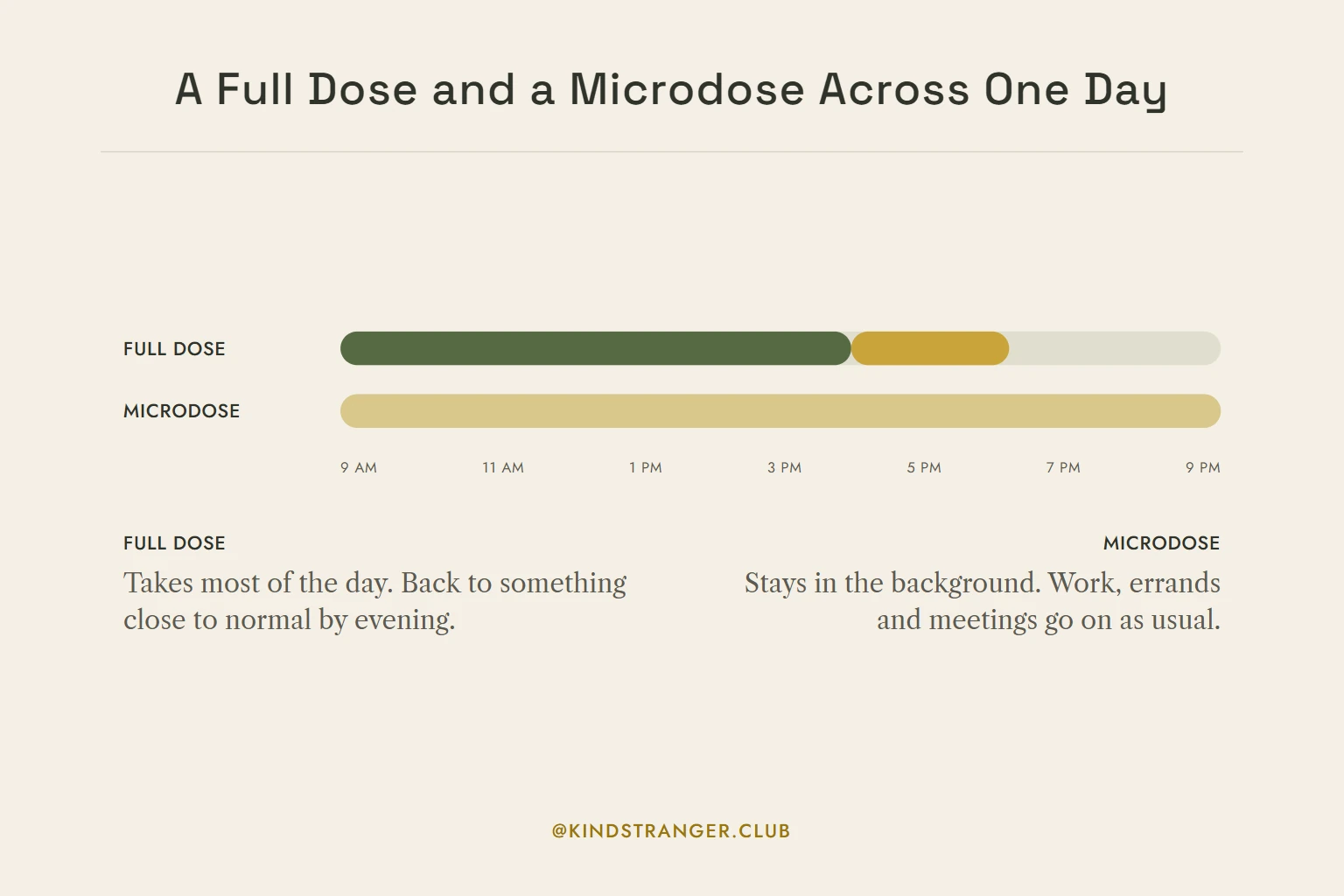
If you just want the clock times, here they are. Health Canada says the effects of magic mushrooms appear within 15 to 45 minutes and usually last four to six hours. That’s a full dose. A microdose follows the same chemistry at a much lower level, and most people say it has thinned out by mid-afternoon.
This article walks through how a day actually unfolds with psilocybin in your system, both at a full dose and at a microdose. It also covers what tends to change the timing, how long it stays in your body, and when to get help. It’s descriptive, not a dosing guide. If you want the numbers on where the lines sit, our dosing page covers that in detail.
Psilocybin itself isn’t the part that does the work. Your body converts it into psilocin, a close chemical cousin of serotonin, and psilocin is what acts on the brain’s serotonin receptors. A review of psilocybin’s pharmacology covers that step in detail. The conversion happens as the mushroom is digested, which is why there’s a wait before anything starts, and why anything that changes digestion, like a full stomach, changes the timing.
Once psilocin is in your bloodstream, your body clears it steadily. In a 2017 study of healthy adults, psilocin’s elimination half-life averaged about three hours. The effects don’t switch off. They fade as levels fall, which is why the end of a full-dose day is a slope rather than a cliff.
Start with the loud version, because it frames everything else. A full dose of psilocybin isn’t something you fold into a workday. People generally set aside a whole day, or at least a large stretch of one, because the experience doesn’t ask permission to run its course.
Here’s the rough shape of that day. The timing moves with food, preparation, dose and the person, but the order of things stays much the same.
| Stage | Roughly when | What people describe |
|---|---|---|
| Come-up | Starts within about 15 to 45 minutes | Nothing, then a shift at the edges of perception. Sometimes nausea or restlessness. Often the most nervous stretch. |
| Peak and plateau | The middle hours | Perception clearly changed, emotions close to the surface, intensity arriving in waves. |
| Come-down | The later hours, as levels fall | A gradual return to baseline. Tired, reflective, often hungry. |
| Afterglow | That evening and the next day | A bit of lightness or a bit of fog, depending on the person. |
The come-up is the part people tend to remember. Some describe it as nervous, like an elevator climbing before the doors open, and the body often joins in with a heavy stomach or feeling warm and then cold. It usually doesn’t last long, but it’s the part of the day where a calm room and a trusted person matter most. If you want to think about the room and the company beforehand, our piece on set, setting and integration covers the preparation side.
In the middle hours, people describe surfaces that breathe a little and music with more rooms in it than they remembered. This is the stretch people usually describe as the most absorbing. It doesn’t leave a lot of bandwidth for spreadsheets. It also isn’t constant: people describe it coming in waves, a stretch of real intensity and then a window that feels almost ordinary. If a wave arrives harder than expected, it helps to know that waves recede.
After that, the day slopes down gradually rather than stopping. By evening, most people say they’re back to something close to ordinary, hungry and ready for bed earlier than usual. Many keep the next day light. A full dose takes the day.
The clock on the wall and the clock in your head tend to disagree on a full-dose day. An hour in the middle can feel like an afternoon, and then the come-down can pass in what seems like minutes.
This has been measured. In a 2007 study on psilocybin and time perception, volunteers had a harder time reproducing intervals longer than about two and a half seconds, and many reported their sense of time itself feeling disturbed.
The practical upshot is simple. Plan by clock time, not by how it’ll feel from the inside. If someone is keeping you company, tell them roughly when you expect to be done. And if time seems to have stopped, it hasn’t. It ends.
A microdose is meant to do the opposite. The whole idea is that it stays under the threshold where perception visibly shifts. You’re not supposed to spend the morning watching the wallpaper. You’re supposed to spend the morning answering emails, and people describe it as a slightly different texture to their attention.
Here’s how a typical day tends to unfold for someone who microdoses in the morning. In the first stretch after taking it, most people notice nothing at all. There’s no come-up in the elevator sense. If anything, there’s a faint sense of anticipation that often turns out to be the biggest event of the morning.
A little later, some people report a subtle lift. Coffee tastes like it’s doing its job properly. The first task of the day gets started without the usual negotiation. A coworker’s annoying habit is still visible but doesn’t have the same hooks in you.
People describe it like the difference between a photo and the same photo with the contrast nudged a few points. Nothing you could point at. Something you’d miss if it were gone.
Midday is where microdosers often say the quiet part: nothing dramatic is happening, and that’s the point. They eat lunch. They attend a meeting and contribute to it. They make phone calls.
If you asked them whether they’re feeling anything, most would say something like “a bit lighter” or “a bit more even,” and then change the subject, because there isn’t much more to say.
By mid-afternoon, people usually say the feeling has thinned out into the ordinary fatigue of a workday. By evening they describe being simply themselves, running on whatever sleep and food they had that day.
There’s no long tail the way there is with a full dose. Most people say their evening and sleep feel ordinary, though not everyone does, and some prefer not to take anything late in the day for exactly that reason.
That is the arc people describe, and why they say it fits around work. It’s also why people who would never book a full day for a session still keep a small routine in their week. Many follow some kind of schedule rather than taking it every day. Our guide to microdosing schedules explains the common approaches and the reasoning behind them.
It’s worth being honest about one open question. How much of what people describe on a microdose day comes from the dose, and how much from expecting something, isn’t settled. In a 2021 self-blinding study, participants who didn’t know whether they’d taken a microdose or an empty capsule reported much the same changes either way. Research on this is ongoing. What isn’t in question is the shape of the day: a microdose isn’t meant to leave you feeling altered, and if it does, the amount is higher than intended.
Neither the loud version nor the quiet version of a psilocybin day is a fixed experience. Several things move the needle, and most of them are boring, which is to say they’re the usual suspects.
Food
An empty stomach tends to make the effects arrive faster and feel a touch stronger. A full stomach slows the whole timeline down and softens the edges. At a full dose, an empty stomach can also mean more nausea for some people, which is why many eat something light a few hours beforehand. With a microdose, the difference is usually between noticing almost nothing and noticing nothing at all.
Sleep
This is the one experienced microdosers mention most. People often say they notice the dose differently depending on sleep, and that it doesn’t change how a bad night feels. Before a full-dose day, people say poor sleep tends to make for a rougher, more emotionally exposed time, and that the night before matters as much as the day itself.
The size of the dose
Obviously, how much you take changes how the day feels. What’s less obvious is that the difference between “subtle” and “noticeably altered” can be a very small change in amount. At the top end, a bigger dose usually stretches the day out as well, with a longer peak and a slower way down.
Potency isn’t fixed either. It varies between strains, and even between mushrooms from the same batch, so the same weight doesn’t always mean the same day. Know what you have, and when in doubt, start lower. If you’re working out where the lines sit, our dosing page goes into it properly.
How it’s prepared
Whole dried mushrooms, capsules, tea and lemon-soaked preparations all deliver the same compound, but people describe different timings. Capsules can take a little longer to start, since the shell has to dissolve first. Tea, where ground mushrooms are steeped and strained, is often described as coming on sooner and sitting easier on the stomach. Lemon tek, a short soak in lemon juice before taking it, is described as arriving faster and feeling sharper and shorter. We’ve written up how people make shroom tea and how lemon tek works.
Recent doses
Tolerance to psilocybin builds quickly. Health Canada notes that it can develop over several days of continued use. In practice, people find a dose taken soon after another one feels weaker than expected, which is part of why microdosers space their days out.
Body size, less than you’d think
It’s natural to assume a bigger person gets through it faster, the way people think about alcohol. In the 2017 study mentioned above, though, differences in how quickly people cleared psilocin weren’t predicted by body weight.
Where you are and who you’re with
A microdose taken at a desk feels different from the same amount taken on a weekend walk. Same substance, different container. At a full dose, people describe the setting becoming part of the experience rather than just its backdrop.
Your own state
Mood, stress, hormones, the news. All of it colours the day. Some people say it feels like a magnifying glass on whatever mood is already there. Long-time microdosers often say they learned to check in with themselves first and let the day itself decide whether it’s a good one for anything at all.
So many hard full-dose days start the same way. An hour has gone by, and you feel nothing, or something so faint you’re not sure you aren’t imagining it. The usual reasons are dull ones: you ate recently, the mushrooms were weaker than you thought, capsules took a while to open, or you simply take longer than the next person.
What to do is just as dull: wait. The most common mistake is taking a second dose because nothing seems to be happening, then having both arrive together a little later. If a full two hours pass with nothing, treat that as information for another day, not a reason to add more now. A lot of difficult stories begin with “I didn’t feel anything, so I took more.”
A few other things people who’ve done this often repeat:
If a day does get hard, our harm reduction guide walks through what helps.
How long you feel it and how long it’s in your system are different questions. The feeling fades well before the last traces are gone.
With a half-life of about three hours, psilocin levels fall steadily through the afternoon and evening after a morning dose. In a controlled study of urine after oral psilocybin, psilocin had usually dropped below the lab’s measuring limit about 24 hours later, and only around 3% of the dose came out as free psilocin. Much of the rest leaves in a bound form, and the researchers noted that breaking that down in the lab extends how long it can be detected.
Whether a particular drug test looks for psilocybin at all depends on the test. Some tests can detect it.
Most of what feels alarming during a full dose is uncomfortable rather than dangerous. Knowing the difference ahead of time makes a hard hour easier to sit through, and makes it easier to spot the rare moment that needs real help.
Usually normal, even if unsettling.
Worth keeping an eye on.
Get medical help if:
In Canada, call 911 or your local poison centre, and tell them exactly what was taken. They need the facts to help.
Medications matter too. Psilocybin can interact with some common medications, including SSRIs and MAOIs, and lithium is a particular concern. In an analysis of 62 online reports of lithium taken with a classic psychedelic, 47% involved seizures. Our guide to psilocybin drug interactions goes into more detail. None of this is a substitute for professional care. If you take any prescribed medicine, talk to your doctor or pharmacist first, and never stop a prescribed medicine in order to take psilocybin. That decision belongs with a prescriber.
Because the line between a background day and a foreground day is closer than most people expect, consistent measurements matter to anyone doing this regularly. Daydream is a small, consistently measured capsule, and people tend to choose it when they want the same amount every time.
How long does a shroom trip last?
Health Canada says the effects of magic mushrooms appear within 15 to 45 minutes and usually last four to six hours, which is what most people mean by a shroom trip. Plan the whole day around a full dose, not just those hours. A microdose isn’t meant to feel like a trip at all.
Will a microdose make me feel high at work?
The intent is that it won’t. A microdose sits below the threshold of obvious perceptual change. Most people describe the feel as subtle enough that nobody around them would guess anything, and often subtle enough that they’d have to think twice themselves. If you’re consistently getting noticeable effects from amounts meant to stay in the background, the amounts are worth revisiting. Our dosing page covers where those lines are.
Is microdosing legal in Canada?
It’s worth being straightforward here. Psilocybin and psilocin are listed in Schedule III of the Controlled Drugs and Substances Act. Health Canada’s position is that unauthorized production, sale, and possession of psilocybin are illegal, and you can read their full statement on magic mushrooms. There are limited avenues such as clinical trials, the Special Access Program and individual exemptions, but for most people, the ordinary legal picture is the one on that page. Our guide to psilocybin’s legal status in Canada has more.
Can I drive on a microdose?
We don’t recommend driving while anything is in your system that could affect you, even subtly, and the law takes a dim view of impaired driving in Canada regardless of the substance. If you’re ever unsure how a given day feels, the safe answer is the boring one: don’t drive.
Comments
There are no comments yet.