
Your cart is empty
Looks like you haven't made your choice yet
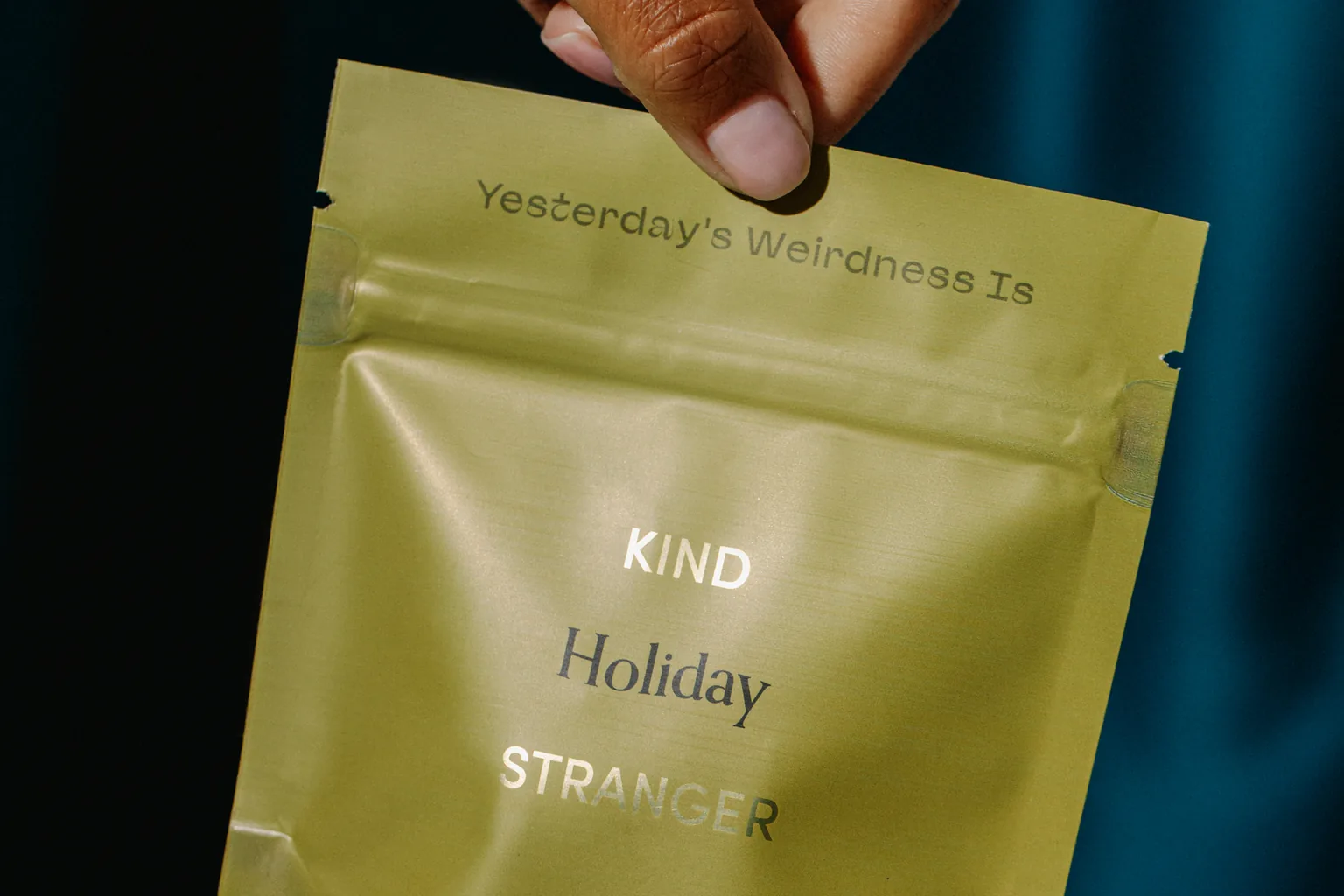
If you live in a Canadian city, you may have seen storefronts selling psilocybin mushrooms. Their windows are bright, their signs are cheerful, and from the outside it can look like psilocybin is legal now, the way cannabis is. It isn’t.
The existence of a shop tells you something about enforcement, which is a different thing from legality.
This creates a strange situation for anyone trying to figure out the rules. You can see a product on a shelf without being able to assume it’s legal. And you can read headlines about legalization proposals without realizing a proposal doesn’t change a single word of the Controlled Drugs and Substances Act.
This page walks through what’s actually true right now, what the exceptions look like, and what all of it means if you’re curious about microdosing.
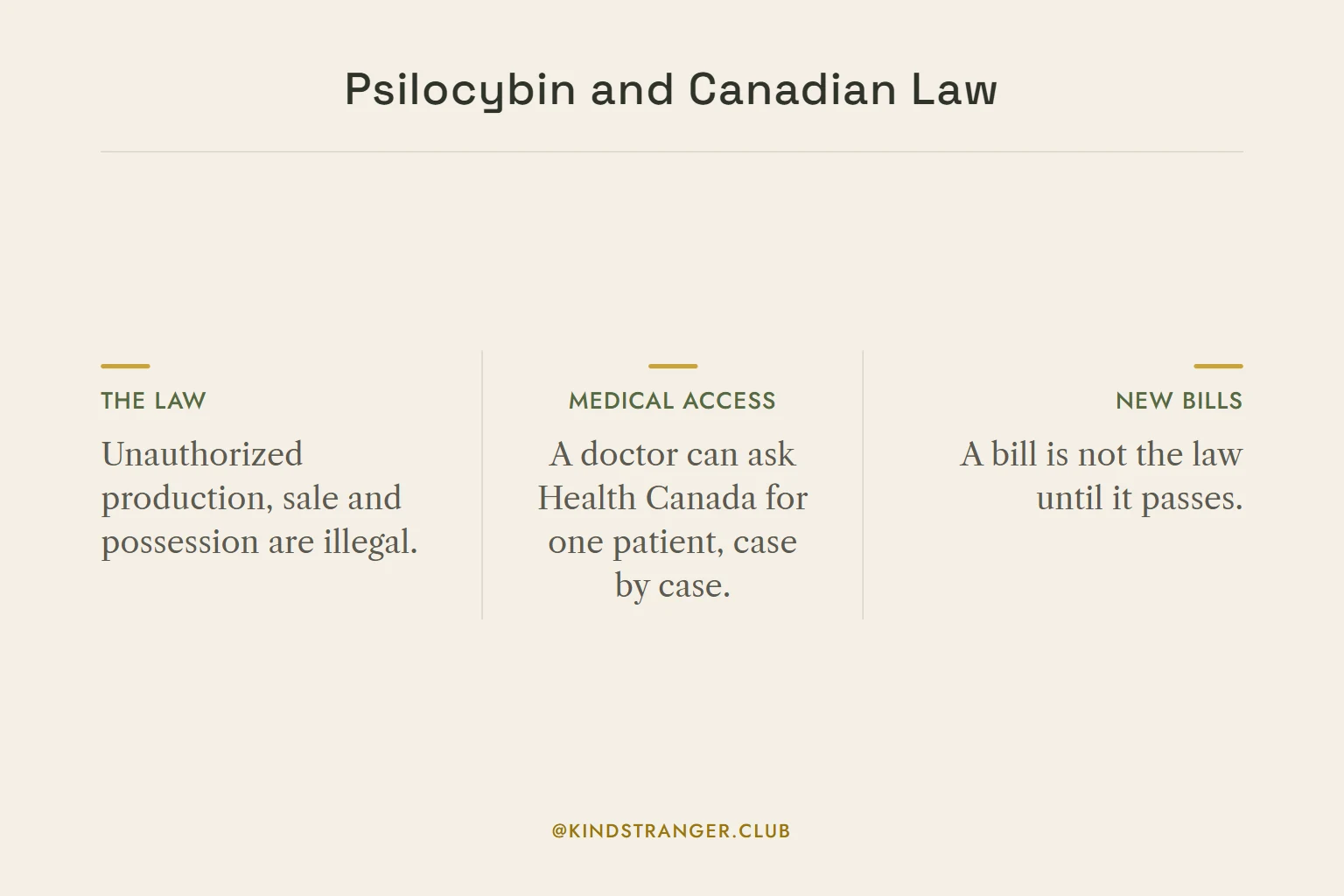
Psilocybin and psilocybin mushrooms are controlled substances in Canada. Health Canada states this plainly: unauthorized production, sale, and possession of psilocybin are illegal.
It doesn’t matter whether the mushrooms are sold in a slick store, offered through a website, or grown at home. Without authorization, they’re illegal.
“Regulated” is worth pausing on, because the word gets used loosely in conversation. A regulated substance isn’t a banned one in the way people sometimes imagine. It’s a substance the government controls tightly, with narrow, specific exceptions carved out for particular circumstances.
Cannabis before legalization was regulated this way. Opioids are regulated this way today — a pharmacy can dispense them under strict conditions while street sales stay criminal. Psilocybin sits in a similar frame: illegal by default, with limited legal pathways most people will never qualify for.
Enforcement is where the confusion takes root.
Some municipalities have signalled they don’t want local resources spent chasing psilocybin shops, and police in various cities have made choices about priorities. That’s real, and it explains what you see on the street. But enforcement discretion isn’t a legal exemption.
A shop you can walk into may or may not be licensed. Health Canada says unauthorized production, sale, and possession of magic mushrooms are illegal, and it describes the exceptions separately. A storefront on its own does not tell you which side of that line a shop is on.
So the honest answer to “is psilocybin legal in Canada?” is no — with narrow exceptions that exist for patients, researchers, and a small set of authorized activities. Everything else, including the retail gray zone, sits outside the law’s protection.
Not on the basic question. Psilocybin and psilocin are listed in Schedule III of the Controlled Drugs and Substances Act, a federal law that applies in every province and territory. So the answer to “is psilocybin legal in Ontario?” is the same as in any other province: no, outside the federal exceptions described in the next section, all of which run through Health Canada.
Where provinces do differ is around the edges.
Alberta
In October 2022, Alberta amended its Mental Health Services Protection Regulation to set rules for psychedelic-assisted therapy, and the requirements took effect on January 16, 2023, as Global News reported. The regulation lists psilocybin and psilocin among its designated psychedelic drugs.
Clinics offering this therapy need a provincial licence, and the regulation requires each clinic’s medical director to be a psychiatrist. These are rules for how licensed clinics operate. They don’t make psilocybin legal to buy or possess in Alberta.
British Columbia
From January 31, 2023, a federal exemption meant adults in B.C. could possess up to 2.5 grams in total of opioids, cocaine, methamphetamine or MDMA for personal use without criminal charges, outside certain excluded places. Psilocybin was never on that list. The pilot expired on January 31, 2026 and was not renewed.
There is one legal pathway worth understanding, because it’s the one that affects real patients. Through Health Canada’s Special Access Program, a physician can request permission to use psilocybin for a patient with a serious or life-threatening condition when conventional treatments have failed, are unsuitable, or aren’t available.
Health Canada’s magic mushrooms page describes three routes to legal access: the Special Access Program, section 56 exemptions and clinical trials. All three run through Health Canada, and none of them involves a store.
Since October 1, 2026, the rules sit in new Controlled Substances Regulations. They list psilocybin as a restricted drug (Schedule 4, Part 1). Among the people they authorize to possess restricted drugs is an individual who got the drug for their own use from a practitioner named in a letter of authorization (section 6). Health Canada issues such letters through the Special Access Program, as its program guidance explains.
The key thing to grasp is what the Special Access Program is not.
It doesn’t license stores, and it doesn’t create a dispensary model. It’s a case-by-case request made by a practitioner on behalf of a specific patient, evaluated on the specifics of that person’s medical situation. If it’s approved, the authorization attaches to that patient and that therapeutic context — nothing broader.
This matters because some shops lean on language that sounds medical. A website might mention therapeutic use, patient access, or Health Canada programs in ways that blur the line between “psilocybin has legal medical pathways” and “this store is legal.” The first is what the government describes. Whether a particular store is licensed is a separate question, and the government’s page is the place to read what authorization actually covers.
For someone with treatment-resistant depression or a terminal illness, this pathway is genuinely meaningful, and advocacy groups have worked hard to make it usable. But for the average person curious about microdosing for mood, focus, or creativity, the Special Access Program isn’t a realistic route. It exists for serious conditions, not general wellness.
A little history helps.
Psilocybin wasn’t always controlled in Canada. Restrictions tightened in the 1970s, alongside similar moves in the United States, and for decades after that the conversation was essentially closed. Research became difficult, and psilocybin settled into the same legal category as many other controlled drugs — technically restricted, practically forgotten.
That started changing in the 2010s. A new wave of clinical research — much of it from institutions south of the border — began producing results on psilocybin-assisted therapy for depression, end-of-life distress, and other conditions. Advocacy organizations formed in Canada, patients went public with their stories, and the Special Access Program was updated in a way that made psilocybin requests possible again.
In 2020, Health Canada granted a handful of exemptions for end-of-life patients, which made national news and restarted a national conversation.
That conversation has now reached Parliament. On June 16, 2026, Conservative MP Corey Tochor introduced Bill C-286, a private member’s bill. Its summary says it would allow psilocin and psilocybin to be used for medical treatment in accordance with the Narcotic Control Regulations, and it would automatically approve priority-review requests for certain new drugs. The bill was written before those regulations were repealed and replaced by the new Controlled Substances Regulations on October 1, 2026. CBC covered the bill as a move to let physicians prescribe psilocybin without case-by-case federal approval. If you’ve seen headlines suggesting legalization is imminent, this is likely what they were about.
A private member’s bill is a proposal, not a law. Nothing on the books changes until a bill passes Parliament and receives royal assent. Until that happens, possession and sale remain illegal regardless of what any party or MP has said they support.
The debate itself is genuinely interesting. Supporters point to the research, the therapeutic potential, and the argument that criminalization pushes people toward unregulated products with no quality control. Critics worry about moving too fast, about commercialization repeating what they see as mistakes from cannabis rollout, and about acting before the science is settled.
Both sides can agree on one thing: the current situation — illegal on paper, visible in practice — is the worst of both worlds. It confuses the public and helps nobody.
Here’s a distinction that trips up a lot of people.
In 2023, the federal government invested nearly $3 million in research on psilocybin-assisted psychotherapy, an announcement you can read on the Canadian Institutes of Health Research website. Headlines at the time made it sound like a turning point. It was a meaningful investment — in studies, not in policy.
When the government funds a clinical trial, it’s saying “let’s find out what the evidence shows.” It isn’t saying psilocybin is approved, and it definitely isn’t saying psilocybin is legal. The study results feed into future policy decisions, but the statute stays exactly where it was while that happens.
It’s also worth flagging a rumour that spread around the same period: the claim that psilocybin was approved for ADHD. It wasn’t.
That misconception seems to have grown out of early-stage research into whether psilocybin might eventually help with attention-related conditions. An approval, if one ever comes, would still be a medical authorization, not a legalization for recreational or wellness use. If you see someone citing an “ADHD approval,” that’s a distortion of what happened.
Let’s be honest about where we stand: plenty of Canadians microdose psilocybin, and interest keeps growing. At Kind Stranger, we think there’s real substance behind that interest.
The emerging research on sub-perceptual doses, the volume of first-person reports about mood and focus, and the sheer number of people who’ve found conventional approaches unsatisfying all point toward something worth taking seriously rather than dismissing. For a deeper look at the practical side, our dosing guide covers what people actually mean when they talk about microdosing.
Now the caveat, and it’s a real one, not a throwaway line.
Psilocybin is illegal to possess in Canada outside the narrow exceptions described above. The law hasn’t caught up to the conversation, and a legal risk exists regardless of how common the practice is. Anyone with a personal or family history of psychosis, or anyone taking psychiatric medications, should talk to a healthcare provider first — psilocybin can interact badly with certain conditions and certain drugs. That’s not fear-mongering; it’s the plain truth, and it’s worth knowing before you make any decision.
With that on the table, back to the useful part.
Because psilocybin sits outside any regulated supply chain, there is no quality control, no standardization, and no testing requirement for what circulates informally. That matters a lot at microdose scale, where consistency is the entire point — you’re trying to take a small, steady, sub-perceptual amount, not a variable one.
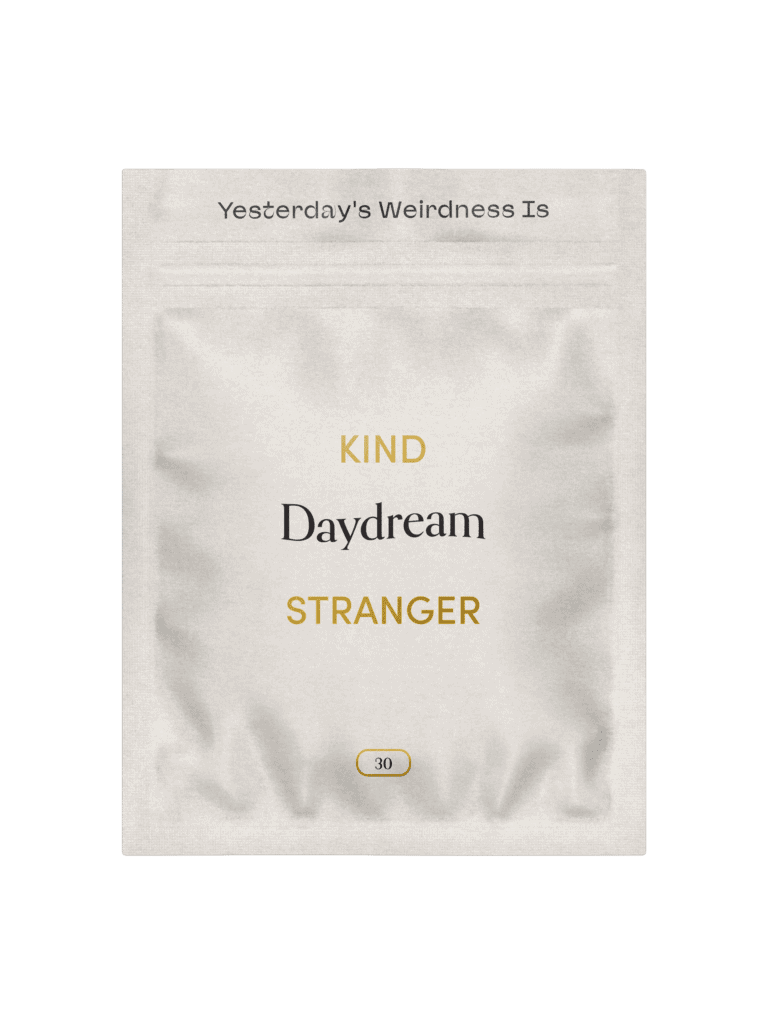
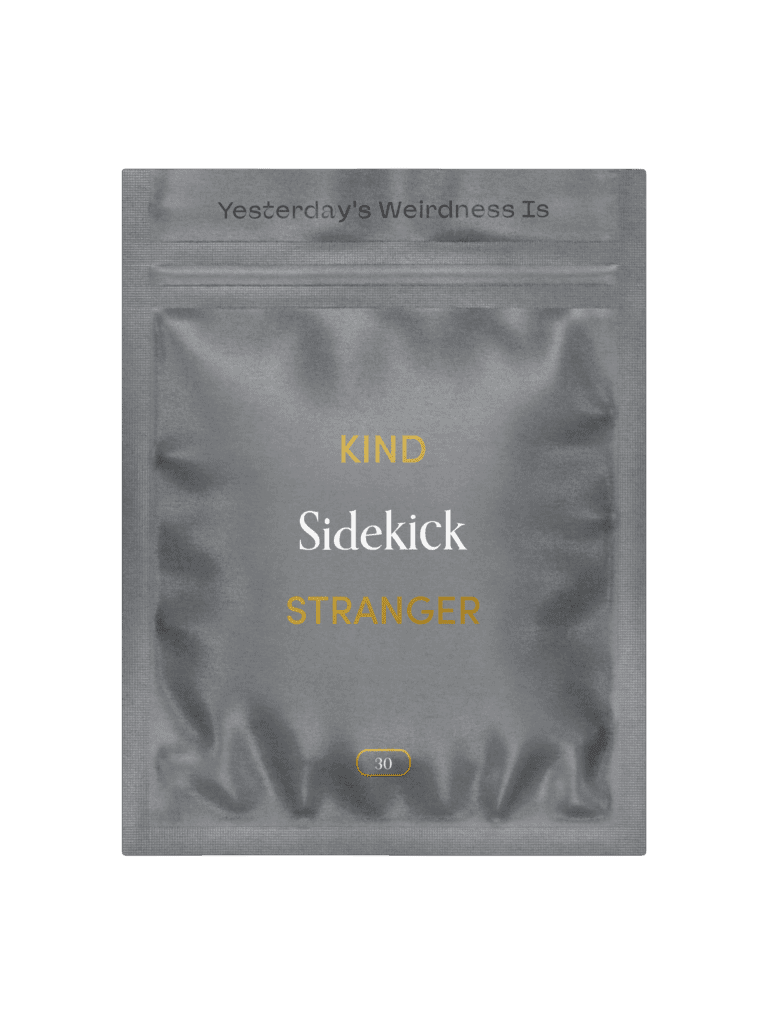
It’s one of the strongest arguments for eventual regulation: a legal, tested product would remove the biggest practical risk for people who’ve decided microdosing is right for them. If you’re exploring what regulated products would look like and how they’re labeled, our shop page shows the level of clarity we believe should eventually be standard across the board.
Beyond product quality, the other pillars of a sensible approach don’t involve anything illegal to discuss: track what you take and how you feel in a simple journal, take regular breaks rather than dosing daily, keep your doses genuinely sub-perceptual, and don’t layer psilocybin on top of major life decisions or a mental-health crisis without support. None of that is a substitute for knowing the law, but it’s the part of harm reduction people can act on privately, starting today.
The law is just one part of the bigger picture. The following guides look at the other safety questions people often ask, from medications and side effects to difficult experiences and travel.
From the shop
Or browse all microdose capsules →
Is psilocybin legal anywhere in Canada?
No province or territory has legalized psilocybin. It’s a controlled substance under federal law, which applies across the country. Municipal decisions about enforcement priorities can differ from city to city, but those decisions don’t change the law itself. Possession and sale remain illegal everywhere in Canada outside of authorized exceptions.
Are the psilocybin shops I see legal?
They may or may not be licensed. Health Canada says unauthorized production, sale, and possession of psilocybin mushrooms are illegal, and it sets out the exceptions on its magic mushrooms page. A shop’s sign does not answer the licence question. The government page is where that answer starts.
Can my doctor prescribe psilocybin?
Not in the way they prescribe standard medications. A practitioner can request access through Health Canada’s Special Access Program for a patient with a serious or life-threatening condition when other treatments haven’t worked or aren’t available. If approved, it authorizes psilocybin for that patient in a therapeutic context — it isn’t a prescription system and doesn’t extend to general wellness use or microdosing.
Didn’t the government approve psilocybin for ADHD?
No. That’s a misconception, likely from early research into psilocybin and attention-related conditions. Health Canada has not approved psilocybin for ADHD or for any other condition as a standard treatment. What the government has done is fund research, including a 2023 investment of nearly $3 million into psilocybin-assisted psychotherapy studies.
Is legalization coming soon?
There’s genuine political momentum — a major federal party has proposed moving toward legalization — but any change would require legislation to pass Parliament and receive royal assent, a process that takes time and isn’t guaranteed. The most accurate statement is that the conversation has shifted from “should we even discuss this?” to “how would this work?” — which is significant, but not the same as legalization.
If microdosing is illegal, why do people keep talking about it?
Because the science and the law are moving at different speeds. Research into psilocybin’s therapeutic potential has expanded dramatically, public interest has followed, and advocacy has pushed the political conversation forward — but the statute hasn’t changed. People talk about microdosing because the early findings and first-person reports are compelling, and because many feel conventional options have fallen short. That interest is real and worth taking seriously; it just doesn’t change what’s legal today.
Where can I check the current rules myself?
Health Canada maintains the clearest official summary of the rules around psilocybin mushrooms, including what’s illegal and what exceptions exist. It’s the right first stop for anyone who wants the government’s current position in its own words, and it will reflect any legal changes faster than most news coverage will.
Comments
There are no comments yet.