

Your cart is empty
Looks like you haven't made your choice yet
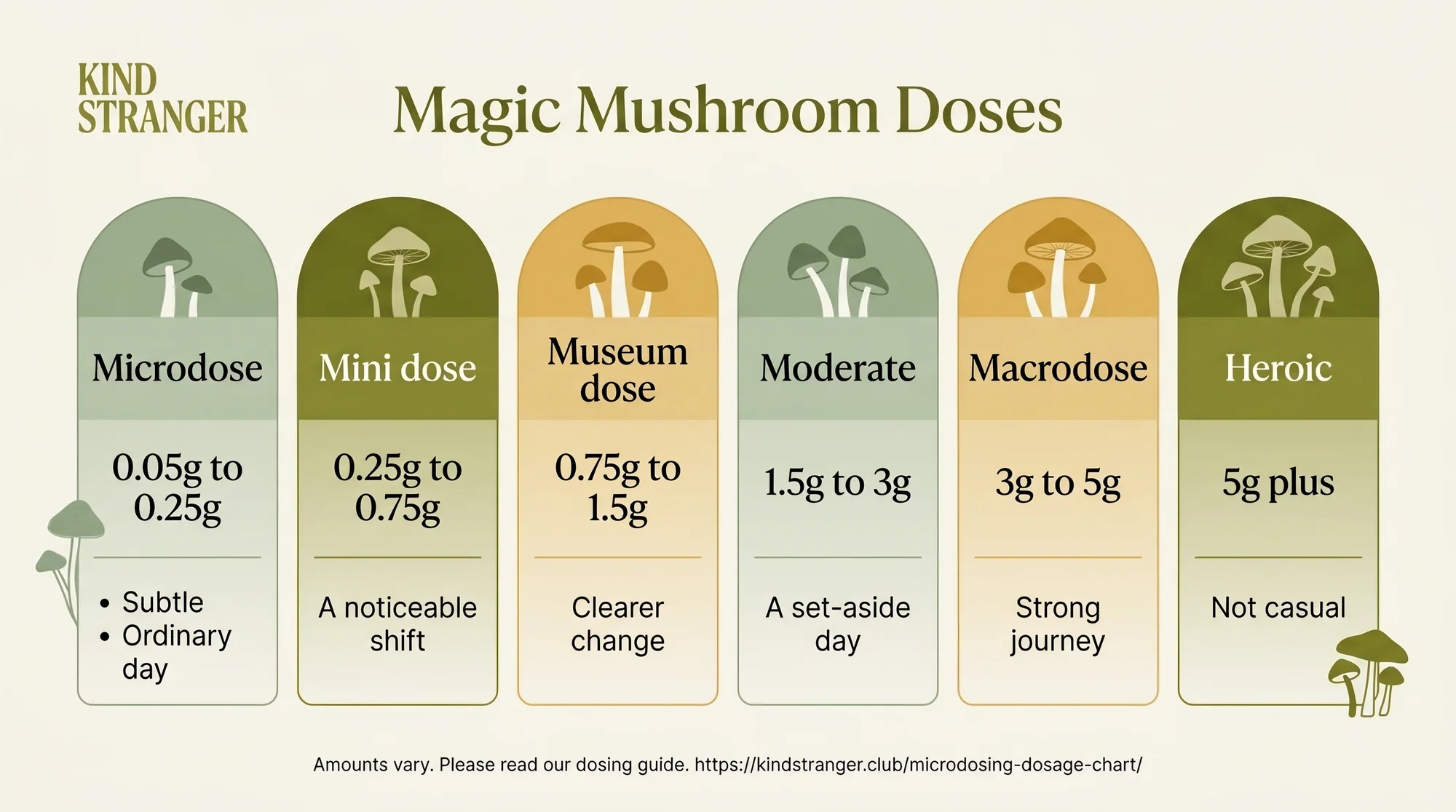
Here’s a map of common dried-mushroom ranges, from an ordinary-day microdose on the left through the set-aside days on the right. The numbers are ranges, not your amount. Sensitivity varies a lot from person to person — your body, your routine, the mushroom you’re working with, even how rested you are.
So please always err on the side of caution!
Reported benefits are what draw most people to microdosing in the first place. A peer-reviewed study of people who microdose psilocybin found that participants reported improvements in mood and overall mental well-being over the course of their practice, strong enough that the authors called for further controlled research (read it here). A dosage chart is how that curiosity gets organized into something careful.
A chart does two jobs. The picture above does the first one: it maps amount. The second job is time — how those amounts are spread across a week. Amount and schedule. You need both. A range with no rhythm is easy to drift on. A rhythm with no sense of which column you’re in is easy to overshoot.
When people talk about a microdose or a museum dose, they’re pointing at a column, not announcing a personality. And it keeps you honest. The most common mistake isn’t picking a wrong amount — it’s drifting. You feel good, so you quietly take a bit more, a bit more often.
When your written plan and your actual week start to disagree, that’s your signal to reset.
Start on the left. The Microdose column is the ordinary-day row. The amount is deliberately small, well below the level where perception changes in an obvious way. You go to work, drive the kids to hockey, answer emails, cook dinner. You feel like yourself — many would say a slightly steadier, clearer version. If a stranger watched your day, they wouldn’t notice anything. That’s the point. That column is built to disappear into your life rather than interrupt it.
Mini dose, museum dose, moderate, macrodose, and heroic are not stronger versions of that day. Each step to the right is a different kind of day — longer, more altered, and meant to be set aside, not folded into a Tuesday. The logic of “if a little helps, more must help more” doesn’t hold between columns. Cranking the amount upward doesn’t intensify an ordinary day. It abolishes it.
This page is still about microdosing. The chart names the other columns so you can see them, and so you don’t treat them as a ladder to climb on a work morning. It does not walk you through a full-dose day. People who plan one of those treat it as its own occasion, with a clear schedule, a safe setting, and someone they trust nearby. For the ranges themselves, and for how Kind Stranger talks about starting small, use the dosing guide.
The practical reading rule: the Microdose column is for your regular week. Everything to the right is a separate decision. If you ever take an ordinary-day amount and start noticing unmistakable perceptual changes, you’ve overshot the column — stop where you are, let the day pass, and revisit the dosing guide before your next dose day.

The picture doesn’t show the other half of a dosage chart, which is time. People often skip this half. But a schedule isn’t an afterthought to the amount — it’s an equal partner. Microdosing runs on a rhythm of dose days and days off, and the off days are part of the design, not blank space.
One reason is tolerance. With regular use, the body adapts and the same amount begins to feel weaker. Days off give that adaptation room to reset, which keeps the ordinary-day column working the way it did in your first weeks.
The other reason is measurement. If you dose every single day, you have no clean comparison. With rest days, you have days with and days without, and the difference between them is where you actually learn what the practice is doing for you. Many experienced microdosers say their journal entries from off days turned out to be the most informative ones.
Kind Stranger’s usual rhythm is a dose day followed by two days off. You’ll also see people dose on weekdays and rest on the weekend, or settle into a more intuitive pattern. All of these work for somebody. Whatever rhythm you choose, keep it steady for a few weeks before judging it. Flip-flopping every few days tells you nothing about either one.
One honest note: some people find the day after a dose day feels a little flat or tired.
Not everyone notices it, and it tends to ease with a settled schedule, hydration, and ordinary self-care. The rest days in a standard schedule already account for it. Read your own pattern the way you read the chart — calmly.
The chart is the map. The Kind Stranger dosing guide is where you actually start: which end of the ordinary-day range to try first, how the on-days and off-days are laid out, and how to adjust without guessing. Don’t screenshot the picture and skip that page. A range is easy to skim. A guide is harder to misread.
Start at the gentlest end of the ordinary-day range and follow the schedule it lays out, dose days and days off exactly as written. Hold that starting amount for at least a couple of weeks before changing anything.
Most people’s instinct is to adjust early, but a range only becomes meaningful once you’ve given your starting point a fair trial. Keep a simple log as you go: the day, whether it was a dose day, and a line or two about how the day felt. A note on your phone is enough.
When you do adjust, change one thing at a time. Adjust the amount or the schedule, never both at once, or you won’t know which change did what. Move in the smallest step the guide offers, then hold again. You’ll know you’ve found your spot when ordinary days feel quietly better and dose days feel more or less the same as off days — that near-invisibility is the Microdose column doing its job.
If you’d rather not handle raw material at all, our Sidekick Focus capsules are made exactly for this. Each one carries a pre-measured amount chosen for the ordinary-day column, so you follow the guide’s schedule and the consistency is already built in. No guessing, no drifting upward by accident. You can see the full range of products we carry, including formats suited to different schedules, in the Kind Stranger shop.
A few cautions that belong in any honest guide. If you take a prescribed medicine or you’re under a prescriber’s care, talk with them before adding anything new to your routine — that’s a conversation to have, not a change to make on your own. Microdosing isn’t a treatment for any condition, and nothing in a chart or guide should be read as one.
And if you’re in Canada, it’s worth knowing where things stand legally: unauthorized production, sale, and possession of magic mushrooms are illegal under federal law, and shops selling them may or may not be licensed. Health Canada’s own page on the subject is here, and it’s the authoritative read.
Or feel free to open the dosing guide, pick your starting point, set your schedule, and start your log.
Comments
There are no comments yet.