

Your cart is empty
Looks like you haven't made your choice yet

People who take very small amounts of psilocybin mushrooms — microdosing, as it’s usually called — keep reporting the same two things: their mood feels lighter and their focus feels sharper.
It’s the most consistent pattern in the self-reports researchers have collected, and a study examining microdosing in naturalistic settings found participants reported improvements in mood and cognition, including better focus and emotional balance. That’s what drew many Canadians to the practice in the first place.
Not a dramatic experience. Just a subtle shift toward feeling steadier through an ordinary week.
Those reported benefits line up with what people describe anecdotally across the country. They say the edge comes off stressful days. They say they can sit down and work without their attention scattering.
Small frustrations, the kind that used to sour a whole afternoon, roll past more easily. Whether those effects come from the substance itself, from the routine around it, or some mix of the two, the reports are remarkably consistent, and they’re worth taking seriously.
Microdosing is rarely a standalone habit, though. The people who report the best experiences tend to pair it with something deliberate: journaling, time outdoors, and more than anything else, a meditation practice.
That pairing is what this article is about. If you’re curious about microdosing in Canada, or you’ve already started and want to get more out of it, a simple mindfulness practice alongside it may be the most useful thing you add to your week.
A microdose is, by definition, small. The whole idea is that you don’t feel high. You go about your day, and the dose sits quietly underneath whatever you’re doing.
That’s why microdosing and meditation fit together so naturally. Both are subtle. Both reward attention.
Both are less about a single dramatic moment and more about the accumulation of small, ordinary ones.
Most people who microdose follow some kind of schedule, taking a dose on certain days and resting on others. If you’re working out a routine, our guide to dosing schedules covers the common approaches people use.
The specifics matter less than the structure itself: a rhythm you can actually keep, day after day, without turning your life upside down.
What meditation adds is a place to notice what’s happening. A microdose might soften your mood or sharpen your focus, but if you’re rushing from one thing to the next, you may never register it.
Sitting quietly for a few minutes gives you a baseline. You learn what your mind feels like on an ordinary day, which makes it much easier to notice what’s different on a microdose day.
There’s also the matter of integration, which is just a formal word for making sense of what you notice and folding it into your life. A microdose isn’t going to reorganize your habits for you.
If you notice you’re more patient with your kids, or more absorbed in your work, integration is the practice of asking what that tells you and how to keep it. We’ve written a fuller piece on the importance of integration, and it’s worth reading if you’re pairing microdosing with any kind of contemplative practice.
It’s worth saying plainly that none of this is medical advice, and it isn’t a replacement for care from a doctor. If you’re taking a prescribed medication, keep taking it and talk to your prescriber about anything you’re considering adding.
Microdosing is a personal wellness practice for many people, but it doesn’t substitute for treatment, and it interacts with certain medications in ways you shouldn’t leave to guesswork.
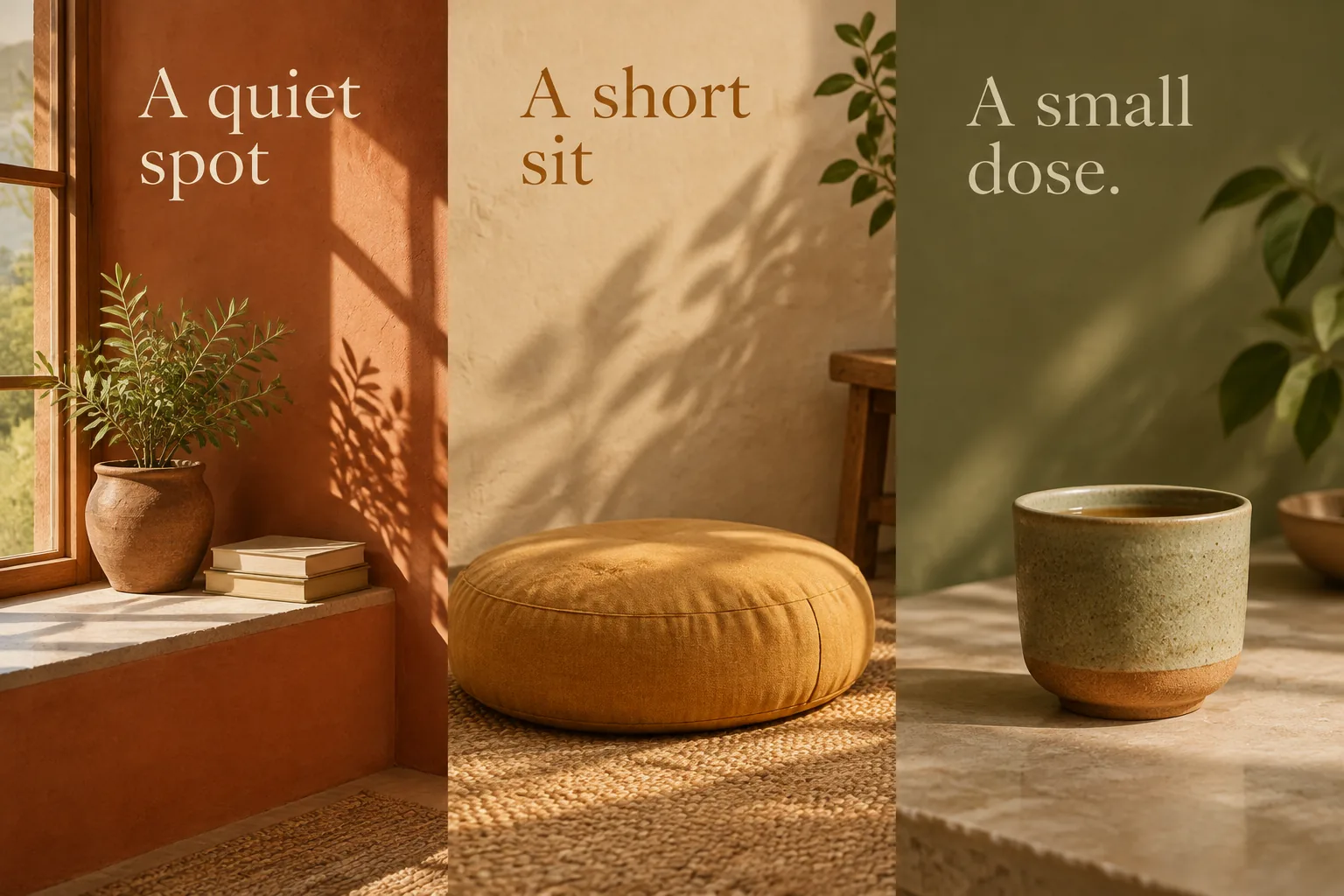
You don’t need a cushion imported from anywhere special, an app subscription, or an hour of free time. You need a quiet spot, a few minutes a day, and one small habit woven into the middle of your day.
That’s the whole practice. Here’s what it looks like.
Choose one place in your home where you’ll sit to meditate, and use that place every time. It doesn’t have to be a dedicated room.
A corner of a bedroom, a chair by a window, the end of a couch before anyone else is awake — any of these will do. What matters is consistency.
When you sit in the same spot each day, the spot itself starts to cue the practice. Your body learns that this chair means settling down, the same way your bed means sleeping.
Make it quiet and make it boring. Leave your phone in another room, or at least face down and out of reach.
If you live with people, let them know this is your few minutes, or simply pick a time when the house is empty. A door you can close is worth more than any accessory.
Some people like a candle or a plant as a fixed point for the eyes; that’s fine, but it’s optional. The quiet spot is the whole requirement.
Once a day, sit in your spot for a short time. Five minutes is plenty to start, and for many people it stays plenty.
Longer isn’t better if longer means you skip it. A short sit you actually do beats a long sit you keep putting off.
Here’s the practice itself. Sit comfortably with your back reasonably upright — not rigid, just not slumped. Rest your hands wherever they land naturally.
Close your eyes or soften your gaze toward the floor. Then bring your attention to your breath.
Don’t change the breath, don’t deepen it, just notice it: the air coming in at the nostrils, the chest or belly rising, the air going out.
Your mind will wander. This is not a failure; it’s the practice.
When you notice you’ve drifted into planning, replaying, or rehearsing an argument, quietly note where you went, and come back to the breath. That return — the moment of noticing and coming back — is the whole exercise.
Each return is one repetition, the way a push-up is one repetition. A five-minute sit might contain forty of them, and that’s a good sit, not a bad one.
Do this at the same time each day if you can, because anchoring the sit to something you already do, like first coffee or brushing your teeth, makes it far more likely to stick.
On a microdose day, the sit can be especially interesting. Many people find the breath feels more vivid, or that they notice their thinking patterns more clearly. Treat those days as data.
Sit, notice, and afterwards jot a line or two in a notebook about what you observed.
Beside the daily sit, pick one ordinary activity and make it your mindful moment. Good candidates: your first sip of coffee or tea, walking to the mailbox, washing your hands, standing in the shower, waiting at a red light. Choose one and commit to it.
When the moment arrives, do nothing but that activity. When you drink your coffee, just drink your coffee. Feel the warmth of the cup, notice the taste, notice the pause in your day.
When your mind jumps ahead to the next task, come back to the cup. It takes thirty seconds, and it works the same muscle as the sit: noticing where your attention went, and gently bringing it back.
One moment is the assignment. People often try to be mindful all day, which sounds admirable and mostly produces guilt.
One deliberate moment, repeated daily, builds the habit. If you catch yourself being mindful at other times, that’s a bonus, not the goal.
So what actually happens when someone microdoses alongside a practice like this? The reports vary, but certain themes come up again and again.
Mood is the big one. People describe a lightness, a sense that minor irritations don’t get the same grip.
The barista gets the order wrong, and it’s a shrug instead of a spiral. A difficult email arrives, and it reads as a task rather than an attack.
It’s not euphoria — people are clear about that. It’s more like a small widening of the space between a stimulus and your reaction.
Focus is the other frequent report. People say they settle into work more easily, that the pull toward distraction weakens, that they look up an hour later and realize they’ve been absorbed in what they were doing.
For creative work, some people describe a fluency of ideas, a sense of connections appearing between things that usually sit apart.
Alongside those, people report subtler changes: more patience, more appreciation of small things like weather and music, a little more willingness to say what they actually think.
Paired with meditation, these observations get easier to catch and easier to trust, because you’ve built a habit of checking in with your own mind.
Honesty requires a caveat here, and it’s one worth including. Controlled research on microdosing is still limited, and some placebo-controlled studies have found that people who believed they were microdosing reported similar improvements to people who actually were.
In other words, expectation may account for part of the experience. That finding doesn’t erase the reports, and it doesn’t mean people are imagining their better weeks.
It does mean the practice around the dose — the routine, the attention, the reflection — may carry as much weight as the substance itself. For anyone pairing microdosing with meditation, that’s arguably good news: it means the parts of the practice you control are doing real work, and the whole approach is worth doing carefully rather than casually.
A few practical notes from the community: keep a simple journal, because memory smooths things over and a written record doesn’t. Stick to your schedule rather than chasing effects.
Take rest days seriously; most people find they’re part of what makes the practice work. And if a day feels flat, don’t escalate — note it and carry on. The people who report the most satisfaction are rarely the people taking the most.
If you’re pairing a microdosing routine with mindfulness, start small and stay consistent. A five-minute sit, one mindful moment, and a schedule you can keep: that’s a foundation most people can build on, and one that makes everything else, including whatever you notice on dose days, easier to see clearly.
Is microdosing legal in Canada?
It’s a complicated area. Health Canada states that unauthorized production, sale, and possession of psilocybin mushrooms are illegal. There are limited pathways, such as special access programs and certain exemptions, but those are narrow and shouldn’t be assumed. Anyone considering microdosing should understand the legal situation in their own province and circumstances before proceeding.
Do I need to meditate to microdose?
No, there’s no requirement. Plenty of people microdose without any contemplative practice. But the reports, and the research on expectation effects, both point the same direction: the routine around the dose matters. Meditation is one of the simplest, cheapest routines you can build, and it makes whatever you experience easier to notice and integrate.
Can I meditate on a microdose day?
Yes, and many people find it’s the most rewarding day to sit. The dose is small by design, so you’re not wrestling with an overwhelming experience. You’re just sitting with a slightly different baseline, which can make the breath and your thought patterns easier to observe. Sit for your usual length; there’s no need to extend it.
How long before I notice anything?
It varies. Some people report noticing mood effects on their first dose day; for others it unfolds gradually over a few weeks of a consistent schedule. Keeping a journal helps enormously here, both for spotting patterns and for keeping yourself honest about what’s actually changing.
What products do people use for microdosing?
People work with a range of formats, from dried material to prepared products. Some shops operate in a legal grey area and others hold licences for specific purposes, so it’s worth understanding what you’re buying and from whom. At Kind Stranger, our Bloom product is formulated with microdosing in mind, and our Holiday selection is another option people explore. Whatever you use, consistency in what you’re taking makes your observations far more meaningful than switching products every week.
Should I stop my medication to try this?
No. Never stop a prescribed medicine on your own. If you’re taking anything prescribed, particularly an antidepressant, keep taking it as directed and have a conversation with your prescriber before adding anything new. There are known interactions between psilocybin and certain medications, and that’s a matter for a clinician, not an article.
What if I don’t notice anything?
Some people don’t, at least not at first. That’s one more reason to keep the journal: you may be noticing smaller changes than you expected to. It’s also a reason to keep up the meditation practice regardless, since a quiet spot, a short sit, and one mindful moment tend to be beneficial whether or not the dose is doing anything on a given day. The practice stands on its own.
Comments
There are no comments yet.